Paulo Flores’s Ex-Combatentes
The Angolan singer's new album deals with war in the widest sense: war with the self, war with family, neighbors, friends.
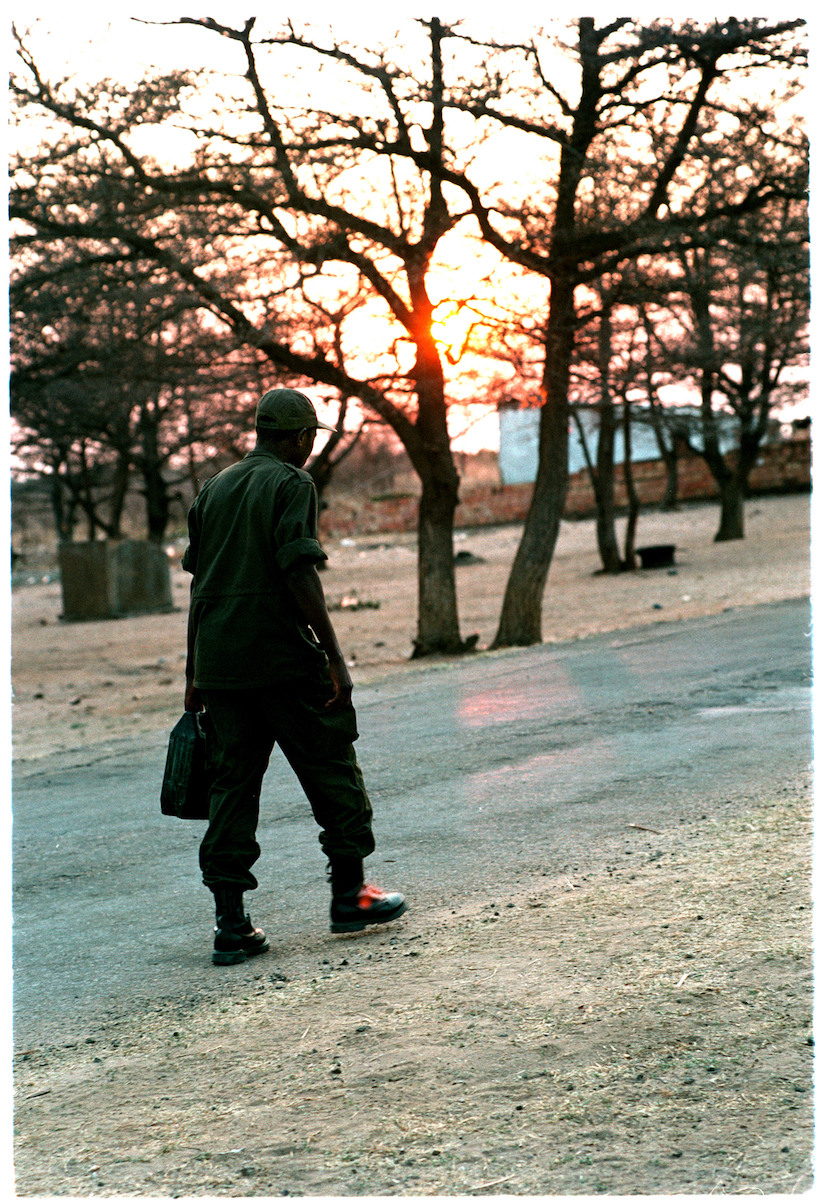
MPLA soldier. Cuito Cuanavale, Angola 2005 © Cedric Nunn
Earlier this summer, the Angolan singer Paulo Flores launched Ex-Combatentes Redux, a 15 track version of his 3 CD Ex-Combatentes (2009) at the Théâtre de la Ville in Paris and then played at the Rio Loco Festival in Toulouse. If you are an assiduous consumer of Putamayo compilations or of Portuguese language music you may know Flores’s work. Sadly, his music is not distributed or well-known in the U.S., despite the fact that he can never be anonymous on the street in Luanda, no matter the hour of the day.
It is easy to slather him with superlatives as his fans on Facebook and the press do. He deserves all that and more. The more of course would be serious critical attention. The international press – and this was the case for the most part this summer in France – still mostly cast him as a poster boy for post-war Angola even when they give him high praise. Now, the album is titled “Ex-Combatentes” (Ex-Combatants), which happens also to be the name of the street he lives on in Luanda, but the music in sound and lyrics has little to do with war. Unless one thinks of war in the widest sense – war with the self, war with family, neighbors, friends, etc—like in the blues tune on Ex-Combatentes, ‘Eu quero é paz’, written with Albano Cardoso. Perhaps what Flores does most brilliantly is to capture Angola’s humanity, at its extremes and in its intimacies; the war on all fronts, the small peaces made every day.
The 3 CDs are titled Viagem (Journey), Sembas, and Ilhas (Islands). Here’s a sample from each below but you should really seek out the full Ex-Combatentes if you can because it is a very complex and rich set of music. If you understand Portuguese you will have the double pleasure of Flores’s poetry and clever lyrics, which both charm and, I sometimes think, elude his fans.
If you want to hear more of this music you might check out the excellent Caipirinha Lounge blog where it was reviewed in 2010.
And pay attention. Paulo Flores has spent most of the summer in the studio recording a new album. We promise to keep you posted.
‘Pé na Lama.’ This video is by the artist Nastio Mosquito, whose work we’ve mentioned before:
‘Rumba Nza Tukiné,’ a tune by David Zé who died an untimely death in 1977. Here’s an acoustic version at Luanda’s Teatro Elinga, recently de-classified as historic patrimony so that a skyscraper can be built (but we’ll save that for another post).
‘Amba,’ also an older song by Murimba Show. The video was shot by Sergio Afonso in the Namibe desert in Southern Angola and at Miradoura da Lua, outside Luanda. Here a song from the late colonial period is used as a critique of poco society: the new man sees no evil, hears no evil . . .