Cédric Bakambu’s gesture
How the Congolese national team has become a rare source of unity, recognition, and solidarity for communities living through war.
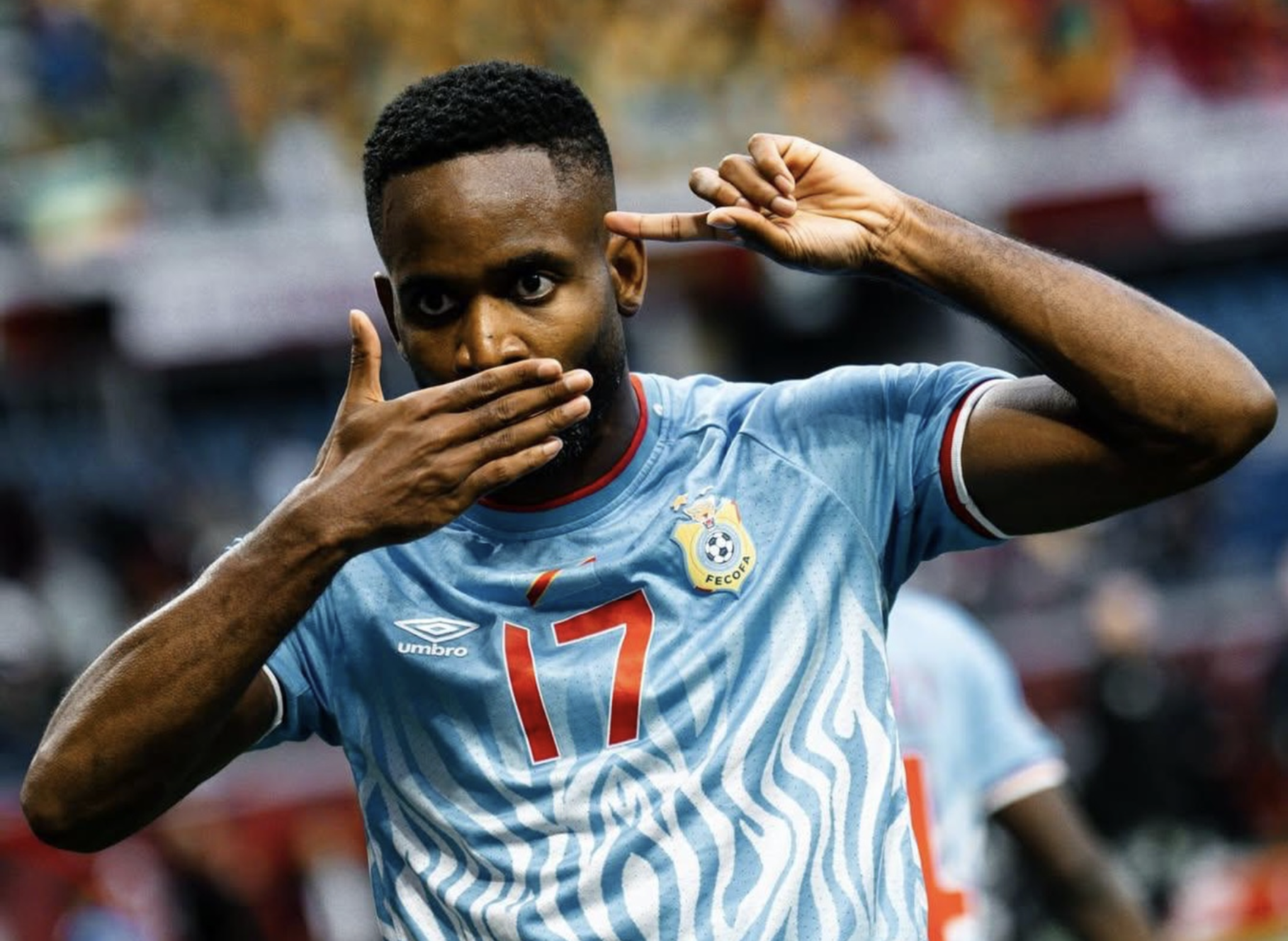
Cédric Bakambu celebrates for DR Congo at AFCON. Screenshot from Instagram, used under fair use.
When Cédric Bakambu scored to give the Democratic Republic of Congo the lead against Senegal he once again reinforced his position as Congo’s favourite son.
The goal took his tally to 20 for The Leopards, just two behind the nation’s top goal scorer ever, Dieumerci Mbokani. But it’s not Bakambu’s goal scoring that has made him the idol that he is in Congo, rather what he did after scoring.
Every goal, for club and for country, that Bakambu scores is followed by a now iconic celebration. He stands tall, covers his mouth with one hand, and with the other he makes a gun pointing at his head. It’s a powerful symbol of communion with Bakambu’s compatriots in Eastern Congo who have guns to their heads while the world stays silent.
And nowhere is Bakambu more loved than in Eastern Congo.
“I love to see that celebration,” Fiston, a school teacher from Bunia, the capital city of the Ituri Province on the border of Uganda tells Africa is a Country. “It [the celebration] was a huge meaning for us. It says that they’re also with us on the East side of DRC. It shows us that we’re together. Even if they’re so far, they have compassion.”
Life is not easy for Fiston who as a child was nicknamed “Shabani Nonda” after the former national team player. While not as famous as the conflict to the south in Goma, Bunia is still a region in conflict and as Fiston says, is in the “red zone” of Congo. People try to go about life normally but in the knowledge that violence can flare up at a moment’s notice, a state that has been present for well over 50 years.
After renewed violence earlier this year, which according to Medecins Sans Frontieres, has displaced more than 100,000 in Ituri, life in Bunia is marked by strict curfew that starts at 11 p.m. every night. But there is one exception.
“On the day of the football they don’t do that [enforce curfew]. The day of the football game you can see people working anytime they need without being disturbed,” Fiston says. Instead, bars and restaurants are open late into the night.
“When there is a match, you can see people wearing the jerseys and scarves. Everyone is involved, even though we’re so far. We are Congolese.”
Bunia may be more than 1,700 kilometres from Kinshasa and the Congolese government—in fact Bunia is closer to Addis Ababa and Mogadishu than it is to its own nation’s capital—and for residents of Ituri it is even further away emotionally, but for football fans like Fiston, The Leopards are as close to Bunia as they are to Kinshasa.
That isn’t simply a sentiment shared by Fiston and those in Ituri. Blaise was born and raised in Goma, once a fixer for the United Nations peacekeeping mission in the city, he was made redundant when the UN pulled out of the city as the M23 rebel group took control.
“People love and trust the Leopards. When there is a game, the town is empty, no one is one the streets,” says Blaise. “Even if we are very far from Kinshasa and the political situation is very complicated because we’ve been separated, we still love the national team.”
Like in Bunia, the presence of M23 rebels who have denounced President Félix Tshisekedi’s Kinshasa government, does not stop fans from celebrating, in fact the rebels themselves still support The Leopards.
“Here in Goma, we see even rebels calling people to watch and support the team,” explains Goma resident and journalist Michel. “The head of the youth department of M23 called people to support and show pride for the national team in the world cup qualifiers.”
This continent spanning love for a national team isn’t a new thing, far from it. The collective memory of cities like Bunia and Goma remember the legendary teams of the 1960s and 1970s who won two AFCONs. For Blaise and Fiston, they keep up with young stars like Noah Sadiki and Nathaneal Mbuku via social media. For their fathers and grandfathers, it was the radio that kept them informed of the performances of Kazadi Mwamba or Ndaye “the assassin” Mulamba.
That generation that was at the heart of building the young and fragile national identity of DRC reached the holy grail of the World Cup in 1974, the first sub-Saharan nation to do so. It’s now been half a century since then and The Leopards have not been back to the World Cup, until now.
A new generation of Congolese players, many of whom grew up in Europe as part of the diaspora, are on the verge of qualifying for the World Cup. Having beaten Cameroon and Nigeria in the final round of African World Cup qualifiers, all that stands between them and Congolese immortality is a playoff match in March.
Just as it played a role in forging a national identity in the 1970s, The Leopards once again are at the heart of a nation that is seeking an identity in a fragmented world. Thanks in part to the growing representation of players from the diaspora, this squad is the most representative of Eastern Congo in decades. Players Noah Sadiki, Axel Tuanzebe, Rocky Bushiri and Michel-Ange Balikwisha all hail originally from Eastern Congo. And those stars are bringing a new hope to the residents of Goma and Bunia.
“At the moment the hope is powerful,” explains Michel. “With the war in some places in Eastern Congo people don’t feel like they are a citizens of anywhere or of any country.”
“But the team gives us hope, the joy of being a citizen of one country, it makes people forget about the pain and gives you the feeling of being Congolese, that you still have a country, still standing up.”
At the last AFCON ahead of their semi-final tie against hosts Côte d’Ivoire, Bakambu was joined by his teammates in his protest. Instead of singing the national anthem, they all covered their mouths and held a finger gun to their head. While the TV directors tried to cut away from them and the fans that joined in, the world saw their protest. For millions of people around the world, it was their first exposure to the conflict in Eastern conflict.
Now fans are hoping for a similar protest if the team can make it further, or even more powerfully at the World Cup and for Blaise in Goma, it is a test of their nerve.
“If they are really Congolese they should do the same and tell the world what is happening.”
While many may scoff at the idea of a football team playing any role in conflicts or peace building, all three of Blaise, Fiston and Michel recalled Didier Drogba’s legendary appeal to the people of Côte d’Ivoire to lay down their arms after the Elephants qualified for the World Cup in 2005.
For Fiston, football as a tool for peace and reconciliation is not academic, but reality.
After fleeing to Kinshasa in the early 2000s, Fiston returned to his home town of Kisangani which had been devastated by violence carried out various militias as well as government forces and UN peacekeepers.
“When I came back to Kisangani in 2006 after the war there what brought people together there was the football. Football was a way to bring back life to the area,” he remembers. Fiston continues:
I remembered we played against the soldiers of a big general—I won’t say his name—in a street where we lived. We organized football games against the soldiers of the general. We gave him a letter and the general accepted and bought the jerseys and balls and we played them. That day was a big party. After the game we ate and drank with them. It was amazing. I remember after that day, the soldiers and us we felt like in the same family. I can tell you, before that the soldiers terrified people. It was so hard, but the football game has the role to play and can play a role in conflict.
This national team may not ever bring an end to conflict in Ituri or Kivu, but whether playing in Rabat or the United States of America, they can bring hope to a nation crying out for it.


