Salah in isolation
Distanced at club level, and scrutinized at home, there is no player with more to prove at this Africa Cup of Nations than Mohamed Salah.
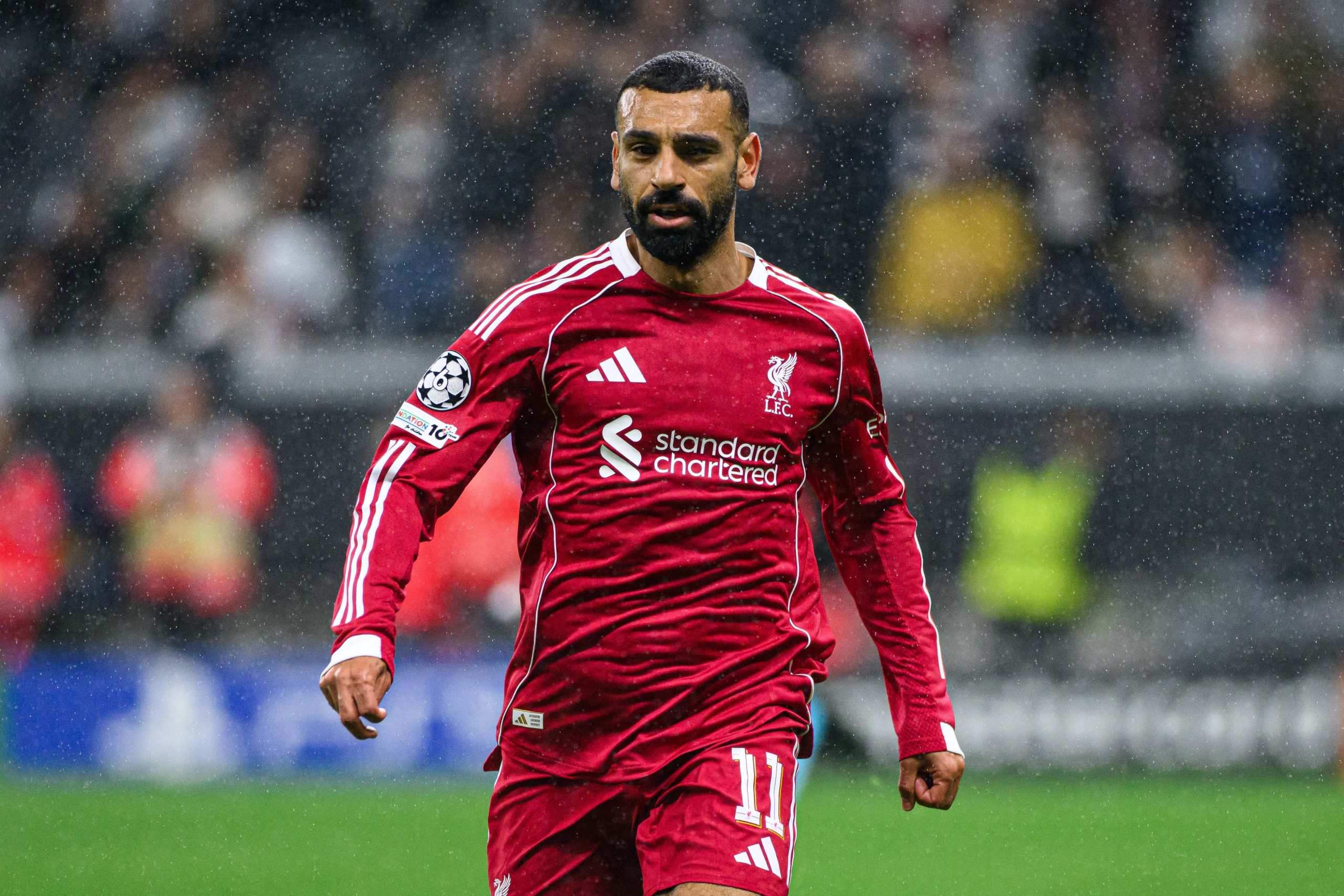
Salah at a Champions League match in Frankfurt, Germany, October 2025. Image credit Vitalii Vitleo via Shutterstock.
It is a well-known tale, but ahead of the AFCON, it is perhaps time to, once more, reflect on Mohamed Salah’s daily bumpy bus journeys as a teenager. Every day on his quest to realize his dream of playing professional football, he traveled four hours up the Nile from his native Nagrig to Cairo and back. That commitment required an obscene amount of sacrifice and discipline in his formative years, and it forced a young Salah to prioritize success above anything else—a theme that continues to define his career.
During his recent public rift with Liverpool, Salah responded to being benched for three consecutive matches by stopping in the mixed zone and speaking to a random Norwegian television channel—an extremely rare act from the 34 year old, and proof that he was looking to get something off his chest. “It seems like the club has thrown me under the bus.” He said, emotionless, as the Liverpool press officer, Jack Walker, dropped his head and groaned inaudibly in the background.
Simon Hughes, who covers Liverpool for The Athletic, and is the author of Chasing Salah a seminal biography on one of Africa’s greatest players, corroborated that Salah has always been selective when speaking to the press:
Even in his first season, when he scored 44 goals, I remember Liverpool’s press officer had to persuade him to stop and speak to the press about the accomplishment. He was always very reluctant. I think the interview lasted for three and a half minutes. Even in that conversation, he really didn’t want to do it, he wouldn’t give up any of himself. He only speaks when he feels there’s a reason to, or there’s something to address.
Of course, there is nothing innately wrong with refusing to speak to media members, but Hughes believes that Salah’s isolation is strategic—borne out of self-preservation after exploding onto the scene during a politically combustive period in Egyptian history:
In the West, we have this perception of Egypt being the Pyramids. Colleagues go to Nagrig and do that journey, visiting the jasmine and onion fields and it’s all quite romantic. The reality is the hardship Salah inherited as a young man due to the political context of the post-Mubarak Arab Spring, means that he has to be very careful about how he presents himself. I’ve been told that he thinks the only way to promote a wider positive message is by doing well on a football pitch and scoring goals.
There are notorious examples of the wider Arab and Muslim world urging Salah to tailor his religious or political messaging. His yearly Christmas photos in front of a small tree in his living room are always amusing in that they draw the ire of the hyper-critical zealots that think he’s selling out.
A more serious post came a few months into the midst of the Israeli genocide in Gaza. Several Arab stars like Riyad Mahrez, posted messages of Palestinian solidarity in early days, but at that time the wider Muslim world had its eyes trained on Salah’s feed. He eventually published an eerily polished video on X calling for “humanity to prevail.” Most deemed it milquetoast. Nonetheless, his video, which posted record numbers, is a testament to his wider popularity.
Hughes again:
We talk about the heroes of Liverpool and the legend, the greatest players, Kenny Dalglish, Steven Gerrard, are almost untouchable. They represent Liverpool as a city, they don’t represent the United Kingdom or England or a religion. Salah represents a massive swathe of people around the world. He never asked for it, but people do see him as a reflection of his country, the Arab world and Islam. His reach is enormous. It’s ridiculous, really, there’s never been a player like it, not just in Liverpool’s history, but in Premier League history.
In addition to his club troubles, Salah is fully aware of the enormous expectations placed on his shoulders by the Egyptian public. Salah hails from a country that has won seven Africa Cup of Nations titles, and he succeeds a generation of players that won three consecutive titles on the trot.
To employ a phrase coined by Egyptian writer, Ahmed Assem, ahead of the 2019 Africa Cup of Nations, “Salah is the best Egyptian player of all time, but he is not the greatest.”
Greatness, to many Egyptians, is defined by ingenuity, magnanimity, and, above all, winning. Those are all characteristics attributed more to Mohamed Aboutrika than Salah. Aboutrika has the philosophy degree, Aboutrika stood up for Palestine without being pushed, Aboutrika propelled Cairo giants Al Ahly to several Champions League titles, Aboutrika came up big when Egypt needed a clutch goal in Cup of Nations victories.
No one can deny that most of the criticism that Salah has faced has been unfair. He almost single-handedly dragged Egypt to two AFCON finals in 2017 and 2021 without the talented teammates Aboutrika had. Additionally, the fact that Salah never played for either of Egypt’s megaclubs, Ahly or Zamalek, means that he cannot fall back on a loyal and feral fanbase to protect him when vulnerable.
All of those are reasons why Salah has become accustomed to withdrawing into himself, and setting up a protective perimeter.
Examples are plentiful. There are anecdotes of Salah being inundated with hundreds of selfie requests upon a return to Nagrig. One Eid break, he allegedly snuck away and left the village.
“Aboutrika would have wasted 8 hours of his day taking those selfies,” Assem mused.
Another time, when the Egyptian FA used his likeness on the team plane without his permission, his representation sharply reprimanded them for overstepping their boundaries preserving his own self-interests over that of the national association.
Salah’s protective perimeter has even been necessary in the geopolitical sphere. Ahead of the 2018 World Cup in Russia, for example, Egypt camped in Chechnya where they were invited to meet controversial leader Ramzan Kadyrov. As is habit, Kadyrov wasted no time in setting up a photo op with the Egyptian star. Salah was reportedly furious with the Federation for their failure to protect him and even reportedly threatened to retire from international football.
Ultimately, Salah will be judged subjectively according to our respective inclinations. Some will see him as aloof and self-centered, others that subscribe to a more deterministic worldview will measure his actions against a very tough upbringing and find him reasonable. However you judge him, you are probably not wrong. Just keep in mind that over the next few weeks, as the Egyptian king keeps to himself in an attempt to win the one trophy that’s evaded him, that he prefers to operate alone.


