The myth of Nigerian football exceptionalism
The Super Eagles don’t suffer from a shortage of talent, but represent a country unwilling to admit that greatness is not a birthright.
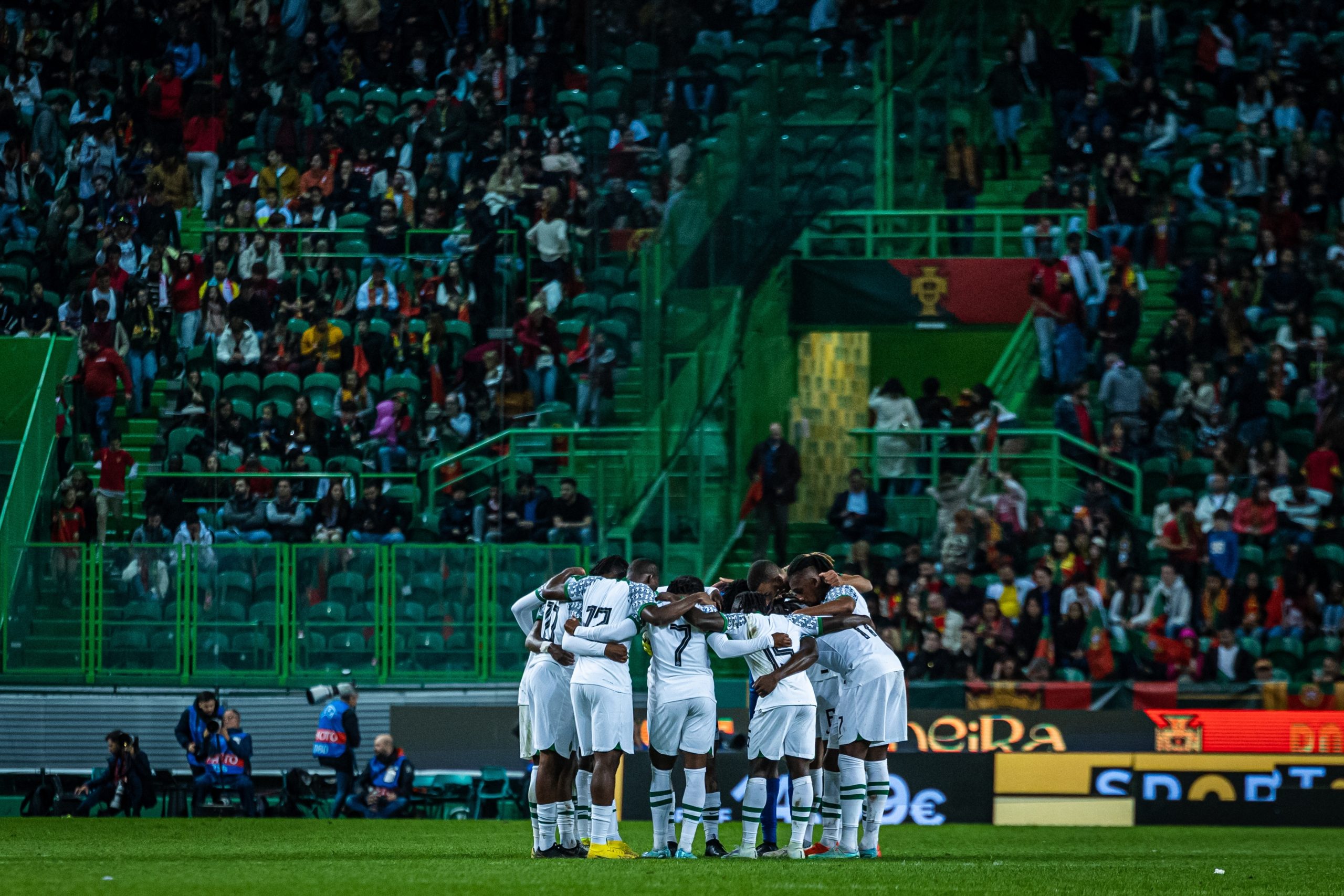
Nigerian men's national team at a friendly in Lisbon. Image credit Maciej Rogowski via Shutterstock © 2022.
For more than four decades, Nigeria has lived inside a carefully constructed narrative of greatness. In the years that followed the civil war, successive governments turned to soft propaganda in an attempt to rebuild national confidence. Slogans such as “Giant of Africa, Africa’s most populous nation, and Good People, Great Nation were promoted as unquestionable truths. These phrases created a symbolic identity that was easy to recite but difficult to verify. What was meant to serve as balm for a wounded nation became the foundation for a culture of exaggeration that still shapes national self-perception.
Many of the children who absorbed these slogans in the 1970s, 1980s and 1990s are adults today. Yet the myth survives with remarkable intensity. Its clearest expression appears during football crises. A failed attempt to qualify for the World Cup is met with familiar outrage. Nigerians ask how the country could possibly lose to DR Congo. The surprise is revealing. It suggests a refusal to reckon with the possibility that the country’s footballing status is not what the national imagination insists it is.
The belief that Nigeria is too big or too talented to lose to any particular African team reveals a deeper problem. It shows how a society that struggles with electricity, infrastructure, education, sports administration and basic governance still finds comfort in inflated fantasies of superiority. The football pitch becomes a stage on which national delusions play out. The result is an unearned confidence that masks years of institutional neglect.
Football is a useful mirror. When a country neglects youth academies, fails to maintain stadiums, sidelines long term planning and treats sports administration as an afterthought, the consequences are predictable. Yet rather than confront these realities, many Nigerians cling to the idea that talent alone will deliver results. Emotional loyalty substitutes for sober assessment. Hope becomes a kind of patriotism that resists scrutiny.
The approach to the upcoming AFCON in Morocco is already following this script. Despite repeated failures, many supporters insist that Nigeria must compete for medals simply because it always has. This expectation is not based on current capacity. It is an extension of an aging national story about Nigerian inevitability.
Consider the widely repeated claim that the current team is a “crack squad.” A closer look shows something different. The squad is largely composed of players in Turkey, Belgium, Greece and the mid table sections of English and Spanish leagues. The captain plays in Saudi Arabia. His deputy plays in Turkey. This is not a criticism of the players themselves. It is an attempt to recognise the reality of Nigeria’s football economy. A decade ago, Nigerians played regularly for top clubs in England, Spain, Germany and France. That era has passed. The talent pipeline is weaker. The global competitiveness of Nigerian players has declined. Pretending otherwise does not change the situation.
The irony is that Nigeria still appears in major football tournaments through its diaspora. Nigerian heritage players represent England, the Netherlands, Germany, Canada and several other national teams. Their success is celebrated as a reflection of Nigerian potential. It also highlights a more difficult truth. The ecosystem that allows these players to flourish exists outside Nigeria. When talented Nigerians succeed on foreign soil, they do so because they benefit from structures and investments that their country has failed to recreate at home.
Nigeria is not losing because the world fears its rise. It is losing because it is trapped inside a myth that prevents honest self-reflection. The real challenge is not whether Nigeria qualifies for a tournament or wins a trophy. The challenge is whether the country can abandon the comforting illusion that greatness is a birthright. Slogans and self-praise cannot replace planning, accountability and long-term investment.
Until Nigerians accept that footballing excellence is earned and not inherited, the cycle of disappointment will continue. The first step is the simplest. The country must let go of the inflated sense of exceptionalism that has outlived its usefulness. Only then can it begin the harder task of building the institutions that make real achievement possible.


