Empire’s middlemen
From Portuguese Goa to colonial Kampala, Mahmood Mamdani’s latest book shows how India became an instrument of empire, and a scapegoat in its aftermath.
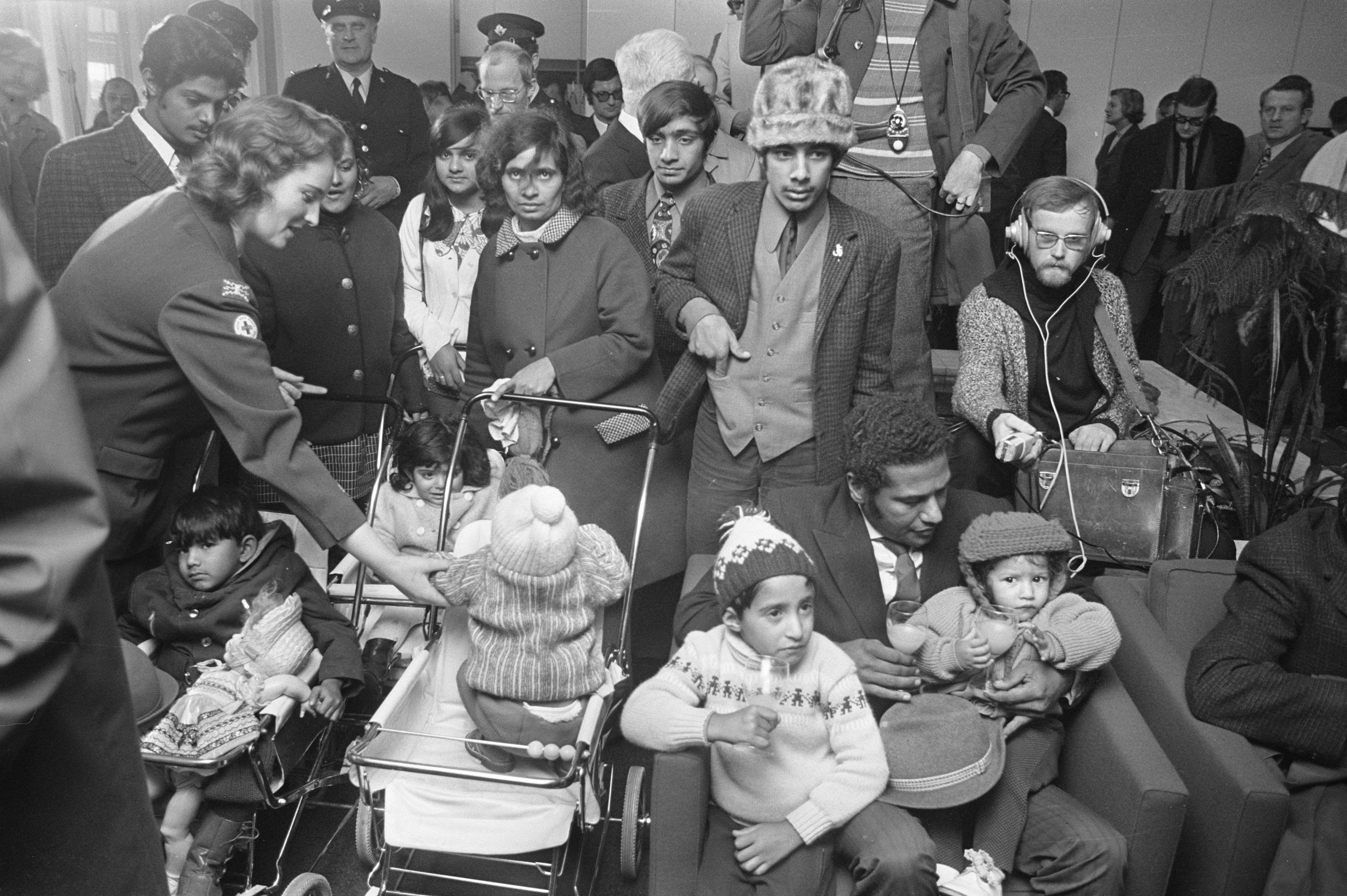
Ugandan Asian families arrive at Schiphol Airport after their expulsion from Uganda, November 24, 1972. Image
In the coastal Indian state of Goa, with no end of charismatic churches, the Mae de Deus Church in Saligao, Bardez, is an arresting sight. The neo-gothic, quaintly ribbed, avant-garde design is more creature than building, a sanguine figure of fantasy insectile in its grace and bewitching in the yet-still-novel mid-19th-century application of the genre to sacral purpose. Architecturally (the Portuguese pair of Major Martins who designed this timeless marvel, and another Martin, Manuel Ferreira who built it, completed it in 1873) it performs a pas de deux with the land around it; the coconut spread of the humid Konkan coast, the acres of paddy fields racing towards the church, confect a postcardable—nay, a hugely Instagramable—icon.
What was it celebrating when, at the time it was built, the great emigration from the Indian subcontinent was underway? Not yet a part of India, Saligao in the Goan taluka of Bardez, was part of a world that no longer exists but would continue as the woebegone Portuguese Estado da India until 1961.
By then, centuries of cruel history had ploughed over Afonso de Albuquerque’s idyll—the word ill fits the war criminal but this is how he saw it—so that the Estado faced, not one, but several failures. It failed spiritually. It failed economically, and in so doing, failed politically. And like much of the Portuguese empire, it came under nominal British influence. For the 450 years Portugal colonized Goa, Daman, and Diu, which made up the Estado da India, barely 100 of those can be said to have been prosperous and stable, meaning that for over three centuries, the Portuguese empire was really part of what British historian Eric Hobsbawm referred to as the secondary British empire.
By the 1590s, a colony founded in 1510 was already on the skids after the Catholic Church took control. Other European powers only allowed Portugal to hold on to its empire out of courtesy for its whiteness. By the 1840s, British power was such that it ranged freely into Portuguese India, as it did in other Lusophone holdings in South America, to pick what it wanted.
Then, in 1869, the construction of the Suez Canal changed the dynamics of global trade. France and the new empire of Germany intruded into what Britain regarded as its terrain. Allied with emergent tariff protectionism, this intrusion set Britain’s sights on the entire Eastern flank of the African continent. A fight was on. To secure India, Britain needed to control the Suez Canal; for this, it had to control Egypt; doing so meant capturing the source of the River Nile. And that in itself meant control of the eastern coastline of the African continent, and in this mounting logic ad absurdum, by which an imperial power is trapped in an expansion it can barely escape, they ended up needing more of the resources of India in order to secure India.
This is how the drama of Uganda with the dramatis personae of Major Charles Gordon, Henry Morton Stanley, Emin Pasha, Capt. Frederick Lugard and the later religious wars of Mmengo were triggered, all a part of the scheme for control of the River Nile. When the events narrated in this book occur, the family of Prof Mahmood Mamdani was not just in Uganda to be in Uganda; they were playing their roles in the larger imperial theater of India. For Britain, India’s gifts were depthless. Without India—without the Bombay Presidency, with its financial and commercial clout—it is doubtful Britain would have beaten either France or Germany to Uganda. Part of the reason the 1888–1892 wars of Mmengo were so entrenched is that France, through the Catholic mission of the White Fathers, who were caught gunrunning, was actively scheming to colonise the country for itself.
India, with its large human population, its European education in both Anglo-India and Portuguese India, had long been taught to reproduce colonialism. In British thinking, it was what Lugard, in his book The Rise of Our East African Empire, referred to as “semi-civilized”. It had in numbers men trained to build and run the railways. Studies in colonial jurisprudence had built up a body of évolué lawyers. They knew its medicine. They knew its pedagogy.
The Indian merchant class, established long before there was a Western Europe, or a Europe at all, parried for gold with the Roman Empire, as British historian William Dalrymple in his book, The Golden Road: How India Transformed the Ancient World, argue.s This class gave the British the tool to open up eastern Africa in ways Bismarck’s Germany could not.
In turn, for many young men in British and Portuguese India – in their confessions and communities and castes – East Africa provided a chance to get away from the stifling colonial atmosphere, an oppressive Catholic Church, and caste rigidities. Incomes were several times higher than they were back home. In the matchmaking market, a young man connected to East Africa was a catch.
India, with its “overpopulated provinces,” Lugard (born in India and creator of British East Africa and the Uganda Protectorate at the age of only 32) wrote, would have to be brought to develop the “embryonic civilized,” “half civilized,” and “savage” lands of East and Central Africa. The first Indians to arrive in Uganda in the late 1890s did not come for trade. Several companies of the Army of Bombay were dispatched to what is now Uganda to help Major MacDonald—later Major General MacDonald—put down the Nubian mutiny in 1897. (There is the longer story here of the abandoned troops of Dr Emin Pasha that Lugard had no choice but to bring into Kampala with dire consequences for Uganda at large, given that it was also the way that this community later birthed Idi Amin.) Along with the final push against Kabaka Mwanga and Omukama Kabalega, these Sikh battalions established the Punjabi community in the region.
In the popular imagination, “Indians” in East Africa came for two reasons: to build the railway and to trade. By far the greater majority in the 1890s did come for these reasons. But many who came to work on the railway went back to India. This simplifies history. Indian merchants had for over a millennium been on East African coasts. The chief focus has been on the age of imperialism. And in this age, over the next several decades, people came individually, the recruiters at the feed-in side keeping stock of placements and charging passage fees. But India is too vast for a single story plotline.
If this narrative was the lot of Antonio Rodrigues of Margao, who came to work and live in Entebbe in 1928, then it was also the world of Jairam Sewji, of Aldina Visram and Alibhai Jeevanjee—India at the other scale, of money and power, and of the Aga Khan’s Ismaili community of Khojas, a world of even more power. A structured India came to East Africa alongside individual narratives. This confection was a complete superfood; Britain did not need to bother with spice further. It already owned the patent to the colonial wheel. They literally transplanted India across the Arabian Sea. Not just the people.
The currency adopted in these years was the rupee, in the silver anna denominations of 2, 4, and 8; the rupee notes in 5, 10, 20, 50, and 100 denominations. It was a power play; the Africans were not without a currency. The cowrie shells the East Africans mostly used were roundly rejected by the British. In one fell swoop, the equivalent of entire national GNPs, GDPs, and their attendant savings, accumulated over lifetimes, were erased; family, clan, and state wealth were wiped out. In reverse, now the white and Asian settlers were beginning to sink their own family legacies. It was an economic holocaust the impact of which would continue to be felt for generations to come. This is the catastrophe under which Africans commenced the perilous seven decades of colonial occupation. The British had a plan.
The new colonial taxes Africans were forced to pay were levied in Rupees, not in the cowries they possessed; Rs 4 paid annually in hut tax and Rs 2 in poll tax, levied on Africans above 16 years of age. Failure to pay in cash meant a month of labour for the poll tax, and two for the hut tax, carried out on colonial government projects. Via this schema, barely any Africans who worked to build the colony were paid.
The Indian Penal Code, the very famous IPC, was another consequential transplant that continues to form the basis of East African Common Law as per the Order in Council of 1902, in total disregard for African legal heritage. (In later years, the British would introduce the Australian Queensland Code, but the IPC continued to underpin East African laws.) There was the complicated matter of legal pluralism by which different communities fell under different laws, but that is another subject matter.
But it was the issuance of trading licences that opened up the widest inequality gaps of all, and which brought the conflict of Indian and African commercial interests into the political crisis described in this book. In these early years, only Asians and Europeans were awarded trading licences. Africans could not own the lucrative cotton ginneries. The African was still regarded as the natural slave.
Within this evolving catastrophe, the rationing of African employment set the essential racial hierarchies. Even employment in the police for Africans was frowned upon out of fear that it would take away labour from private enterprises. The force paid three times what wage labour paid. Native Africans preferred police, with its powers and prestige, to wage labor. Voices, including from the influential Church Missionary Society, let alone the chambers of commerce, called for this avenue to be blocked, for the posts to be reserved for the Sikhs, in order to force Africans into the labor market.
The most consequential abuses were in Buganda. There, native chiefs aided in the abuse and exploitation of their fellow Baganda. The Buganda collaborator class, handsomely paid from £200 (£32,000) for county governors to £400 (£64,000 in 2026 Pounds Sterling) a year for the regents of the young Kabaka Daudi Cwa II, did not protect their own people the way Indian communities protected and promoted the interests of theirs – an own goal that the more savage anti-Indian voices in the kingdom do not care to admit. With their handsome paychecks, bigger than the nominal cabinet salaries in 2025 money, these chiefs, whose families remain the powerful landlords referenced in this book, readily procured black labor to ensure the cotton, rubber and coffee plantations were manned. Pressure ranged anywhere from land evictions to corporal punishment; death by burning their own people had been stopped by the British.
A further weapon hardly commented on was the rationing of urbanity. As the platform unit for colonization, it etched segregation into the landscape and neatly controlled the parameters of having and of having-not. It was in the towns that colonial injustices were the most visceral. Colonialism in this form was urban, bourgeois in its denotative sense. This is a very crucial point to understand, particularly for voices that blamed Africans for not doing enough.
The town was where the economy gravitated. Into these, the Europeans and Asians brought centuries of their urban culture along with the social values accumulated in these naturally socially hierarchical and segregated constructs. By the time these communities arrived in Uganda, they had already developed the bourgeois instinct, its culture and notion of values long delinked from rural sensibilities. The Africans who arrived from the rural areas into these constructs still relied on what would later be called the social or solidarity economy, as indeed the peri-urban economics of cities like Kampala still operate. Against the extractive efficiency of bourgeois systems, they were lambs to the slaughter. This places the conflicts described here in a wider history of human society, rather than simply race against race, and requires deeper knowledge of such dynamics to take apart.
At the beginning, Africans provided labor because under systems like Buganda, it was an honour to work for the state – or as the vernacular has it, to work for the Kabaka. The rewards were often recruitment into public, kingdom offices. Under the colonial dispensation, the reward was loss of status, health, and even life. Learning the ways of urban, bourgeois labor relations was a steep carve that took till the 1930s, and 1940s, for the Africans to come to terms with, and when they did, their reaction, via unionization, strikes, protests and boycotts, began to undo the latent colonial idyll.
In the essential years of value and wealth transfer away from African control, they were required to provide the labour, to clean and keep the towns in trim, but not allowed to live within the towns. Regarded as the polluted race, they found themselves in dangerous, fetid, new environments their culture was not cut out for. The reduction in status, loss of health and attendant malnutrition, the loss of age and generational set status, underscored the fact that it was the African alone who was not allowed in these urban environments without the antidote to the construct—a traditional religion, a financial capital plan, and the requisite unguents of social and artistic culture suited for these new realities. With the exception of the kingdoms of Uganda, this was the first time many of the Africans were experiencing structured oppression.
To this day, urban areas function as breakers of African culture and social bonds. The many rich neighborhoods in the cities and towns grew up with corresponding ghettos attached to them of maids, “boys,” cooks, nannies, garbage collectors, gatekeepers and security guards too poor to live in the same rich areas but paid less than they needed to transport themselves daily to work. That the poor and rich can and should live side by side remains unthinkable.
There was a further complexity to Uganda, which set it apart from Kenya: In the British East Africa protectorate, which did not gain the name Kenya until 1920, the large presence of white settlers placed the white man squarely in view as the oppressor and transmitter of exploitation and appropriator of lands. In Uganda, there were never more than 6,000 white people at any point in time. In contrast, there were up to 250,000 in Kenya. This left the Ugandan “Bayindi” as the embodiment of this complex encounter.
Slow Poison is a book too large for its 280 pages. In terms of structure and content, it is a compendium. The semi-autobiographical texture serves to dispense with the difficulties a historian might face in setting these themes – if the word is adequate. Mamdani is alive to this history. A realist and a storyteller, he deftly embeds his personal experience with the intellectual bearing that makes his work trustworthy. We are grateful for the stories he tells. We learn about Idi Amin’s history in ways we have not come across before. That Idi Amin’s mother was so close to the Buganda Royal family (Daudi Cwa II) and that the family may owe its continuance to her, goes a long way in providing insight into what became of Kampala in the post-Mwanga years, its dependencies, its moral and social crises.
As a writer on Kampala myself, there are new insights here, and the city arises as a living ghost out of the rapid changes and shifts which the passage from colonialism to the end of post-colonialism occasioned. A colonial city, Kampala, cannot keep its memories without incurring contradictions.
The crisis that the Ugandan Indian community endured from the years after the Second World War takes the study from the broad into the personal. What the book does not overtly mention, but is everywhere, is the frailty of cosmopolitanism. Much as I earlier posted it as a crisis, the African faced thrown hothouse-style into commercial, coastal city culture, was and continues to be an unresolved crisis for all. Can constitutional law and the institutions of pedagogy, commerc,e and industry truly create a platform on which people can define their place away from the fraught cosmologies of social groups, bloodlines, and autochthonous politics? The Africans who came to the colonial urban cauldron suffered intensely for not knowing the game. But even the most seasoned heritage still functions within systems of power, and when the economic underpinnings of these threaten even the most seemingly enlightened, the redoubt remains the volk. The “semi-civilised” of Lugard’s framing suddenly became ethnic and a problem for the British Isles when their very home turf became the point of immigration. As the anti-immigration din in the West ratchets up, we are watching how the biggest exporters of migrants to other people’s lands actually think of the idea.
In the post-World War One years, the East African shilling replaced the rupee. Removal of legal segregation followed. But the momentum of the beginning of the colony lingered on. Segregated settlement could not be so easily undone. There was the matter of real estate, and of cultural differences, to say nothing of extra-legal barriers elite Asian and White neighborhoods raised to keep black people away.
But the worst factor for the central region of Uganda in these decades was the land tenure. The mailo land has been studied extensively, but I’ll draw attention to a factor not so well known publicly. The towns and cities where Europeans and Asians settled were leasehold tenure. The Africans were mostly subject to mailo land.
The survey and determination of mailo land took more than 30 years to complete, as its cost ballooned from an original £75,000 (£12m) budget in 1906, to £200,000 (£31m) when it ended in 1936. C.W. Allen, the surveyor for whom one of the earliest streets in Kampala was named, had estimated not more than 15 years for the exercise. By 1936, the colony had exhausted half its lifetime. A generation had come and gone and this slow-walked administrative barrier had prevented Africans from turning their holdings into lucrative commerce. It is the reason that African-owned lands even in Kampala today, remain unplanned slums, but that is a bigger topic. The setback to African enterprise, where Asian and European ones hit the ground running, was considerable.
Reading through Slow Poison and absorbing the family biography of its author, I was reminded of cycling through the Goan countryside and struggling to come to terms with the fact that everybody I spoke to had a link to East Africa. The Tanzanians, the Ugandans, the Kenyans. There were people with ties to Zambia, South Africa, and Malawi, but East Africa had a particular hold. The Mamdani family is a very special part of a special group of the Indian diaspora—the business and intellectual elite who, cross-migrating into the Anglo-Saxon world, found that their education and place in the business of the empire gave them an extra edge in the capitalist, globalist instinct of bourgeois Anglo-Saxons, as either perpetrators of the system, or its critics. It is a revealing turn of events that, as the keystone of Anglo-Saxon power wanes, it is turning increasingly to its East African Indian affiliates in search of political remedies. India had once been the making of their empire. Now that the empire is in decline, a natural homing instinct seems to point them to a magnetic, imperial North that once made their fortune.
Mine is a contextual reading of Slow Poison. As a Ugandan, this reading was irresistible. But it is also the kind of book that provokes its readers to think about their own place in the narrative being told, and hence, risks not being ready primarily. It is perhaps the fate that a man with the long, academic, and vast grasp of historical and current affairs such as Prof Mamdani is bound to suffer.
Or be read as a political crutch, as towards the run-up to the historical mayoral elections of New York, editors began casting about for anything that could explain the phenomenon of Mamdani fils. They came looking for signs that Zohran’s leftist bent did not fall far from the tree; they came looking for what kind of tree he sprouted out of. There were many disingenuous reactions; that Mamdani’s paterfamilias’ studied approach to politics was a betrayal of the experience of Indians expelled by Idi Amin; that he was misrepresenting Uganda; that he misread Museveni. Some came for signs that what had gone on could be assuaged by the all-seeing eye of history.
At some point, after the Helen Epstein review for the New York Review of Books, I resolved to stop reading reviews until I got my hands on the book. I found little of what many reviewers were talking about. I was perhaps caught up in my own reader’s prejudice; what I found was the first coherent account of my own coming-of-age years, but to a continuing white gaze, of what use is this account?
It is a book for Ugandans only, being read widely. A very becoming account of the post-colonial collapse of the Ugandan state and a personal, street-level insight into the issues and personalities that shaped the age. Mamdani draws them close enough to smell their breath. That long drive Mamdani shared with Museveni in a VW Combi in Nyerere’s Tanzania, from Moshi to Dar es Salaam, deserves its own account. He was perhaps too close to Museveni for comfort, given what the tyrant has become, and for this, he, like the late Ali Mazrui, who trumpeted the tyrant in his early days, owed Ugandans some explanation. Has he done so here?
Mamdani knew many of the dramatis personae paraded here and was a lot closer to the creation of post-Amin Uganda than even followers of his work might have imagined. As a Ugandan, I began to see something familiar. This was our book, but like our lives, and because of that, it has gotten caught up in the familiar, impervious, imperial narrative malaise from writers like Helen Epstein who come to the colonies and disregard all they see and only take what they want. You feel dismissed and patronised. Not so with Mamdani, and this is the essential character that endears him to many here.
The reason Mamdani is a celebrated scholar is that he was there with the country all along and did not let the experience of 1972 distort his studious approach. It takes a lot of character to achieve that. In the crunch of the late 1980s and early 1990s, he chose to become a taxi driver in Kampala rather than leave Makerere University and the country when there was so much rebuilding to do. He became a member of a
drinking group; this was the social media network of the time—the marwa club, that millet brew served in a hot water suspense and sipped through a long straw—the Facebook of Kampala. He refused offers of a cabinet job at the time because he wanted his perspectives unsullied. For Ugandan readers, respect for Mamdani can only go up after reading this book.
Unless they are Musevenists, at which point their shock at having their man lined up alongside Idi Amin, then found wanting, will not let them read it soberly. They have accused him, as Uganda’s inestimable Musevenista ambassador to the UN, Adonia Ayebare, did on his X account, of being ungrateful after all they did for him. (After his government tortured Stella Nyanzi, Adonia has the gall to say they saved Mamdani from her.) Amazing. Living now in Mamdani Jr’s New York should be a new pleasure for him.
The book is also a biography by a participatory observer who serves up delectable accounts of Ugandan society. Its main, if the word can be used, is the politics of identity in the transition of colonialism, but more importantly, how identity was weaponised by colonialism and how, in perpetuating the same, Mr Museveni betrayed the emergent nation.
The protagonist-antagonists in this tale are two of Uganda’s military rulers, Idi Amin and Yoweri Museveni. But any expectation of a compare-and-contrast framing soon runs into the fact that the tale itself is set in the wider tableau of Uganda. There is a fine line here between Uganda and the perceived Ugandan-ness. The perceived one can here be traced to the emergent nationalism of the 1930s, when the awakening consciousness movement of Marcus Garvey coined the phrase, Africa for Africans. Did this easily but misleadingly lead to the short-circuiting of the African identity to blackness? What is “Uganda”? Or “Kenya”, for that matter? This is a question that can hit you hard in places you did not know about, as happened to me when I visited Goa.
There, nearly everyone I spoke to was the progeny of, or related to, someone who had come to East Africa, or been born here. The decades following the Amin explosion left deep wounds. There was the memory of parents whose longing for their homes in Uganda was one of the saddest things I’ve ever been confronted with. In those moments, I am split between loyalty to my pre-colonial Bunyoro-Kitara and Nilotic heritage, began to see how much I may have taken “Uganda” for granted. India gave me Uganda!
This fine line between nationalism via an autochthonous heritage can easily be confused with citizenship. “Uganda”, I began to see in India, did not belong to blackness any more than “Uganda Railway” in any way implied the railway line was invented by that ethnicised, black Uganda.
There is an argument here for understanding cosmopolitanism and how the immigrant Indians may have seen things. India’s coastal cities had long been cosmopolitan by the time the Portuguese arrived: Europe, Mughal, Persia, Asia, and even Africa had combined through the long millennia to create their characteristics. Portugal added its own thing to further the growth of a long de-ethnicized identity, at which point the word is open to play. Even on the most touchy of Indian subjects, religion, even caste itself, as Indian historian Manu Pillai in his tome, Guns, Gods and Missionaries: The Making of the Modern Hindu Identity argues, have been subject to fluidity. Here were people who for millennia had understood the fractal expansiveness of identity and had developed an accommodation with it, being flung into a world which had been sheltered from it.
The Indian-African encounter in this age was a case of bad timing. By themselves, it is unlikely there would have been better relationships, but the texture of it would have been different. Colonial weaponising of “race” made it a foregone conclusion that something like the expulsion of 1972 was coming. But was it based on fear or misunderstanding? After all, the “Bayindi” were no more a solid, single unit than the Africans themselves were one tribe. Blaming Indians for colonial injustice did not prevent Amin from massacring thousands of Lango and Acholi people, who are as black as he is. Or perhaps, did the Indian immigrants, as well as white settlers, bring with them a cosmopolitan culture whose value systems were too remote from African, communitarian culture the latter found threatening? How much does this explain the current conflicts between the so-called Gen Z and the entrenched neoliberal elite? Are the neoliberal political and business class of Ruto, Museveni and Samia the new “Bayindi”?
There is another matter to consider, and this is the differences in colonial experience between Africans and Indians: We had not been colonized long enough nor occupied often enough to develop a fatalistic acceptance. In comparison to colonialism in India, 1972 was the early days of even speaking of a colonial experience at all. In Indian terms, 1972 would be 1582, seven decades since Afonso de Albuquerque, the Indian equivalent of Capt. Lugard took Goa. The grinding centuries from then on, to 1961, when the last of European rule in India came to an end, can only give an idea of what the Indians who ended up here would know of colonial rule. In Indian terms, East Africans would have to wait till the years beginning in 2300 to begin to understand their relationships to India.
Mamdani’s intellectual framing of these issues parses some of these ideas, however indirectly. There are givens. Indian construction of identity is what it is. British colonial policy did not set out to create intercommunal harmony. It was a set-up. But, and this is the argument of this book, there was the matter of the nation-state, based on constitutionalist underpinnings, the task of nation-building after the catastrophe. Such a construct cannot be ethnic – cannot afford to be ethnic, as Kenyans and Ugandans may have learnt by now. It has to overcome sectarian, group instinct, and arrive at an expansive understanding of the human being and human society. An enlightened construct sorely needed in today’s world.