Grounded expectations
The 2025 Africa Cup of Nations marks a transition period for the Nigerian men's national team. This could be good for them (and the nation).
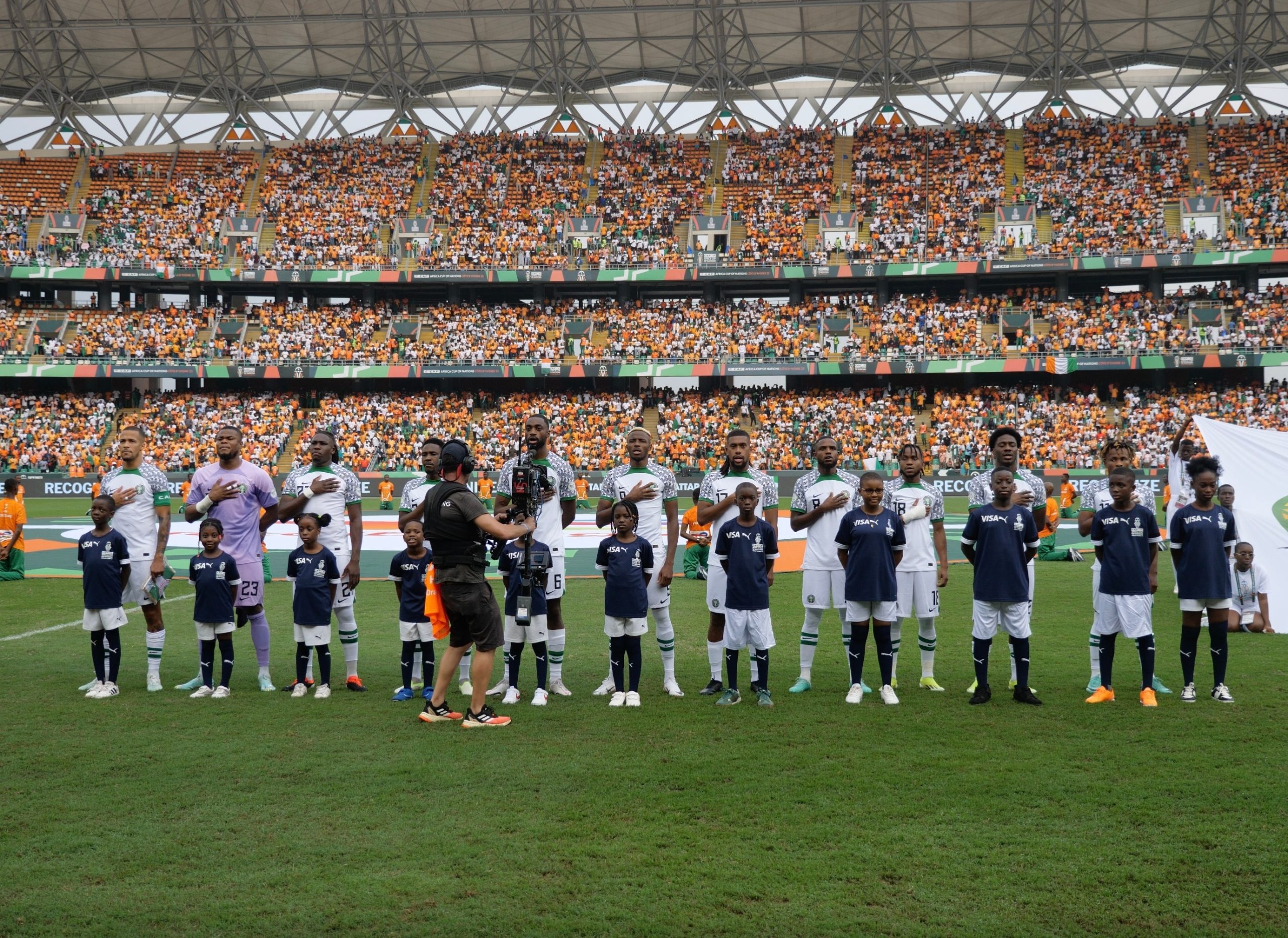
The Nigerian men's national team in Côte d'Ivoire during the 2023 AFCON. Image credit Clement Demazure via Shutterstock © 2023.
Ahmed Musa’s retirement from international football was more than just the second recent departure of a Super Eagles captain, following on from that of his successor, William Troost-Ekong. It marked an interesting milestone—Musa was the last surviving member of the victorious 2013 African Cup of Nations side. In the subsequent period, Nigeria failed to defend its title at the next tournament. It didn’t qualify for the 2017 edition either, before two podium finishes sandwiched by a round-of-16 knockout by Tunisia in 2021. Similarly, it made the 2014 and 2018 World Cups but has failed to qualify since, most recently after being knocked out of the continental playoffs by a resurgent DR Congo side, drawing the furor of a football-mad nation expecting to have made it.
This transition is also similar at the coaching level. Since the late great Stephen Keshi became only the second man to win the tournament as both a player and a coach, Nigeria has relied on legendary players such as Sunday Oliseh and Finidi George, as well as foreign coaches such as Gernot Rohr and Jose Peseiro, to mixed fortunes. Accordingly, their strategies also changed, with players exposed to attack-minded coaches who neglected the defensive side of the game to coaches who prioritized a solid shape at the expense of leaving frontmen adrift.
This uncertainty has led to some frustration with the Super Eagles, and even that might be putting it mildly. Nigeria expects its population and talent bank to make it a powerhouse on the continent, but even its number of continental titles is dwarfed by those of fierce rivals Ghana, neighboring Cameroon, and all-time winners Egypt. Nigeria’s unexpected run to the 2023 Final in Côte d’Ivoire was sandwiched between two World Cup qualification disasters, despite boasting two of the last three African footballers of the year.
Yet the response to missing the 2026 World Cup revealed something more unsettling than anger: resignation. The Football Federation president and, most tellingly, the coach, remained in place. No heads rolled. No protests materialized. This muted response mirrors how Nigerians increasingly engage with political leadership—vocal frustration has given way to deep, muted acceptance that systemic failure rarely yields accountability. The federation’s prioritization of self-enriching schemes over player welfare has drawn comparisons with wider governance failures, but these comparisons no longer spark outrage. They simply confirm what citizens already know about how institutions function when accountability is absent.
But these complaints aren’t new. What is new is a side that aptly reflects a new era for the Super Eagles, and this current feeling represents a change in the nature of the relationship between the Super Eagles and their fans. For 70+ minutes against Tunisia in their second group match, with Nigeria leading 3-0, fans across the world were spellbound as the side appeared to have finally delivered on the promise that millions have often expected but have usually been reluctant to dream. And while the spirited Tunisian comeback, itself owing to some questionable substitutions, could have dampened this start, this Nigerian side is now quietly but firmly in the conversation at a tournament where only a brave pundit can bet on who would win.
Here lies the paradox that defines Nigeria at AFCON 2025: the Super Eagles arrive in Morocco among the favorites alongside the hosts, yet Nigerian fans refuse to believe. Bookmakers rate them highly, pundits cite their talent depth and both star forward Ademola Lookman and coach Eric Chelle were named in the tournament’s side of the group stage. But Nigerians have learned that being favorites is not the same as winning, that potential is not the same as delivery, that talent is not the same as infrastructure. They carry the psychological weight of being expected to succeed while anticipating disappointment—a uniquely Nigerian burden that transforms every match into an exercise in managed hope.
This evolution finds its anchor in three key elements that will make or break the future of Nigerian football. First, it is reaching the cusp of diaspora players enchanted by an older legacy. The squads of AFCON 1994 and the 1996 Olympics have inspired millions and their children, who took a chance on Nigeria when it might have been worth holding out for a call-up from a bigger power. Future players faced with a choice internationally will need new heroes, and this side is the culmination of all who came before, and bears the responsibility of inspiring those who will come after. It also further strains the connection to the domestic league, which notably produced key players on previous title-winning sides. That pipeline has not dried up, but it might in the future, not from lack of talent but systematic neglect.
Second, it is based on a new generation of leaders whom Nigerians have seen “grow up.” Alex Iwobi, nephew of Jay-Jay Okocha and one of the first diaspora players to choose the green and white, has now marked a decade and has surged through the appearance charts. New captain Wilfred Ndidi has similarly become a symbol of longevity. At the same time, star Victor Osimhen represents the promise of successful young players moving through cadet sides and becoming key elements of the national side. These players, who demonstrate the promise of yesteryears, now represent the hopes of today and can link these ambitions and hopes to forge their own destiny and carry Nigerians’ aspirations with them.
Finally, this side represents a shift in how citizens engage with the elements that define society. This could describe how Nigerians engage with political leadership, ahead of 2027’s elections, and even with sentiments around nationhood and security. For the first time in decades, Nigeria doesn’t expect—or rather, it has learned not to. This side can use this space to chart its own course and redefine its relationship with Nigerians, freed from the crushing weight of assumed greatness. Perhaps this transition is not the dramatic fall from grace, but the quiet recalibration of what success means. For now, that’s enough. The Super Eagles don’t need to soar—they just need to take flight.


