A world reimagined in Black
By placing Kwame Nkrumah at the center of a global Black political network, Howard W. French reveals how the promise of pan-African emancipation was narrowed—and what its failure still costs Africa and the diaspora.
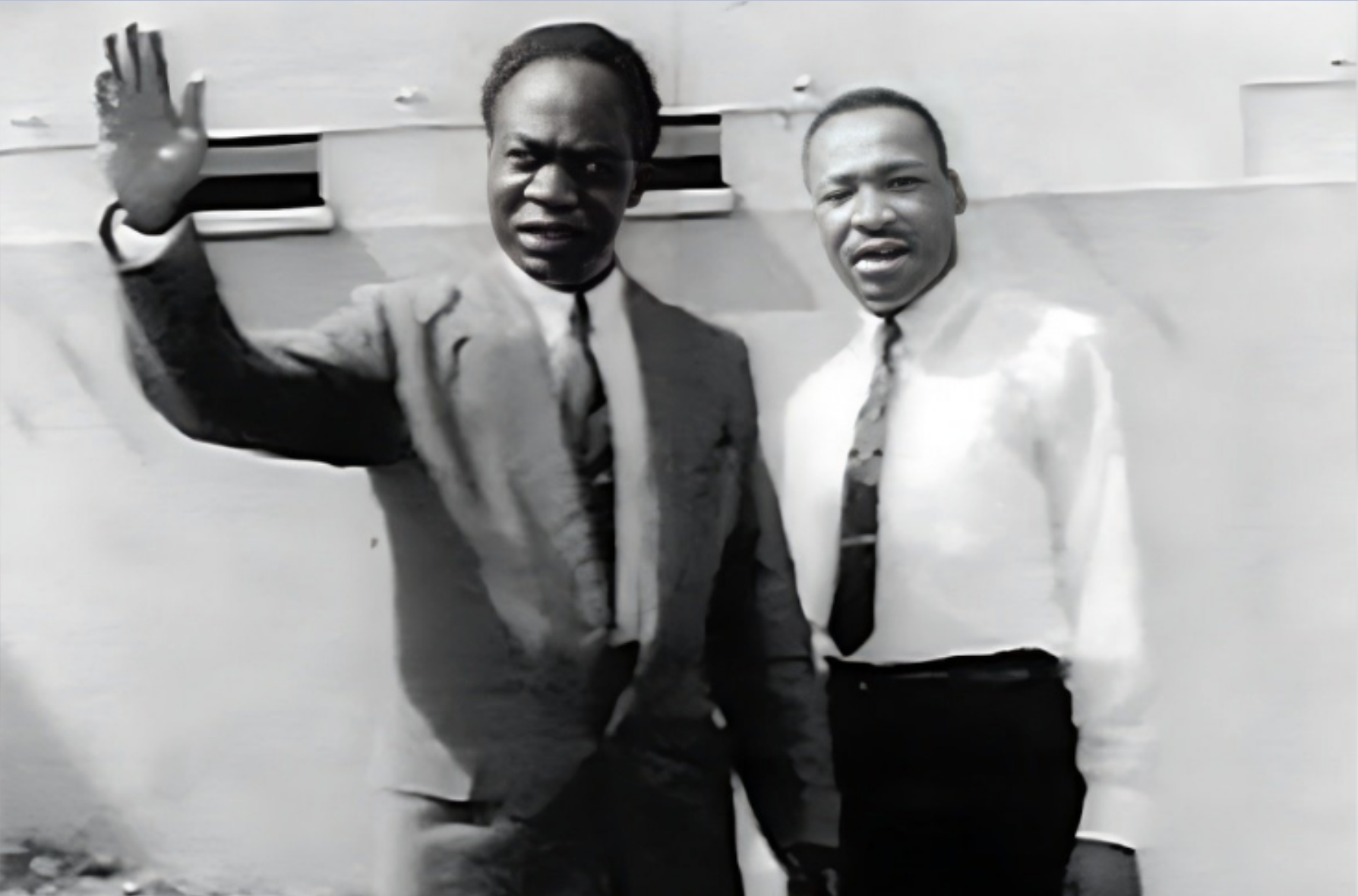
Kwame Nkrumah (left), Ghana’s prime minister, with Martin Luther King Jr. during King’s visit to Accra for Ghana’s independence celebrations, March 1957. Photo courtesy of the Government of Ghana.
In late December 1998, a few months after I started an LLM program at Harvard Law School, I had two encounters that I began to unpack only decades later. In the first, George—another Nigerian in the program—an African American woman, and I were discussing race when George said words to the effect that African Americans were lazy and needed to pull themselves up by their bootstraps. It was my view too, but I would have couched it more diplomatically. I can still recall the blood rushing out of her face as she tried to comprehend fellow blacks who did not understand structural racism. The second was with a female law student whom I shared student accommodation with who heatedly shared her preference for being described as Black American; she had no affinity for or interest in being identified with Africa. Her remark may have been before or after I observed that as a stranger trying to settle into life in Cambridge, I found myself more comfortable engaging Caucasians than Black Americans. Almost 40 years after African countries gained independence, the language of solidarity between Africans and Black Americans had all but disappeared. George and I were not simply ignorant, we were products of a colonial and national education system designed to leave Africans and Black diasporans without the vocabulary to discuss and empathize with our different structures of constraint.
There was a time though, when we understood each other. Howard W. French’s sweeping and ambitious new book, The Second Emancipation, offers a history of when Africans everywhere were briefly aligned for a world project. The book spans a period in the mid-twentieth century, when Black freedom was not simply a series of regional, disconnected struggles but a global agenda. For French—the veteran journalist, historian, and author of Born in Blackness—this was the era when the first wave of independence movements in Africa, the US civil rights struggle, and the ferment of diasporic thought in the Caribbean converged in a “high tide” of Black political possibility. At the center of this tide stands Kwame Nkrumah, Ghana’s first president, whose life becomes the lens through which French tells a story of the promise and betrayal of African independence and Black solidarity.
French’s Nkrumah is not merely a national hero, he is a central part of a vast intellectual and political network stretching from Accra to Harlem and from Trinidad to Moscow. He is part of the relay of thinkers, like Edward Blyden, Henry Sylvester Williams and Marcus Garvey, who advocated for Pan-Africanism. Drawing on archives, travels and extensive secondary research, French traces how a young man from a modest background led his country to independence. Born in the margins of the border between Gold Coast and Ivory Coast, Nkrumah was educated at Achimota College and Lincoln University; radicalized in 1930s America and returned home bearing the belief, no doubt influenced by his exposure to the US brand of racism, in the indivisibility of Black liberation. Ghana’s independence in 1957 was, in French’s telling, the symbolic dawn of a global emancipation that sparked the political imagination of the twentieth century.
Yet the book’s ambitions far exceed biography. French’s larger claim is that the era of decolonization must be understood as a continuation of a centuries-long global struggle for Black freedom—an unfinished emancipation that began with the abolition of slavery in 1833 in England and 1865 in the United States of America, and sought to culminate in full sovereignty and self-definition for African states. The “second emancipation” of his title thus points to an ongoing aspiration: the attempt to complete the work that the first emancipation left unfinished.
It is in this context of an uncompleted vision and the limits of formal education in Africa about the politics of race and its symbiotic relationship to capitalism and imperialism, that three issues raised in Second Emancipation have bearing for Africa and Africans today.
Global Blackness and Pan-Africanism
French, an African American who spent formative years in Africa, writes with the journalist’s eye for character, the historian’s patience for connection, and the personal experience of a Black man. He reconstructs the intellectual scaffolding that triggered Nkrumah’s Pan-Africanism—i.e., the writings of Nnamdi Azikiwe, who encouraged him to prioritize an education in the US over Britain, and the moral and cerebral support that sustained Nkrumah’s vision: the mentorship of W. E. B. Du Bois and George Padmore. The relationship between the three men was symbolic of the joint purpose and tripartite relationship between Africans, Black Americans, and Afro-Caribbeans. It was a case of, as Steve Biko put it, “We are in the position in which we are because of our skin… what can be more logical than for us to respond as a group?”
Afro-Caribbean and African American communities gave Nkrumah and the project of African independence wholehearted support in the years following World War II. Intellectuals such as Horace Mann Bond and A. Philip Randolph, working in the Garveyite tradition, understood Black freedom as an intrinsically transnational struggle and saw “the rise of a free Africa as a source of redemption and empowerment for African Americans.” When Nkrumah made his first official visit to the United States in June 1951, African Americans were instrumental in securing State Department recognition of the trip, his honorary degree from Lincoln University, and the widespread press coverage that followed him. Likewise, Ghana’s independence in 1957 was witnessed by dozens of African Americans—Martin Luther King Jr. among them—who experienced it as the inauguration of a new historical moment. As Marguerite Cartwright wrote in the Chicago Defender, “Africans have two vital things we need badly… a sense of destiny, of inescapable achievement and glory.”
Where, then, is that solidarity today?
At a moment when a multipolar world is emerging, and when Africa’s persistent subordination in the global political economy makes clear that emancipation was never completed, why does Pan-Africanism often appear as a hoary legend, consigned to dog-eared symbolism rather than living political practice?
Part of the answer lies in the consolidation of neocolonialism following the collapse of Black Atlantic federalist ambitions, from Nkrumah’s proposed United States of Africa to Eric Williams’s West Indian Federation. As African states rejected Nkrumah’s insistence on securing the “political kingdom” first, postcolonial sovereignty was narrowed to juridical independence without corresponding social and economic power. As Africa’s ruling classes integrated into an international order structured by capital, aid, and geopolitical patronage, Nkrumah’s warning in Neocolonialism, materialized: “The rulers of neocolonial states derive their authority to govern…from the support which they obtain from their neocolonial masters.” Pan-Africanism, stripped of its institutional and material foundations, was thus reduced to diplomatic ritual and cultural tokens.
However, to explain this outcome solely in terms of elite betrayal or external domination is insufficient. The deeper limitation of postindependence Pan-Africanism lay in its failure to resolve the problem of class power. The transition from formal decolonization—achieved through broad nationalist coalitions—to substantive transformation required a redistribution of resources and authority that would inevitably generate class conflict. Such a project could not be sustained by states alone. It required the construction of mass, working-class organization capable of acting autonomously and transnationally, linking African and diasporic labor through shared political struggle.
Instead, Pan-Africanism remained statist. Organized labor was incorporated into the postcolonial state as a managed constituency rather than cultivated as an independent source of power. In Ghana, as elsewhere, trade unions were disciplined, centralized, and subordinated to ruling parties, reflecting a broader conviction that the state—not class struggle—was the primary agent of historical change. This approach produced a paradox: Pan-Africanism aspired to continental unity and global transformation, yet its social base remained nationally bounded, politically contained and intellectually stunted on structural racism. Once economic crisis set in and redistribution became unavoidable, the absence of autonomous working-class power left postcolonial states exposed—unable to advance transformation and unwilling to confront capital.
Education and ideology were central to sustaining this arrangement. Horace Mann Bond observed after visiting Nigeria and Ghana that the “lack of race consciousness that the British (education) system conveyed to students… harmfully mute on questions of identity and historical exploitation.” Postindependence elites largely preserved these silences, recognizing that an education oriented toward Black internationalism and political economy would cultivate not merely cultural pride but class consciousness. Such consciousness would threaten both neocolonial dependency and domestic class hierarchies. Malcolm X’s warning that “the first thing the American power structure doesn’t want any Negroes to start thinking is internationally” captures this logic, but this was not an American malaise alone. It is a structural feature of a postcolonial order in which Pan-Africanism is celebrated symbolically, while its most destabilizing implications—mass transnational class politics—is carefully contained.
Pan-Africanism had self-imposed, some might say pragmatic limits, as Malcom X found out when he tried and failed to get Nkrumah on his side for a United Nations resolution condemning racism in the United States. Nkrumah knew that any such political support or alignment with Black radicals would endanger funding for the Volta Dam project. It was the same cool reception Malcom X got when he attended the July 1964 Organization of African Unity meeting in Egypt. His warnings about African countries’ reliance on US dollars fell on deaf ears, and in place of an Africa-led UN resolution against racism, he got an OAU resolution calling on the US to “intensify their efforts to ensure the total elimination of all forms of discrimination in the future.” This trade off of solidarity with African Americans for aid and development is not covered in Second Emancipation, neither is the more recent betrayal of Black solidarity which took place during the 2001 UN World Conference Against Racism. There, Ghana and Nigeria, on the same side this time, along with Senegal, South Africa, and other African states, dismissed demands for reparations and by so doing, in the words of Sir Hilary Beckles, rejected “the diaspora’s [Black] vision for the deepening of Pan-Africanism and the continuation of African liberation.” Arguably, the conditions for betrayal have always been there in our taking for granted that Africans do not need to work on our understanding and empathy. As Maya Angelou observed in All God’s Children Need Traveling Shoes, “We wanted someone to embrace us and maybe congratulate us because we had survived. If they felt the urge, they could thank us for having returned… It was only by and by that the newcomers discovered that our arrival had a little impact on anyone but us. We ogled the Ghanaians and few of them even noticed.”
Today, Pan-Africanism is not the intellectual, ideological and cultural force it once was. The relationships between Africans and diaspora kin are a mix of bursts of collaboration on music, fashion, and art, interspersed with social media battles about Black identity as a marker of belonging and authenticity; offshoots of rising nationalism and fears of migration driven by ever-evolving vampiric capitalism.
African Unity
Three years before Nkrumah was ousted in 1966, his dream of a federated Africa had given way to the balkanized realities of postcolonial states beholden to foreign capital and the allure of power. French is balanced in his review of reasons why Nkrumah could not convince the 32 African leaders about the importance of a United States of Africa. It was the consequence of the legacy of multiple colonial pasts, and a world order that had never truly relinquished the logic of empire; it was Nkrumah’s impatience with “the stupidity” of those who could not see that without unifying, Africa would not thrive; and it was the mistrust of those who saw Nkrumah’s fixation as a personal obsession to lead the continent. But at the same time, some of the most interesting elements of the debate in 1963 over the structure of African unity are not covered by French. Two arguments, identified and analyzed by Adom Getachew, in her book Worldmaking After Empire, are worth noting in the context of furthering a second emancipation. First is that Nkrumah missed a point in upholding the United States of America’s federation as a model for postcolonial success. The United States was the only former colony to have triumphed over the postcolonial predicament, not because it had federated but because it was an imperial federation. The second, was the crux of the debates: Did the survival of Africa’s freedom require political integration or was economic integration enough? While Azikiwe and other members of the Monrovia group—i.e., Liberia and Francophone West Africa—favored a “united nations” model which would reinforce state sovereignty, Ghana, Guinea, Egypt, and other members of the Casablanca group were convinced that unified political power was vital for securing Africa’s economic independence.
The verdict is out. In 1960 GDP per person in Africa was half the average in the rest of the world; according to The Economist, today it is a quarter. Africa has 3 percent of the world’s GDP, 2 percent of global trade, and 18 percent of global population and the gap with the rest of the world is growing. Political alignment on trade and foreign policy, and joint investments for research and development, could have provided the scale Africa needs, but instead there is a proliferation of duplicated, underfunded initiatives. The Africa Continental Free Trade Agreement is no match for the reality that infrastructure deficits make it cheaper for some African countries to trade with Europe than with each other.
Nkrumah tried in the nine years he led Ghana to put theories of African unity into practice in ways that had no precedent on the continent. Ghana provided financial support for Guinea after France ceremoniously pulled out in 1958, destroying public goods as they left, piqued by Guineans’ rejection of continued economic association with France. For a brief period, there was the Ghana-Guinea-Mali Union—immortalized in a song by E.T. Mensah—and in 1960 Nkrumah championed a clause in Ghana’s amended constitution permitting Ghana to give up sovereignty for a United State of Africa. Ghana kept momentum with Pan-Africanism, hosting in 1958 an All-African People’s Conference, where Patrice Lumumba was radicalized. Nkrumah’s support for and defense of Lumumba and an independent Congo—which included sending Ghanaian soldiers to be part of the UN’s first peace-keeping force—put him in the cross hairs of Cold War propagandists, despite the soldiers’ betrayal of Lumumba under the command of the British. Those examples of solidarity were carried by Sékou Touré in his support for Amical Cabral and Guinea-Bissau and by Nigeria in its unwavering support for South Africa’s liberation.
It would seem though that the struggle for independence and maintaining the arbitrary borders drawn up during and after the Berlin Conference, always took precedence over any serious attempt at securing political and economic sovereignty for Africa. Later attempts at world-making by Africans with the New Economic International Order, championed by Julius Nyerere and Michael Manley, did not go far either. Sixty-two years after its founding, the Africa Union is ineffectual and relies on external donors for 70 percent of its budget. Riddled with corruption and spies, the institution is inconsistent in its responses to coups and election malevolence. The imagination required for a different, stronger union for Africa could have come from the mental clarity and energy of millions of Africans steeped in the lore and vision of Pan-Africanism, but our socialization and education ensured there would be no danger of that. In 1962, Eric Williams listed “cost of diplomatic representation” as one of the challenges to newly independent Trinidad and Tobago. Nigeria has not had ambassadors in any of its over 100 diplomatic missions for over two years. A persistent story is that, already heavily leveraged, Nigeria cannot afford to fund its missions. If the political kingdom, Nkrumah envisioned existed, would Africa need to spend scarce resources on a proliferation of missions?
Opposition politics for democracy
French’s portrayal of Nkrumah is sympathetic but unsparing. Nkrumah is inflexible in his vision for Ghana’s economic transformation, and impervious to counsel. Nkrumah dismissed the warnings of W. Arthur Lewis, the Saint Lucian economist and Nobel laureate, that the loan terms underpinning the Volta Dam were unfavorable and that Ghana’s most immediate developmental gains would come from raising agricultural productivity and improving public services. Yet French situates these decisions within the larger pressures facing a leader attempting to industrialize rapidly while holding together a fragile postcolonial polity, just as South Korea ignored advice against its industrialization plans. In doing so, French navigates the familiar narrative of Nkrumah’s descent into authoritarianism without reducing his overthrow in 1966 to personal excess or inevitable tragedy.
Nkrumah’s autocratic turn is not necessarily a moral failure but a recurring postcolonial dilemma: How to govern under siege while pursuing rapid transformation, continental ambition, and economic sovereignty in the absence of durable mass consent and organized class power? As Nkrumah pushed through constitutional amendments establishing a one-party state and later the presidency for life, he repeatedly justified these moves by pointing to the absence of a “loyal opposition.” This was not merely rhetorical. His experience of Ghana’s elite and powerful ethnic constituencies convinced him that opposition politics often functioned less as democratic accountability than as an obstacle to structural transformation. J. B. Danquah, one of Ghana’s foremost nationalists, famously accused Nkrumah of placing “too much emphasis on development” when he sought to invest cocoa revenues in long-term national projects rather than return them directly to Asante farmers. What appeared as democratic pluralism was, in practice, a struggle over whether independence would reorder social relations or merely reallocate rents among elites.
French uses this episode to illuminate a broader problem inherited by postcolonial states: opposition formed under colonial conditions was often adept at resistance but poorly suited to the politics of transformation. Once independence made redistribution unavoidable, opposition quickly hardened into elite and regional vetoes rather than alternative national projects. The category of “loyal opposition,” central to liberal democratic theory, thus arrived in postcolonial Africa stripped of its social and historical preconditions.
This returns us to the earlier limits of Pan-Africanism as a project that aspired to continental transformation while failing to anchor itself in mass working-class organization. As Prof. Issa Shivji has argued, nationalist movements that incorporated labor into the state rather than nurturing its autonomy ultimately hollows out popular politics. Seen in this light, the subsequent repression of opposition across the continent appears less as an aberration than as a structural tendency rooted in the unresolved legacies of colonial rule.
From the early postindependence period to the present, African states have repeatedly responded to dissent through coercion rather than consent. Today, political opponents are murdered, jailed, brutalized, or administratively harassed through tax and anticorruption agencies. Where opposition exists, ideological differentiation is often thin, and public respect correspondingly low, reinforced by the pattern whereby former opponents, once in power, reproduce or intensify the very practices they once condemned. The problem, as French suggests, is not simply intolerance, but the absence of a political settlement in which opposition is understood as both legitimate and socially rooted.
Second Emancipation also raises questions about the genealogy of opposition politics to the violence of late colonial elections. In many African territories, electoral competition was forged in an atmosphere of coercion, surveillance, and repression, conditions that normalized political violence as a tool of governance rather than an exception. This inheritance remains visible in contemporary electoral rituals, where legitimacy is often manufactured through managed competition, pliant opposition parties, and implausible landslide victories. Achille Mbembe’s observation that “sovereignty consists fundamentally in the exercise of power outside of the law” is not an abstract provocation here but an empirical description of how postcolonial authority has been repeatedly constituted.
Read this way, Nkrumah’s sense of being under siege—shaped by assassination attempts, the imperial and African complicity in the murders of Lumumba and Sylvanus Olympio, and the systematic dismantling of his Pan-African project—appears less paranoid than historically grounded. The question French implicitly raises is not whether Nkrumah was right to suppress opposition, but whether postcolonial states ever developed the institutional and social conditions that would have made loyal opposition possible. For nationalists like Julius Nyerere, who watched Nkrumah rise and fall, this was not an argument against democracy itself, but a warning that the uncritical adoption of textbook liberal democratic norms—divorced from the realities of postcolonial political economy and colonial violence—was itself a form of political evasion. Today, the social, economic and political realities of millions of Africans is partly responsible for the current romanticization of the strong-man ruler. Granted, longevity in office is no guarantee of development; after 43 years in power Paul Biya’s Cameroon ranks 155 of 191 on the human development index. However, if Nkrumah had pulled off what Lee Kuan Yew did in Singapore after ruling for 31 years, would he still be wrong?
The unfinished emancipation
Second Emancipation’s vastness is both its virtue and its limitation. French moves briskly, sometimes in a nonlinear manner, between continents and decades, stitching together intellectual history, biography, and geopolitical analysis. The result is exhilarating but occasionally diffuse and repetitive. That said, it does evoke a sense of the continuity of political struggles: the resurgent discourse on reparations and Pan-Africanism, the critique of development as neocolonialism, the tensions and violence with practicing democracy and the ongoing scramble for Africa’s land and critical minerals to power green growth. What would it mean for the Black world to complete its emancipation—not merely in formal independence or civil rights, but in redefinitions of solidarity and global power?
Black internationalism and solidarity are particularly crucial today as the global order shifts. Despite the many ideological contradictions that those in power are entangled with, Africa has opportunities, in collaboration with the Caribbean, Afro diaspora in the Americas, and other global majorities, to shape what comes next, but only as a bloc. Negotiating Africa’s priorities for critical minerals, debt, domestic resource mobilization, and fair finance as laid out at the recently concluded G20 summit in South Africa will take political collaboration and imagination. Latin America modeled the power of continental collaboration with the success of the No al ALCA movement in 2005 when the United States proposed Free Trade Area of the Americas agreement was soundly rejected. There are lessons there for Africa that dictate that we engage more with Latin America.
Ignorance of the history of Pan-Africanism and Black internationalism explains the strained relationship between Africans and Afro diasporans. The historian Panashe Chigumadzi, in her ever-green essay, “Why I Am No Longer Talking to Nigerians About Race,” picked on the heart of what remains a thorn in the relationship: “If it is true that we of African descent have grown up in different households, that shape our experiences of the world differently, how do we respond to the pain and yearnings of our sisters?”
In the end, The Second Emancipation forces us to examine the state of global Blackness today to discover “where the rain began to beat us” to borrow from Chinua Achebe. It calls for more history, more investigating, and more solidarity and understanding. If Africa’s future lies in its own capacity to envision tomorrow on its own terms, it will have to do this together with new, collective imaginary not individually, piecemeal, trapped by borders and divisions created centuries ago.