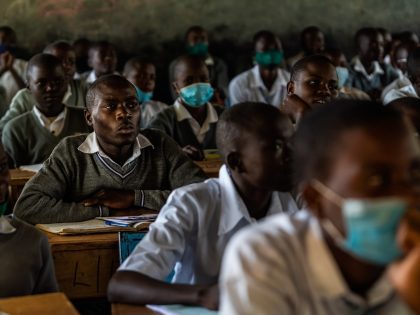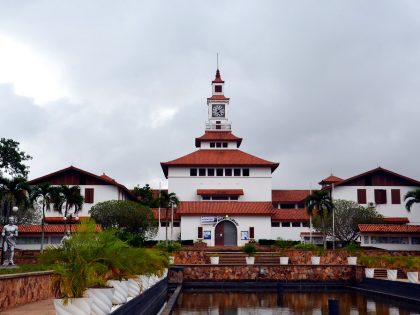
A case currently before the Supreme Court of Ghana is seeking to establish that Wesley Girls’ High School, Cape Coast, is violating the constitutional and international human rights of its Muslim students. The plaintiff is also asking that the court direct the Ghana Education Service (GES) to “enact constitutionally compliant guidelines for the regulation of religious practice and observance for all public schools in Ghana.”
The case is the latest in a series of public disputes and legal challenges with respect to religious freedoms that have played out in the arena of secondary schools (also known as senior high schools). Operating under strict Methodist rules, Wesley Girls’ is one of the many schools in Ghana that traces its founding to Christian missions that accompanied European conquest and colonization.
The suit is framed primarily as a battle between religious freedoms and constitutional rights. But the legal dispute begs a deeper question about the history of Western education in Ghana: What is (or ought to be) the relationship between the state, religious missions, and the secondary schools founded by such missions?
This is one of the questions at the heart of my ongoing research project on The Architecture of Education in Ghana. It is a question that has not been satisfactorily answered by either the colonial or post-colonial state—not in the 15th century when the first Western-style school was established in Elmina by Portuguese slave traders, nor in the 19th century under British colonial rule when some of the oldest secondary schools (including Wesley Girls’) were founded by Christian missions led by Africans, Europeans, and people of mixed African and European heritage.
Neither was the question adequately answered in the mid-20th century, when the country’s first African leader, Dr Kwame Nkrumah, presided over the unprecedented expansion of secondary schooling. And since independence, due in part to limited capacity, a lack of political will, and mismanagement, successive Ghanaian governments have also failed to address the issue satisfactorily.
In the heated public debates that followed after the recent enforcement of Methodist rules by school authorities, refrains such as “why don’t they just go to their own schools” and “the government should return the mission schools” are frequently repeated. The underlying reasoning here is that Christian churches own their secondary schools and have the right to administer them as they see fit.
The opposing camp, referencing the 1961 Education Act, points out that Wesley Girls’ is a government-assisted school—meaning that the school receives assistance through staff, salaries, subventions, building facilities, textbooks, and other grants-in-aid from the state. Their underlying argument is that the mission-founded secondary schools are now public institutions run with public funds drawn from religiously undifferentiated taxpayers.
In practice, governments frequently delay or deny payments and assistance to secondary schools. This has resulted in a longstanding practice of school administrators relying on other sources of funding for construction projects and day-to-day operations. Over the decades, these sources have often been religious missions, but they have also included parent-teacher associations, alumni groups, and public-spirited individuals.
Furthermore, many mission-founded secondary schools have only managed to survive past the 19th century due to the contributions of congregants and missionaries, some of whom died in the course of their work and are fondly remembered to this day. This has contributed to the ongoing murkiness in the relationship between the state, churches, and mission schools.
Those arguing from a religious rights perspective insist that the essential facts lie further back in history. The Ghana Catholic Bishops’ Conference and the Christian Council of Ghana have stated that Christian mission schools have “the constitutional right to operate schools that express [their] faith [and] maintain… the religious character [because the schools predate] the modern state of Ghana.” The Attorney General’s response to the case contends that Wesley Girls’ is “owned by the Methodist Church and not the state.”
This contention oversimplifies the histories of higher education in the country. Dominant narratives cast European missionaries as founders and headteachers who pioneered against all odds. However, these narratives minimize the visionary zeal and hard work of numerous Christian and non-Christian Africans who often did the heavy lifting of getting secondary schools going. Some of their stories may be lost to time, but others persist through brief mentions in literature, archived fragments, orally transmitted accounts, and in architectural ruins and remnants.
The usual prejudices, including race, class, religion and gender, influenced which secondary schools the British colonial government funded, and to what extent. Colonial officials rarely approved funding for African-led “Native Authority” schools, especially when they were non-Christian. To counteract this injustice, African groups contributed resources, built and ran their own schools, and in some cases invited Europeans to run the schools they built.
The history of Mawuli Secondary School illustrates the latter example. The noted Ghanaian theologian and statesman, Gonçalves Christian Kwami Baëta, met Walter Trost while touring the US, and invited the American preacher and educator to head the secondary school to help it receive government aid. Mawuli would later be included in the list of schools that received bespoke school buildings funded by the colonial government.
In addition to the legacies of Africans who were instrumental in founding schools, there are accounts of land given freely or sold at below-market rates to missions and the colonial government because people saw the benefit in getting schools for their communities. Jacob Wilson Sey, the wealthiest African in the Gold Coast at one time, donated extensively and willed land and buildings to the Aborigines Rights Protection Society so that Mfantsipim School could continue to exist. The architects of Amedzoƒe Training College, who also designed Aburi Girls Secondary School, Wesley Girls’, and Opoku Ware Secondary School, reported that local communities cleared sites for construction and built roads to the new schools.
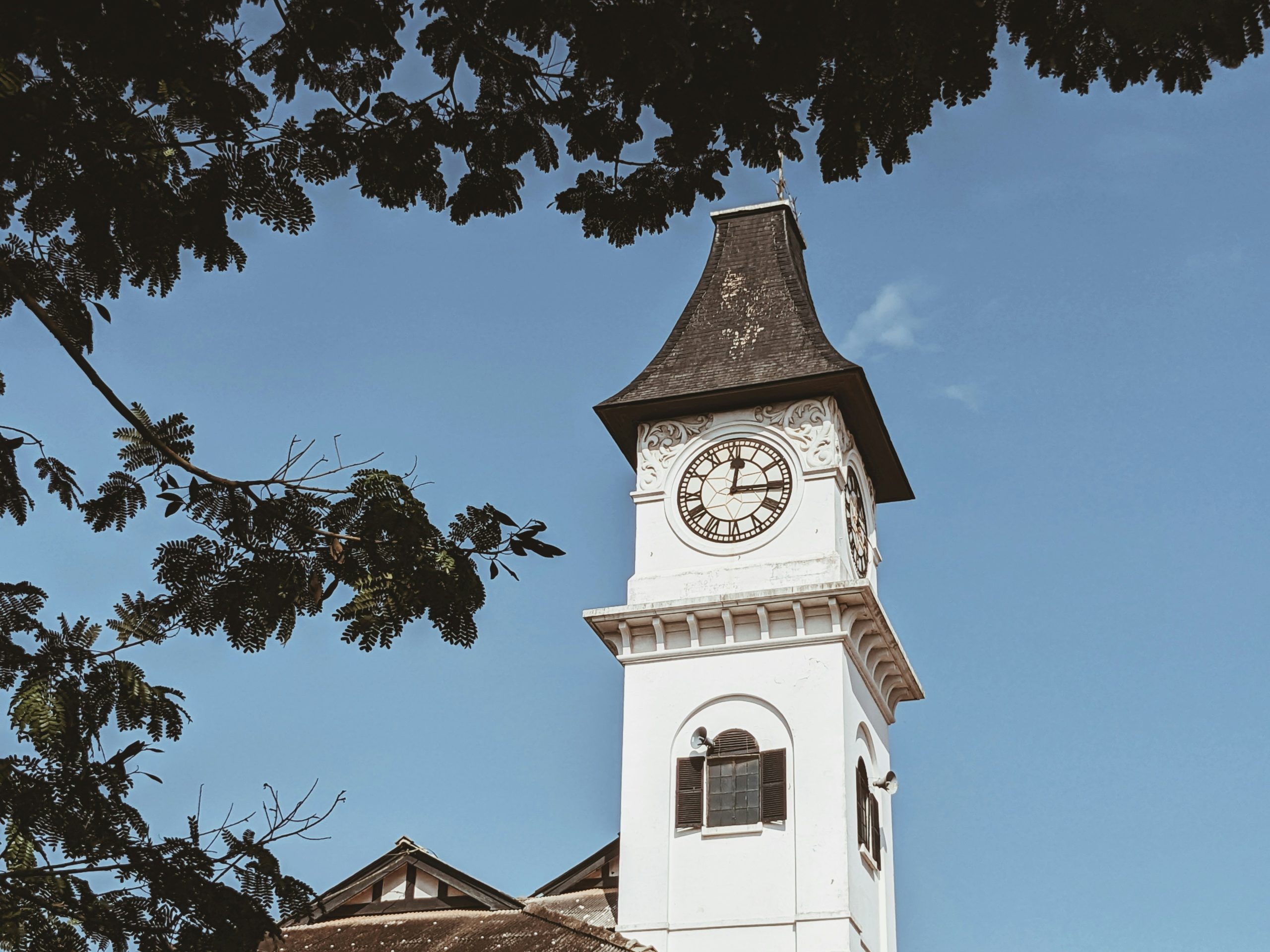
In an unprecedented move in the 1940s, the British colonial government provided large capital grants for the construction and extension of more than 16 secondary and post-secondary schools. Designed in architectural style now known as tropical modernism, the architecture of these “leading secondary schools,” as they were known, became the template for school architecture within and beyond the country. Significantly, the money for the grant was drawn from export wealth, taxes, and duties contributed to by all in the Gold Coast, regardless of religious persuasion, class status, gender identification, or ethnicity.
From the late 1950s to the 1960s, the first African government undertook an even more massive and rapid education expansion project. At least 40 secondary schools were constructed or expanded through the Ghana Education Trust and grants-in-aid from the Ministry of Education—also funded with taxes, duties, and wealth derived from the nation’s resources. Without those grants, Ghanaian secondary education may never have expanded in the way it did.
This case marks an important moment in Ghana’s history. It is an opportunity to decisively define the relationship between secondary schools, religious missions, and the state in a manner that considers the multifaceted histories of education in Ghana, the contributions of a wide cast of characters, the immensely important place of secondary schools in Ghanaian sociopolitics, as well as the realities of being and belonging in the nation today.