The demographic dividend no one wants to pay
Although increasingly celebrated as an asset, Africa’s youth remain locked out of power and decent work.

Photo by Joshua Duneebon on Unsplash
Africa’s youth have been called the continent’s greatest asset so many times that the phrase has lost its weight. Assets are meant to be invested in. The real question is who benefits from keeping this one deferred.
Africa is young; its youth population is projected to rise by 132 million this decade alone. But demographic scale is not destiny. A continent’s youth profile is not a strategy, and invoking it as one has become a way of avoiding the harder question: Why have the political, institutional, and economic investments needed to convert that demographic into shared prosperity been so consistently withheld?
The answer is not technical. It is political. African economies, as currently organized, are not generating enough productive, dignified work for their young people, and this is a crisis of accumulation. Those who bear the cost of that crisis most acutely have been systematically excluded from the political spaces where it can be prioritized and addressed. These two failures are not parallel—they compound each other.
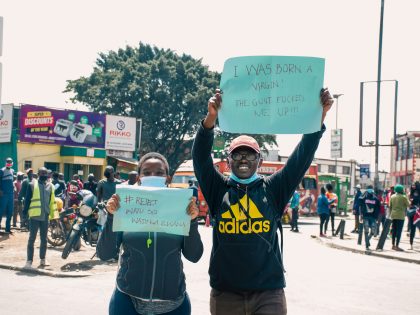
“Gen Z” has had enough. Kenyan youth stormed parliament over a finance bill imposing new taxes on essential goods, arriving barely a year after a housing levy had already strained households. The anger ran deeper than the defeated bill: Despite Ruto winning office on a “hustler-friendly” platform, many young people grew disillusioned with a government that campaigned on economic relief but reverted to repression when confronted with dissent. Similar patterns emerge in Madagascar, where youth protests in 2025 over chronic power failures escalated into demands for political change and an end to corruption, set against a stark backdrop in which roughly 75 percent of the population lives below the poverty line—exposing an economy repeatedly unable to absorb its educated youth into meaningful employment. The same appears in Morocco, where youth demands for health care and education reform unfold against a backdrop of stark governmental misallocation of priorities. Amidst soaring youth unemployment and exclusion, large-scale infrastructure investments at the expense of dilapidated social services raise the question: “The stadiums are ready, but where are the hospitals?” These movements are not isolated disruptions but part of a continental script of exclusion and frustration rooted in the persistent infantilization of youth as political actors. Political power and decision-making remain concentrated among older generations—a persistent feature of postcolonial governance. This has contributed to political apathy, entrenching a culture that sidelines young voices. This exclusion is structural as well; despite pledges to eliminate youth marginalization, credible institutional follow-through remains lacking. Thus, while continental frameworks hold genuine promise as a blueprint for progress, ratification and implementation have stalled, reflecting not a technical failure but a political one.
Moreover, Africa loses an estimated $90 billion annually to illicit financial flows—resources that could fund the schools, infrastructure, and institutions young people demand. Beyond fiscal loss, corruption entrenches impunity, fuels nepotism, and erodes trust between youth and their governments. Economies and institutions cannot function while marginalizing their largest demographic. Ignoring these patterns undermines frameworks like the African Continental Free Trade Area (AfCFTA), which depend on functional, credible institutions. Where these are hollowed out, the gains of liberalization fail to materialize.
Africa’s informal economy is vast and sustains nearly 70 percent of households, serving as the primary livelihood for the vast majority of young workers on the continent. On the one hand, it’s easy to read this as straightforward precarity, and in some ways it is—enterprises in this sector are typically unregistered, receiving minimal government support, and are sometimes even deemed illegal, particularly when cross-border trade is involved. Moreover, the informal economy is marked by high economic risk, instability, and a lack of legal or social protections. A staggering 90 percent of employed young Africans work in informal jobs, and 34 percent live in extreme poverty despite being employed. Working, in other words, does not guarantee a pathway out of poverty.
Still, informality is a structural feature of how African economies are currently organized. In this system, young people show real agency, maximizing limited opportunities such as freelancing, digital gigs, research, customer service, and content creation. The problem is not youth ingenuity; it is the government’s mistaken belief that this is a reason to disengage. Rather than confronting these structural gaps, the default policy response has been to hand the problem back to young people themselves. The assumption is that, with sufficient training, mentorship, and access to microfinance, youth will create their own opportunities. What this assumption quietly ignores is the chronic lack of institutional support for SMEs, the hostile credit environment, and the simple arithmetic that self-employment cannot substitute for an economy that is not producing enough “good” jobs.
Even so, promoting the expansion of formal employment as the sole gateway to a decent work economy has allowed a quieter, equally damaging crisis to go underaddressed. Africa’s youth employment problem is one of both unemployment and underemployment. Unemployment gets the headlines, but underemployment—millions of young people working without security, without adequate hours, without a living income—is just as corrosive, and receives a fraction of the policy attention.
More broadly, economies hollowed out by corruption and precarious work don’t become more equitable when borders open—they become more exposed. The AfCFTA Protocol on Women and Youth in Trade, adopted in 2024, holds genuine promise—a continental framework with the potential to open markets, generate employment, and bring youth and women from the margins of trade into its center. Theoretically, open markets and deeper integration into global trade should generate economic activity that pulls millions of young Africans into productive employment. However, Africa’s exports remain overwhelmingly concentrated in raw commodities; the gains from trade openness do not reach workers or the broader economy. Without value addition, competitive industries and market depth, liberalization can hinder youth employment rather than augment it.
Reform must start at both political and economic levels—they’re inseparable. Addressing youth exclusion means youth must have genuine representation in AfCFTA implementation and continental bodies, not tokenism. One possible step is to establish continental quotas for youth inclusion and to implement data-collection mechanisms to track policy priorities, ensuring measurable progress on the Women and Youth Protocol.
Even so, political inclusion without economic reform means little. While the continent has made significant progress in accelerating financial inclusion through homegrown innovations like mobile money, ongoing gender and income disparities reveal the need to restructure systems to include SMEs, informal workers, and youth without access to credit. Africa needs a long-term industrial strategy oriented toward formal job creation—one that invests in education pipelines connected to labor markets and identifies youth opportunities across value chains. The continent has too often exported its youth to precarious jobs rather than invested at home, and this cannot continue. If youth are truly Africa’s greatest asset, investment must match the rhetoric.
The protests that have swept the continent are not a phase but a verdict on governments that have invoked youth potential without delivering on it. Comrades lost their lives in these movements, and this cannot be treated as the acceptable cost of “business as usual.”
At the same time, Africa’s youth are not standing by waiting to be invested in. Whether it’s in informal markets, digital spaces, or the streets, they are a constituency, legitimate, active, and precise in their demands. The question is no longer whether Africa’s youth are ready. It is whether its governments are. The task is clear: Restructure the economic models that have kept young people precarious, and redistribute the political power that has kept them voiceless. These two priorities are inseparable and require a deliberate choice by states and institutions that have deferred.
The demographic dividend has been promised long enough. It is time to pay up.