Who gets to be a civilian?
Often in war, language is twisted and used to change meaning, to dehumanize, to invent enemies, and to justify atrocities.
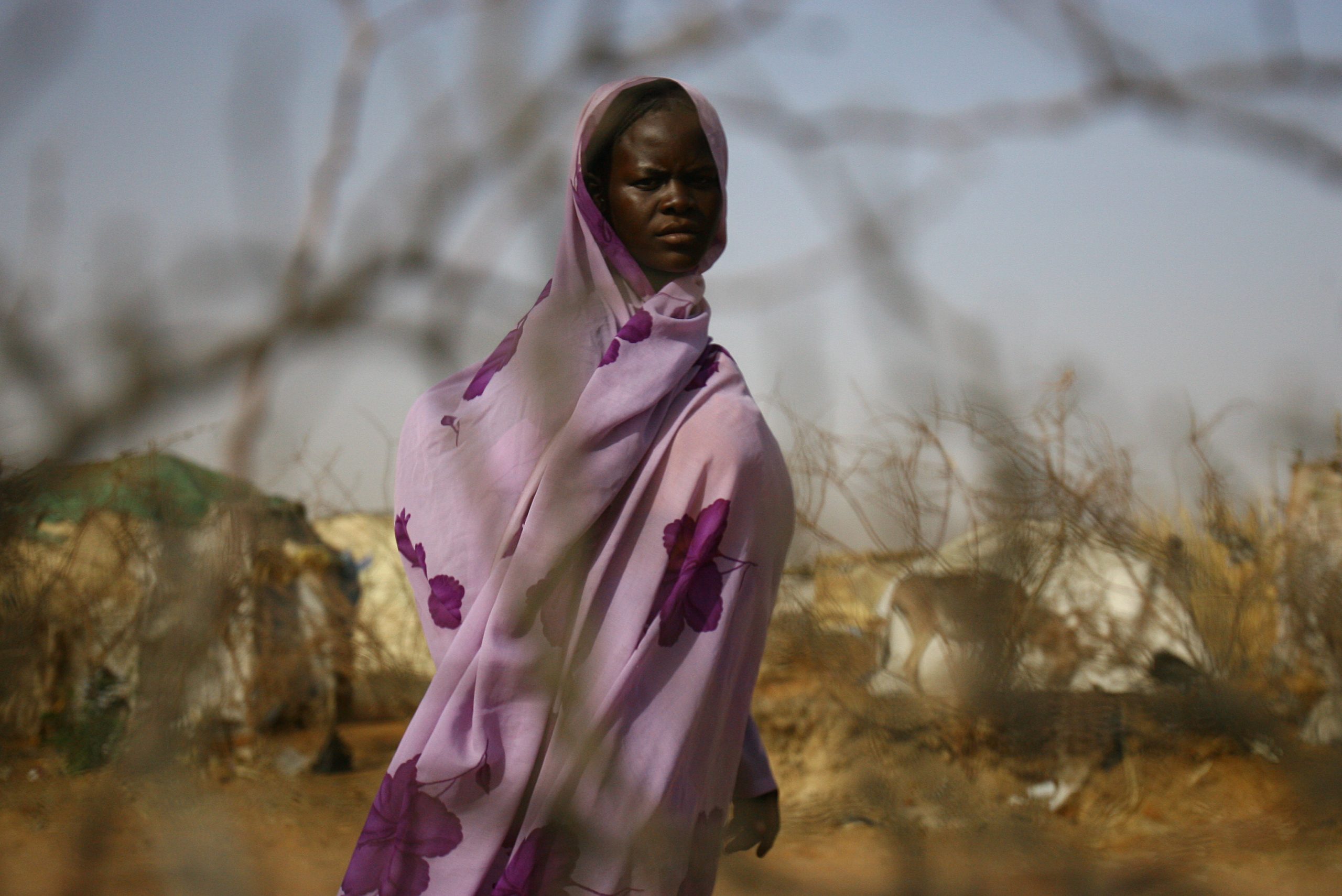
Darfur, 2007. Image © Kursat Bayhan via Shutterstock.com
In one of Sudan’s largest agricultural regions, where vast fields sustain millions of livelihoods, a woman we will call Samira took on a role she had never planned for. As state institutions receded and everyday systems began to falter, the work of keeping life going did not disappear—it shifted. Samira became part of a small group coordinating agricultural activity: helping ensure crops were harvested, facilitating access to basic supplies, and trying, in quiet ways, to prevent food shortages in an increasingly uncertain environment.
Her work was not political in intent. It was practical, immediate, and rooted in necessity. In a context where formal governance structures had fractured, such roles often emerged organically—filled by civilians responding to the urgency of survival.
Months later, as control over the area changed, so too did the language used to describe what had taken place. In public conversations and circulating narratives, Samira’s role was no longer framed as part of a civilian effort to sustain livelihoods. Instead, it began to be described in terms that suggested political alignment—language that implied affiliation, authority, and intent far beyond the reality of her actions. That shift, subtle in wording but profound in consequence, marked the beginning of a different trajectory.
What had once been understood as a form of community coordination was recast as something else entirely. The same actions—organizing, facilitating, maintaining continuity—were no longer read as survival. They were interpreted as something closer to complicity. Words, in this sense, redraw the boundaries of innocence.
This raises a deeper question: Who gets to be recognized as a civilian in war? This phenomenon is not unique to Sudan. Across conflicts—from Syria to Ukraine—terms such as “sympathizer,” “affiliate,” or “informant” often enter public discourse long before any formal investigation or judicial process takes place. Once repeated and circulated, such labels begin to take on a life of their own. They become embedded in the moral architecture of the conflict. Through them, distinctions are drawn not only between sides but between those deemed worthy of protection and those considered suspect. In this process, civilians who operate in gray zones of survival can find themselves recast as participants in the very conflicts they were navigating.
For individuals like Samira, the consequences are not abstract. A shift in language can alter how neighbors perceive them, how authorities classify them, and whether they are able to remain within their communities or are forced into displacement, detention, or worse. The distance between a description and an accusation can be remarkably small. For journalists, policymakers, and humanitarian actors, this raises an uncomfortable but necessary question: How can language be used responsibly in the midst of war?
Reporting on conflict requires describing complex and often ambiguous relationships between civilians and armed actors. Yet the act of description itself carries weight. Without careful context, a word intended to explain a situation may instead assign intent, responsibility, or guilt. Responsible reporting, therefore, is not only about accuracy in facts, but also about awareness of how language travels. A phrase used in a headline, a report, or a public statement does not remain confined to its original moment. It moves across platforms, into conversations, and, eventually, into the frameworks through which accountability is later understood.
In societies emerging from conflict, these early narratives often resurface. They shape debates about justice, influence legal interpretations, and inform collective memory. In this way, the language of war rarely disappears when the violence subsides. It lingers in archives, in media, and in the ways communities come to understand what happened and who was responsible.
Recognizing the power of language does not mean avoiding difficult truths—armed groups commit abuses, and accountability remains essential. But it does require acknowledging that the words used to describe conflict should illuminate reality rather than prematurely fix it into simplified categories. In contexts such as Sudan, where the line between survival and complicity is often blurred by necessity, that distinction matters. Because in the end, the question is not only what happened during the war—but how it is named, and who that naming leaves protected.