Whose progress?
A new documentary reveals how Ethiopia’s manufacturing push redistributes land, labor, and opportunity—delivering gains for some while displacing others.
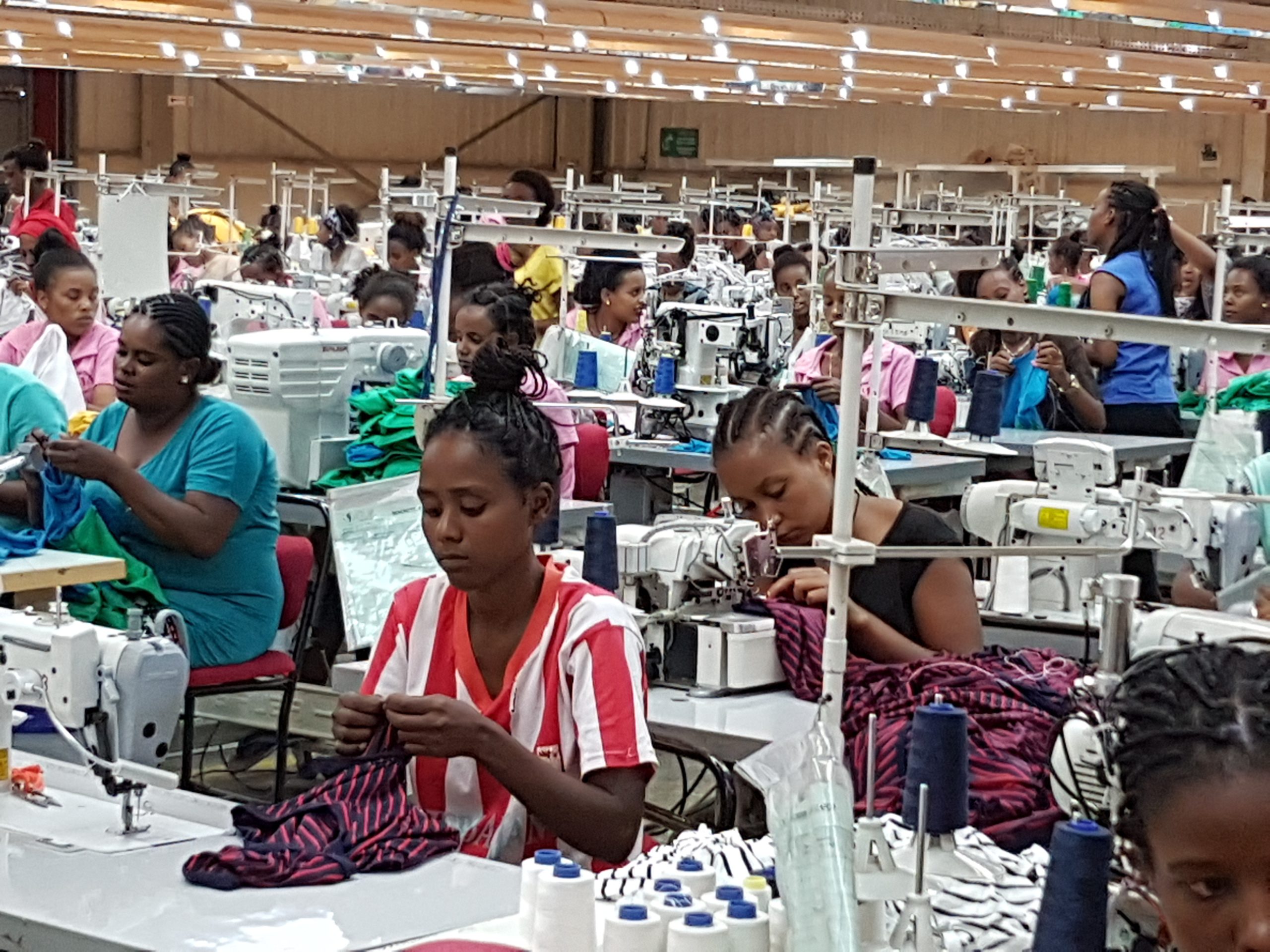
The women workers of a textile factory in Addis Ababa, June 2018. Image credit Pinar Alver via Shutterstock.
The global garment industry often shifts labor-intensive production to countries where wages are low. That model has driven the rise of special economic zones across the Global South, including Ethiopia, where industrial parks are central to the country’s growth strategy. Framed as engines of growth, they promise jobs, exports, and industrial transformation.
A decade ago, I stood among a crowd of excited residents at the opening of Hawassa Industrial Park, now renamed Hawassa Special Economic Zone (HSEZ). Built by China at a cost of more than $250 million, it was billed as Africa’s largest. At the ceremony, then Prime Minister Hailemariam Desalegn spoke confidently about turning Ethiopia into an industrial hub. The mood was hopeful.
Like many young people, I imagined a steady job, high salary, and new skills. Currently, the picture is far more complex. Industrial parks have become spaces where the interests of investors, workers, local communities, and the state often collide. These tensions are not limited to HSEZ, and I recently saw them brought vividly to life in the documentary film Made in Ethiopia, which focuses on the Eastern Industrial Zone (EIZ).
Directed by Xinyan Yu and Max Duncan, the 2024 award-winning film explores the tension between rapid industrial growth, local traditions, and personal lives. The EIZ, launched in 2009 about 35 kilometers south of Addis Ababa, has created more than 20,000 jobs. For some, this means new income and opportunity. For others, it has meant land loss and deep disruption to their way of life. What is at stake in Made in Ethiopia is not simply whether industrial parks create jobs, but how the gains and losses of development are distributed. Who benefits from this model, and who pays its costs? The film does not offer simple answers, but it makes one thing clear: the outcomes are deeply unequal.
The film opens with powerful scenes that blend the old and the new. Fireworks light up the sky during a wedding celebration, while traditional songs in the local language fill the air. An Ethiopian woman marries her Chinese partner.
After the celebration, they travel into the EIZ, and the symbolism is clear: two cultures encountering each other in a space shaped by global capital.
At the center of Made in Ethiopia are three women whose lives unfold side by side. There is “Motto,” a Chinese factory manager trying to keep production running in a difficult environment; “Beti,” a young Ethiopian worker who spends her days sewing jeans labeled “Made in Ethiopia”; and “Workinesh,” a farmer and mother whose land and livelihood are threatened by the expansion of the industrial zone.
Through their lives, the film reveals the uneven ground on which Ethiopia’s industrialization stands. For Beti, factory work offers income but limited security or mobility. For Motto, global production demands constant efficiency and expansion, often at the expense of workers’ conditions. For Workinesh, development arrives as displacement. These are not separate stories, but predictable outcomes of a development model built on cheap labor and contested land. One striking moment captures this clearly: Chinese business leaders describe the project as a “win-win,” while farmers protest being pushed off their land.
These tensions are deeply political, and in Ethiopia, land is not just a natural resource—it is profoundly tied to social values, cultural practices, and political power. The land question has long been at the center of political struggle; from the 1975 revolution’s slogan “land to the tiller,” to recent debates over so-called land grabbing.
Certainly, while the language of shared benefit sounds persuasive, the reality is far more uneven. Land, in this context, is more than an economic asset. It is livelihood, identity, spirituality, and security, and its loss cannot be easily compensated by low-wage factory work.
Made in Ethiopia arrives at a moment when the country’s industrial strategy is under strain. The wars in Tigray and Amhara, occurrences of ethnic violence, and ongoing foreign exchange shortages have disrupted supply chains and shaken investor confidence. Global shocks, such as Ethiopia’s suspension from the African Growth and Opportunity Act (AGOA) and the COVID-19 pandemic, have also hit the manufacturing sector hard, especially the garment industry. Yet the government continues to present industrial parks as the path forward. Without taking an explicit position, the film invites viewers to ask whether this model can deliver on its promises when the social, economic, and environmental costs are so unequally distributed.
Indeed, what moved me most about this documentary is its focus on women’s voices. Debates about industrial parks tend to focus on investment figures, export numbers, and knowledge transfer. The people who actually run the machines are rarely placed at the center of the story. In this regard, Made in Ethiopia does something important: It gives voice to three women who are living through a turning point in Ethiopia’s development. That, undoubtedly, is the documentary film’s greatest strength. What’s more, it does not speak in abstract terms about “industrialization” or “progress.” Instead, it shows how these big ideas play out in the lives of real people: a manager under pressure to meet targets, a young woman trying to build a future through factory work, and a farmer struggling to protect her land and family.
But the documentary is not without its limitations. While it offers compelling personal stories, it largely omits the perspectives of scholars and policy advisors. As a result, viewers are left without a deeper analytical context since, in my view, including expert voices might have strengthened the film by situating the women’s experiences within broader global patterns.
Even so, Made in Ethiopia is a timely film. It points to a set of unresolved futures at the heart of Ethiopia’s industrial drive. These prompt the following unanswered questions: Can factory jobs become stable and offer dignified livelihoods? Can displaced farmers be fairly compensated? Can rapid industrial growth coexist with social justice?
In my opinion, these are questions not just for policymakers but for anyone invested in Ethiopia’s future. Industrialization is not simply about building factories or attracting investment. It is about how the benefits and burdens of development are distributed. The issue is not whether Ethiopia should industrialize, but how it can do so in a way that protects workers, respects communities, and delivers more equitable outcomes. Made in Ethiopia does not answer that question, but it forces us to ask it more honestly.


