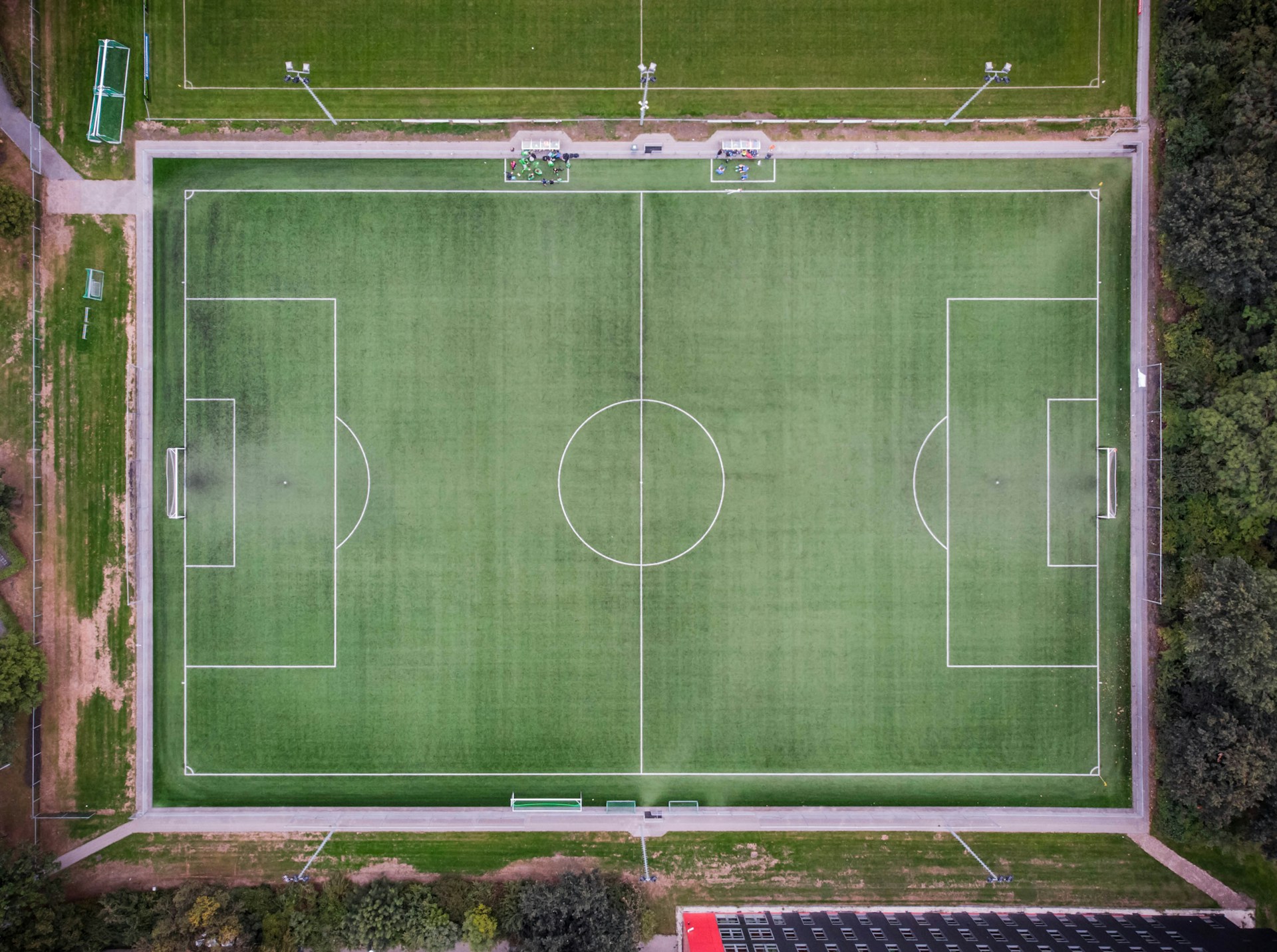
There is something stubbornly anachronistic about the pitch. A rectangle of grass, marked out with chalk or paint, governed by rules that are simple enough to learn when you’re young and serious enough to demand a lifetime’s attention. As the old saying goes, “of all unimportant things, football is the most important.” Time on the pitch is not optimized or personalized, but is shared. Ninety minutes pass whether you are ready or not, and nothing can be paused, rewound, or skipped. Bodies gather, not to curate an experience, but to submit to one whose outcome cannot be known in advance. For all its compromises, football remains one of the few mass rituals left in public life that still insists on collective presence—on being there, together, in the same place, at the same time.
That insistence matters more now than it once did. Over the past while, it has become harder to ignore how much of collective life has slipped out of reach, and not through dramatic prohibitions but through quieter forms of exclusion. Culture and politics increasingly arrive as images rather than encounters. The dominant experiences of our time are frictionless, mediated, endlessly reproducible—and therefore strangely weightless. We watch more than we attend, and we react more than we participate. We are present everywhere, and almost nowhere.
This was a year in which that shift could be felt in the body. Not just in the familiar exhaustion of feeds and cycles of outrage, but in the growing sense that being there—at a match, a concert, a festival, a square—was becoming conditional. Conditional on money, on access, on belonging. The crowd, once assumed to be a public, increasingly resembles a filter. What used to feel shared now feels tiered, and what used to feel ordinary begins to feel like a privilege.
Football sits uneasily inside this transformation. It is not innocent of it, and has been shaped by money, spectacle, and power for a long time. And yet, the pitch continues to hold open a different relation to time and attention, one that resists full abstraction. You do not watch a match in fragments without losing something essential. You cannot fully outsource the feeling of being in the crowd. The game still asks something of you: patience, attunement, the willingness to be carried along by a rhythm not of your own making.
It is for this reason that football remains such a charged site, politically and culturally, even when politics seems to have retreated everywhere else. More than just a metaphor, the pitch is itself a social form. And as the spaces where people once gathered freely become harder to access, more surveilled, more priced, and more mediated, the question is no longer simply what football represents—but what it still makes possible.
Of course, people have always been priced out of certain experiences. Luxury boxes, private clubs, front rows and members’ enclosures have long existed alongside more accessible forms of public life. Exclusion, in this sense, is not new. What has changed is not the fact of exclusion, but its object—and the ease with which it is now normalized.
For much of the twentieth century, scarcity attached itself to things: land, housing, art, durable goods that could be owned, accumulated, and passed on. Even where access was unequal, these objects existed alongside shared spaces and mass rituals that assumed a public presence. Increasingly, scarcity has migrated away from possessions and toward moments. The most aggressively priced goods today are not assets that endure, but irreproducible experiences: finals, premieres, ceremonies, once-only events whose value lies precisely in the fact that they cannot be replayed or shared without loss.
A recent article in the Economist captures this shift with unusual candor. Surveying the declining appeal of traditional luxury assets like fine wine, art, and mansions, it notes that the ultra-rich are redirecting their money toward what it calls “ultra-luxury services”: Super Bowl tickets, Wimbledon debentures, Met Gala invitations, World Cup finals. These are not valuable because they can be resold or inherited, but because they are rivalrous. A seat on Center Court, the piece observes, cannot be duplicated; its worth lies in the knowledge that, for those hours, no one else can occupy it. Luxury, in this account, is no longer primarily about ownership, but about access.
Read politically, this is not simply a story about changing tastes. It describes a quiet reorganization of collective life around the enclosure of embodied presence. When scarcity attaches to moments rather than things, being there becomes the scarce good. Events that once presumed a public are reconceived as positional goods, and exclusion takes on a softer, more defensible form. No one is formally barred. Everyone can still watch. But the distinction between attending and viewing hardens into a hierarchy of experience.
What is new, then, is not that some people are excluded, but that presence itself is increasingly treated as exceptional, as something to be competed and bid over (see, for a recent example, the fallout from Lionel Messi’s much-publicized “GOAT tour” of India, or FIFA’s handling of ticket pricing for the 2026 World Cup). The rest are offered a technologically sophisticated substitute: access without proximity, connection without participation. The loss is not dramatic enough to register as outright injustice, but is cumulative enough to reshape how collective life is lived.
Alongside this reorganization of access, another development has been quietly taking shape. Not yet dominant, not yet universal, but increasingly visible: the rise of live streamers on platforms like YouTube, Twitch, and Kick, who do not offer a finished product so much as a continuous form of mediated presence. Figures like iShowSpeed or Kai Cenat do not ask you to watch something; they invite you to be with them. Their appeal lies less in entertainment content than in co-presence—the sense of inhabiting the same time, reacting together, sharing an unfolding interval of life. It’s a way of inhabiting time with others when shared physical presence is unavailable, deferred, or increasingly costly.
What matters here is not that people have abandoned embodied life. They plainly have not. Streets, stadiums, workplaces, and homes remain full of bodies. The shift is more subtle. Streaming introduces a different expectation of togetherness, one that does not replace physical co-presence but begins to shadow it, offering a parallel way of being with others that asks less of us and demands less in return.
This is new not because mediation itself is new, but because the form it takes gestures toward a future in which presence no longer needs to be collective to feel social. The promise is not immersion in a spectacle, but continuity of company. You may not be there, but you are not alone. Time is shared, reactions are synchronized, life unfolds in common, but at a distance. What is being rehearsed is not withdrawal from the world, but a loosening of the assumption that public life requires bodies to gather in the same place.
The significance of this lies not in what streaming has already done, but in what it prepares us to accept. It lowers the threshold of what counts as participation. It trains us, gently, to believe that being connected is close enough to being together. And once that belief settles, the enclosure of embodied public life no longer needs to be imposed. It will be met halfway, with public life increasingly reorganized into parallel, insulated streams rather than shared spaces.
Still, one of the peculiar features of the present moment is that politics feels both omnipresent and strangely unavailable. The language of politics saturates everyday life—identities, consumption, culture, morality—and yet the spaces in which people once encountered one another as a public continue to erode. Polarization intensifies, but shared worlds peter out. Everything is contested; very little is held in common.
This is not a return to apathy. On the contrary, the dominant mood is one of constant activation. Opinions circulate at speed, moral positions harden quickly, and crises succeed one another without pause. And yet, much of this intensity unfolds in environments that are structurally incapable of sustaining durable collective action. Engagement is immediate, expressive, and often sincere, but it rarely cements. What looks like politicization frequently bypasses the institutions, habits, and social forms that once translated feeling into force.
The result is a kind of hyperreal politics: politics experienced primarily as image, affect, and declaration. It is intensely felt, widely shared, and endlessly mediated, but only intermittently anchored in collective organization. Publics appear and disappear rapidly. Mobilizations flare, peak, and dissolve. The infrastructure that once stabilized political life—parties, unions, civic associations, mass rituals—has not been replaced so much as thinned out, leaving behind a field of heightened sensation with few places for it to settle.
This condition invites a certain misrecognition. It is tempting to assume that the problem lies in insufficient conviction, or insufficient radicalism, or insufficient clarity of values. But what is often missing is not passion or commitment, but rehearsal: the slow, embodied learning of how to act with others over time. The ability to endure disagreement, to coordinate movement, to sustain attention, to recognize oneself as part of a collective that is neither purely chosen nor instantly gratifying.
It is in this context that older forms of gathering begin to look newly significant. Not as solutions in themselves, and not as romantic holdovers, but as sites where political capacities are formed before they are named as political. Rituals of gathering; whether religious, cultural, or sporting, have historically functioned as a kind of pre-political infrastructure. They taught people how to inhabit shared time, how to submit to collective rhythms, how to be affected by strangers without immediately sorting them into allies and enemies.
Recently, I have been thinking about Maher Mezahi’s essay on the politics of Algerian football fandom from our recent special issue on Africa in the mass protest decade. Maher’s account lingers on what happens in and around the stadium: the chants, the gestures, the sustained presence of bodies over time. These were not spaces of explicit political education, and often, they were stifled by surveillance or repression. But, they were also places where people learned how to gather without guarantees—how to remain with one another, how to synchronize movement and voice, how to recognize collective force before it had a name.
What stands out is the ordinariness of this learning. Nothing here depends on clarity of program or ideological alignment. What mattered was repetition, rhythm, and the slow accumulation of habit. Long before protest reappeared on the streets, these capacities were being rehearsed elsewhere, embedded in routines that did not announce themselves as political at all.
Maher is careful not to overstate the case. Football crowds did not cause the Hirak, and the terrace was not a substitute for organization. But, neither was it incidental. It was one of the few places where collective life could still be practiced under conditions that made other forms of gathering difficult to sustain. When politics eventually returned in visible form, it carried with it dispositions shaped in those spaces, including the ability to occupy space, to endure over time, to act together without needing immediate resolution.
What makes the essay stand out is its refusal of romance. The stadium appears not as a site of redemption, but as a fragile and contingent infrastructure that could be repurposed or repressed. And yet, for a time it held open a capacity that had few other places to go. It carried a potential that did not announce itself in advance, but accumulated sideways. That sideways accumulation matters now. Not because it offers a blueprint, but because it reminds us that political possibility often depends on forms of gathering that appear incidental until they are gone. The erosion of such spaces rarely registers as a crisis at the moment. Its consequences are felt later, when the habits they once sustained are no longer available to draw on.
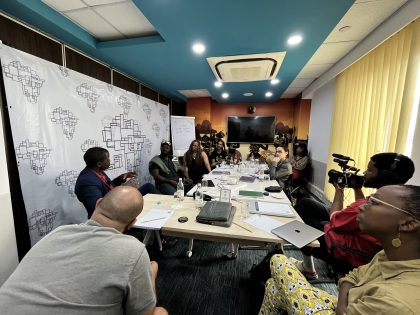
In recent years, much of our work at Africa Is a Country has been animated by a worry about this transformation in human sociality. Even if they are not explicitly named, questions of presence, attention, and shared experience sit just beneath much of what we publish throughout the year. This concern also helps explain a number of editorial decisions we have made along the way, such as expanding into print and investing more deliberately in convenings, screenings, festivals, and other forms of gathering. It has also meant slowing down our publishing rhythm at certain moments, not to disengage, but to concentrate attention rather than scatter it. Across different formats, the impulse has been the same: to treat the public sphere, on the continent and beyond it, not as something to be merely analyzed, but as something that has to be actively sustained.
Over the years our biannual “On Safari” post has has evolved to become an essential tool for this practice, becoming a space for reflecting not only on the previous months’ events, but on the conditions under which we encounter them. The pauses that follow have never meant an exit from the world, rather, they are part of a recurring rhythm that offer a chance to slow the pace, take stock, and redirect attention.
For the past few years, this redirection has become reflexively in sync with another recurring event: the Africa Cup of Nations (AFCON) football tournament. We shift our focus deliberately and for the duration of AFCON because football, especially at this scale, remains one of the few events capable of briefly reassembling publics that otherwise appear fragmented and dispersed. For a few weeks, attention is shared rather than scattered; rivalries unfold within a shared frame; time is held in common rather than endlessly individualized. As Maher has argued in his brilliant writing, the tournament’s distinctiveness lies not only in the football itself, but in the social worlds it brings into view: its relative parity, its accessibility, the intimacy between fans, players, and officials, and the way it generates collective memory across borders and generations.
Maher, who is both a contributing editor at AIAC and the host of the African Five-a-Side podcast (the best football podcast around), will be leading our coverage of AFCON. His work has consistently treated African football not as an aside to politics, but as one of the places where political history, popular feeling, and everyday life intersect most densely. Under his guidance, our coverage will attend not only to matches and moments, but to the broader textures of the tournament: how it is lived, argued over, celebrated, and contested.
To be sure, AFCON is not immune to the dynamics that shape contemporary public life. It is also entangled with money, power, and state ambition, and it is increasingly mobilized as a vehicle for spectacle-led development. This year’s tournament, hosted in Morocco, brings those tensions into particularly sharp focus. As Omar Kabbadj reported for us a few months ago, preparations for AFCON and the 2030 World Cup precipitated the rise of the GenZ212 protest movement, whose demands for healthcare, education, and dignity stand in direct contrast to the state’s prioritization of stadiums over social infrastructure. The juxtaposition of hospitals and stadiums has become a potent symbol, and a reminder of the material concerns that sporting spectacle cannot substitute for.
Other silences shape the tournament’s political backdrop as well. Just this week, Zahra Rahmouni’s reporting on Western Sahara at the UN underscores how Sahwari self-determination continues to be sidelined, even as Morocco presents itself as a stable regional hub through sport. In this sense, the tournament itself functions as a kind of reputational laundering, redirecting attention toward spectacle and hospitality while narrowing the space in which unresolved questions of occupation can appear. Solidarity is unlikely to surface under these conditions: any gestures in that direction will be carefully policed, and Sahrawis will remain largely absent from regional and global political consciousness, even as that same consciousness mobilizes powerfully around other struggles over occupation and self-determination, most notably Palestine.
And yet, it would be disingenuous not to say something simpler. AFCON is an extraordinary tournament. For all the analysis it invites, it remains unpredictable, uneven, tense, funny, and alive. After the year we have had, with its relentlessness, its moral weight, its exhaustion—there is nothing trivial about wanting to watch, to argue, to be carried along by the spectacle for a while. Wanting to join in does not cancel our responsibility to be critical; it exists alongside it.
That, finally, is part of why AFCON matters. Not because it resolves the contradictions that surround it, but because it still creates space for collective anticipation; for joy that is provisional, contingent, and hard-won. In a moment when so much public life feels scripted in advance, that openness is not nothing. It is, at the very least, worth showing up for.