The Senegalese paradox
How Senegal rose to become one of the most fertile grounds in African football, and why this success still struggles to transform the local football economy.
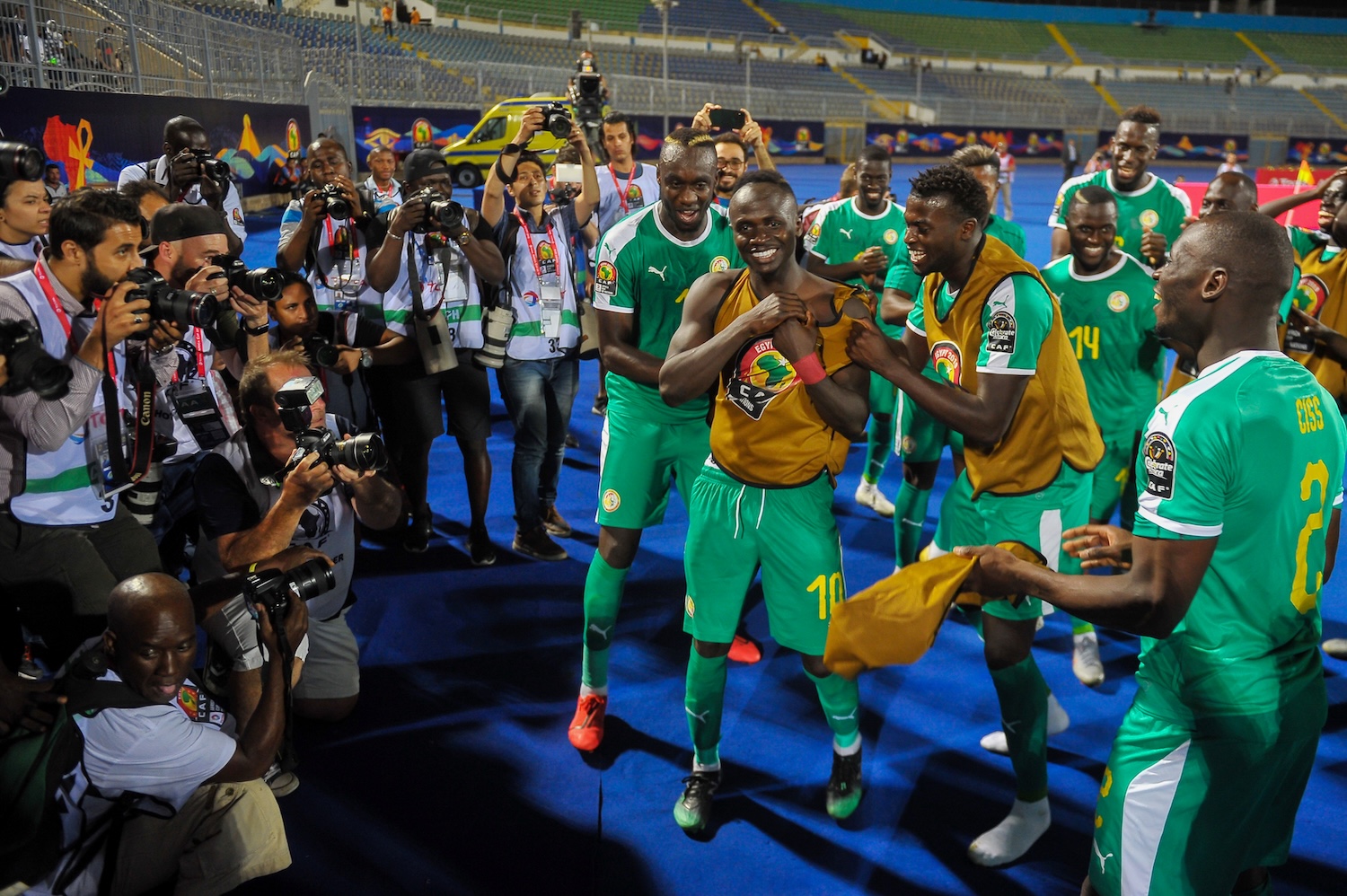
Sadio Mané of Senegal celebrates victory after winning the 2019 Africa Cup of Nations Semi Final match between Senegal and Tunisia at 30th June Stadium. Image credit Mohsen Nabil via Shutterstock © 2019.
Over the past decade, a silent revolution has reshaped the landscape of Senegalese football. Far from European stadiums, far from the spotlight of major international competitions, a new ecosystem has emerged, driven by a generation of coaches, executives, and scouts who have ushered the country into an era of methodical professionalization.
The revolution has helped national teams win titles across almost every age category, secure successive World Cup qualifications, and—most importantly—has set conditions for the emergence of precocious talents exported to Europe or the Middle East on a yearly basis.
All metrics seem to point to the irresistible rise of an African giant, but built into the fabric of this success story is a menacing paradox.
While Senegal has become a global reference point in player development, its football economy remains one of the most vulnerable on the continent. Between sporting euphoria and structural precarity, the country presents the troubling image of a brilliant model that is hauntingly fractured.
Revolution of the academies
In the early 2000s, Senegalese academies were improvised structures, sometimes without standard pitches or a full-time staff. A quarter-century later, and some of them rival the best European academies in methodology and rigor. The transformation has been as gradual as it has been radical.
“Visionaries like Saer Seck understood before most other African countries that the key to success at the national team level lay in academies,” explains Bertrand Dasilva, Managing Director of the Diambars Institute—one of Senegal’s premier academies. Founded with Patrick Vieira and Bernard Lama, the academy imposed a new standard: that of a complete player—athletic, disciplined, and supported academically, nutritionally, and psychologically.
“We don’t just train players; we train professional athletes,” insists Dasilva. That ethos has spread across the national territory and even inspired initiatives beyond Senegal’s borders.
From Dakar to Ziguinchor, structures have multiplied, synthetic pitches have been nailed down, weight rooms assembled, video technology acquired, data specialists hired, and so on. The outdated trope of a hastily appointed run-of-the-mill coach has disappeared.
“The myth that only a foreign coach can deliver modern training is over,” affirms Pape Malickou Diakhaté, former captain of Senegal and now General Manager of US Ouakam. “When it comes to building football academies, local know-how has reached a level that even surprises European recruiters.”
The success of Senegalese academies is in the detail. In the best academies, players quickly pick up the micro-skills of elite football: coordinated pressing, rapid transition play and workload management. Training sessions are filmed, broken down, and analyzed meticulously.
“When I scout in Senegal, I know I’ll see youngsters already familiar with positional play,” observes Sandro Conti, an independent Serie A scout.
As a result, national teams are now fed a pool of young but mature talent.
In recent years, Senegal has won the 2021 Africa Cup of Nations, as well as the U20, U17, and U15 AFCONs, often steamrolling the opposition. More than 80% of selected players come from structured academies.
“They arrive in the national team with tactical customs already internalized,” explains El Hadj Abdoulaye Seck, former coach at Diambars, Génération Foot, and the Mauritanian and Comorian national teams.
“That changes everything: we can immediately work at the elite level, not on basic acquisition.”
This early mastery not only translates to national team succes, but also accelerates integration at club level, in Senegal and in Europe. “The transition to the professional world is much faster than before,” confirms Diakhaté. In just a few years, Senegal has become one of the most sought-after talent reservoirs in the world. The direct consequence of this rise in quality is the explosion of transfers to Europe, Asia, or the Gulf. The Senegalese player is now perceived as a known commodity. A disciplined technician, and a robust athlete with a strong mentality.
“It’s a real brand,” assures FIFA agent Oumar Koliba Soumaré. “The Senegalese footballer is a naturally technical and physical athlete, capable of adapting very quickly to any environment, thanks to our core cultural values. European clubs know that behind every young Senegalese prospect lies methodical work.”
The success of Senegal’s youth players has also shone a spotlight on the ingenuity of a new generation of local coaches. “The players’ natural qualities were not enough; they needed a framework,” emphasizes Nfally Badji, goalkeeper coach at Diambars and former U17 international. “We built that framework with limited coordinated means, but with a modern vision.”
Senegalese coaching expertise is now also being exported. Local coaches are sought after all over the Global South.
Behind this façade of success, however, another picture emerges… that of a structurally fragile local football scene.
Domestic football taken advantage of
National team performances are a seductive showcase, but they mask a contrasting economic reality marked by underfunded clubs, underpaid players, and infrastructure lagging behind the country’s ambitions.
“We win on the pitch, but we lose in the boardrooms,” states Djibril Diallo bluntly.
Diallo is a legal expert and keen observer of Senegalese football. For him, Senegal’s sporting ascent has not been matched by corresponding institutional transformation.
“Administrative structures are still managed as they were in the 1990s. That is to say without financial flow control, modern governance tools, or real professionalization. You cannot build a football industry on an associative and informal model,” he argues.
Diallo’s diagnosis is shared by Bousso Dieng, a management expert working with several institutions including UFOA and the Dakar 2026 Youth Olympic Games, who sees this lack of a clear legal framework as one of the main obstacles to the development of national football.
“The legal vacuum is colossal. A professional footballer’s legal status is not recognized, clubs are not considered sporting enterprises and contract protection is almost nonexistent,” she explains. According to her, this structural flaw opens the door to unresolved disputes, a constant drain of talent and opaque practices that weaken the local economy.
“As long as the law does not protect players, clubs, and investors alike, Senegal will remain a sporting giant built on a fragile administrative foundation. Performance alone cannot compensate for the absence of a sporting rule of law,” she warns.
The Senegalese local football economy is one of survival. In the absence of significant TV rights, powerful sponsors, or an adapted tax framework, clubs survive through transfers.
“When you haven’t paid salaries for three months, you’re forced to sell,” confides a club president under anonymity. Selling becomes an act of survival, not a lever for development. The Senegalese Ligue 1 prize money of 20 million CFA francs ($36,000) for the champion illustrates this fragility.
Despite some visible progress, local players’ salaries remain among the lowest on the continent. Most local players make between 50,000 and 200,000 CFA francs per month ($90 and $360 per month), and that’s not counting recurring delays in salary payouts at certain clubs. This precarity pushes many footballers into exile in less prestigious but better-paying leagues: Libya, Tanzania, Rwanda, Guinea.
“Senegal trains the players, but other African leagues reap the rewards,” laments Abdoulaye Sall, a plugged-in player agent.
Said talent drain has direct consequences for clubs’ international performances. The departure of Senegalese players often occurs mid-season, before even clubs are able to stabilize a squad.
“Every time a team starts to become competitive, it loses half its roster,” explains Saikou Seydi, a local journalist.
Ultimately, it becomes impossible to compete sustainably in the CAF Champions League or the CAF Confederation Cup due to the lack of continuity within squads.
Aware of this structural fragility, the new president of the Pro League, Babacar Ndiaye, has committed to cleaning up a championship he found drained and heavily indebted. “Collectively, we must be between 50 and 60 million CFA francs ($90,000 and $110,000) in debt,” he stated after his election, referring to a deficit inherited from the previous leadership.
“We will hold a meeting to share information, but there are also those who owe money to the Pro League,” he added, alluding to sponsors who have yet to honor their commitments. His objective is clear: “In the short or medium term, the champion must be able to break even the day after being crowned.”
During his campaign, Ndiaye had promised to increase the bonuses awarded to top-ranked clubs. He confirmed that the Ligue 1 champion would now receive 40 million CFA francs ($72,000), while the runner-up would receive 10 million ($18,000). A measure aimed at strengthening the league’s attractiveness and encouraging a higher level of competition.
This revaluation is also intended to compensate for the abolition of “travel grants” by the new Ministry of Sports, a major blow for teams involved in African competitions that previously benefited from this logistical support. “If you add CAF’s $50,000 and the Federation’s subsidy, that should cover the costs of competing in the first round for our representatives in Africa,” Ndiaye assured, calling for stricter management and greater anticipation of costs associated with continental campaigns.
A troublesome legal vacuum
Professional football still has no clear legal existence in Senegal. Clubs are not recognized as sporting enterprises, contracts are insufficiently protected, and disputes are often handled informally. “As long as this vacuum persists, the system will remain vulnerable,” warns legal expert Awa Ndiaye.
Partnerships between Senegalese academies and foreign clubs often resemble one-sided agreements. Europeans provide equipment or occasional assistance, but in return obtain privileged access to the best Senegalese talents.
“It’s a subtle form of outsourcing,” analyzes Nfally Sirabé Diemé.
The absence of adapted taxation, the circumvention of official channels and establishment of undervalued transfers means that economic benefits largely escape Senegal.
“The country has become a footballing tax haven,” observes Seydi bitterly.
“We are operating within an informal economy,” deplores Bousso Dieng, sports manager and senior official of the future Dakar 2026 Youth Olympic Games. Without a legal framework, without solid TV rights, without incentive-based taxation, without structural investment, football in Senegal remains precariously balanced.
The paradox is powerful and troubling.
The country of Teranga boasts the best training systems in Africa, a high-performing national team, talents exported en masse… But also a drained domestic league, financially dependent clubs, and a system of exploitation plundered by better-organized foreign actors.
Without deep legal, economic and institutional reform, the paradox risks overshadowing the revolution. Senegal will remain a country that creates the champions of tomorrow, without fully benefiting from the value they generate.


