Lions in the rain
The 2025 AFCON final between Senegal and Morocco was a dramatic spectacle that tested the limits of the match and the crowd, until a defining moment held everything together.
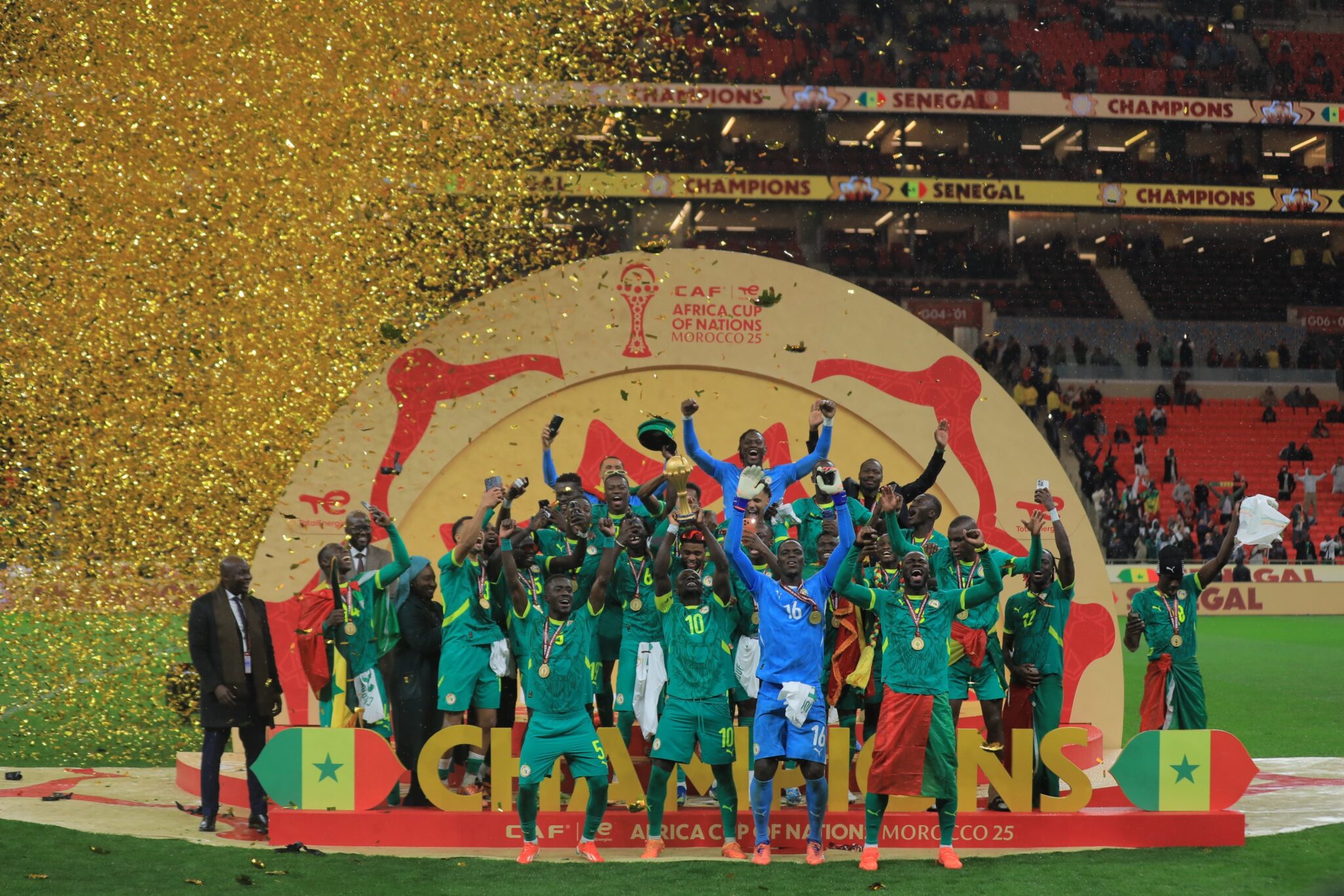
Senegal lift the Africa Cup of Nations trophy after defeating Morocco in Rabat, January 18, 2025. Image: CAF Instagram, used under fair use.
Youssou N’Dour’s “Gaindé” is the perfect music to listen to during a trophy ceremony. It is rhythmic, uplifting, and irresistibly catchy.
That’s what I was thinking to myself as it blared through the Prince Moulay Abdellah Stadium sound system and confetti cannons blasted golden ribbons into the rainy Rabat night. Moments later, Sadio Mané lifted the 2025 Africa Cup of Nations in front of the photographer corps furiously clicking their shutters, immortalizing the 35th champion of our continent’s flagship tournament.
To be honest, the rest of the night feels like a fever dream. I only remember flashes burned into my mind like overexposed film.
I do remember that Senegal were largely in control in the early stages of the match, building play with the quiet maturity of a team fully aware of its own capabilities. The Teranga Lions circulated possession patiently, trusting their structure and timing. Morocco sat in a mid-bloc that appeared organized but was nonetheless porous, allowing Senegal to find pockets between the lines and advance with measured confidence.
The hosts adjusted after the break. Their bloc tightened and Morocco began snapping into 50/50s with increased aggression. They threatened through set pieces and quick counters, turning the match into a series of momentum swings. After trading body blows for 90 minutes, both teams seemed resigned to extending the battle into extra time.
The next distinct memory came at the moment that should have ended it.
In the 92nd minute, Senegal won a corner. The delivery was perfect for Abdoulaye Seck, who swiped at the outstretched arms of Achraf Hakimi before their bodies collided. Seck’s header crashed against the goalpost. The rebound was scrambled into the net—pandemonium—only for Congolese referee Jean-Jacques Ndala to blow his whistle and signal a foul on Seck.
It was soft. Technically defensible, perhaps. Barely.
Minutes later, on a corner at the other end, Malick Diouf pulled Brahim Díaz to the ground. This time, Ndala initially kept his whistle down—until a VAR check intervened. Penalty. It was probably the correct decision, but correctness offered no comfort to Senegalese players or supporters who felt injustice had already been served.
Cue mayhem.
Behind the goal, the Senegalese supporters known as the 12ème Gaïndé (“Twelfth Lion”) lost all composure. Projectiles rained onto the pitch. Chairs followed. Fists flew. What began as protest turned feral, as if something sacred had been violated, as if families themselves were under threat.
In the middle of it all, one man stood tall: Sadio Mané.
The former Liverpool forward defied the team’s initial decision to forfeit the match. Instead, he walked to the touchline and spoke with Claude Le Roy and El Hadji Diouf. Then he turned to his teammates and convinced them to return to the pitch, asserting simply: “We will play like men.”
Not long after Mané led Senegal back onto the field, Díaz stepped up to the penalty spot. A goal would be his sixth of the tournament, enough to tie the record for a Moroccan player at AFCON and, more importantly, virtually guarantee Morocco a second continental title.
In a moment of total madness, a visibly tense Díaz attempted a panenka. Édouard Mendy read it all along and caught the ball with utter ease. Extra time.
Before the additional periods began, Mané walked over to the 12ème Gaïndé, hands raised, urging calm and asking them to stand behind the team. His message landed. And soon after, Pape Gueye embarked on a lung-busting 40-yard run that ended with a beautifully struck shot that finally beat Yassine Bounou.
Morocco huffed and puffed, but they could not equalize.
Senegal were champions again.
Mané fell to his knees. This most extraordinary of matches had delivered him a second AFCON title – no non-Egyptian player has won more. To place the achievement in context, Mané was also named Best Player in both of his AFCON triumphs, something even Samuel Eto’o never managed. Eto’o, widely regarded as the greatest African footballer of all time, finished his international career with 56 goals. Mané now has 53 and, at this rate, will surely surpass that mark within the year.
But numbers feel inadequate after a night like this. Mané’s status will definitely rise for what he did on the pitch, but also just as much for his refusal to disappear when the game turned hostile.
As “Gaindé” echoed once more through the stadium and the gold confetti littered the emerald pitch in Rabat, Senegal didn’t just celebrate a victory. They celebrated a leader that understood that greatness is not only about winning, but about how you behave when the world is on fire.


