What’s in an AFCON final?
From national redemption and continental dominance to personal legacy and political ambition, the 2025 Africa Cup of Nations final means everything to Africans.
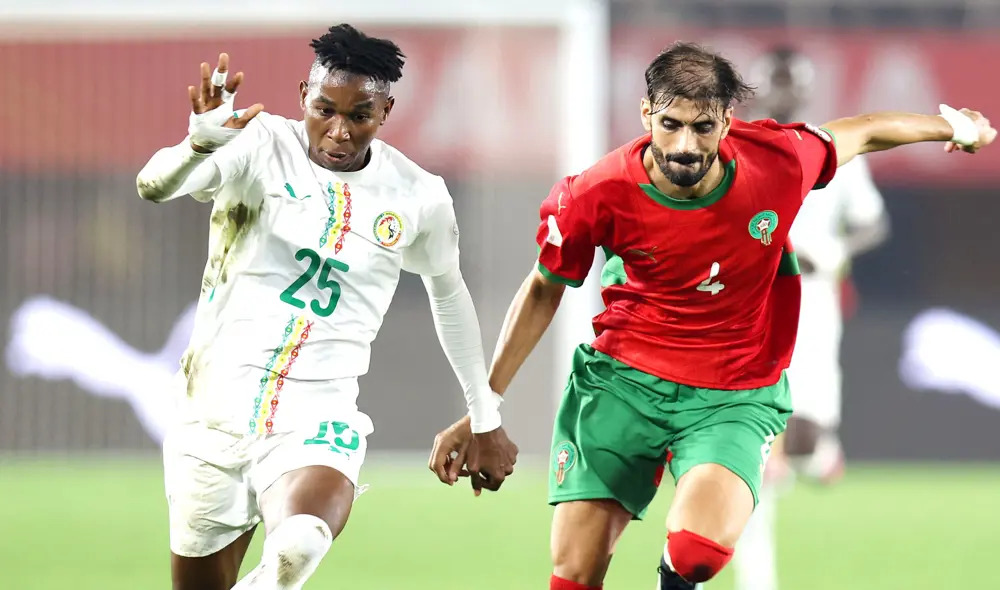
Vieux Cissé and Marouane Louadni during the CHAN 2024 semi-final between Senegal and Morocco, August 26, 2025, Kampala, Uganda. Image: CAF.
What’s in an Africa Cup of Nations final?
For Morocco, a chance at long-awaited continental glory. Since 1976 when the Ahmed Faras’ Atlas Lions lifted the Cup, generations of superstars have come and gone without winning Africa’s most coveted trophy. Aziz Bouderbala, Mustapha Hadji, Hakim Ziyech have shone at the FIFA World Cup, but all have failed to add a second star on Morocco’s red jerseys. As Walid Regragui, Morocco’s head coach, once put it: “You cannot be kings of the world if you are not kings of your continent.”
For Senegal, this final is about confirming supremacy. The Teranga Lions boast one of the strongest squads on the planet, with players that have competed at the very highest level. They have been the benchmark on African soil in recent memory. Sunday evening will mark their third Africa Cup of Nations final in four editions. Even if they are to lose to Morocco, one fact remains true: At the 2027 AFCON in East Africa, Senegal will enter the tournament not having been eliminated from an AFCON by anyone other than the eventual champions in a decade.
The last time Senegal lifted the trophy, in 2021, Macky Sall was president, governing in what would soon harden into an increasingly unpopular and embattled tenure. This final unfolds under very different political skies. The early years of the Bassirou Faye era have been marked by popular expectations of renewal and restored dignity, a mood echoing wider regional currents.The national team’s sustained excellence offers a parallel register of continuity and confidence, and an image of a country that believes it belongs at the summit, whether on the pitch or beyond it.
For Achraf Hakimi, Africa’s reigning Player of the Year, the final offers a chance to focus on sport. Amid ongoing legal proceedings in France, where he has been accused of rape, the Paris Saint-Germain fullback can become a national hero at home, where his legal issues are mostly ignored.
Meanwhile, for Sadio Mané, winning the final is a chance to cement himself amongst Africa’s greatest ever players. The Bambali native is a former African Footballer of the Year, runner-up in the 2019 Ballon d’Or, and currently seventh on the all-time list of African international goalscorers. His CV demands reverence and that will come with a second AFCON title.
For Mané’s teammate and captain, Kalidou Koulibaly, this final will be watched from the stands. The match will be his second absence from an AFCON final after also missing the 2019 showpiece through suspension. In 2021, he lifted the trophy after collecting it on behalf of his teammates; on Sunday night, he will hope to do so again. Then, it was presented by Paul Biya, the oldest head of state to host an AFCON. This time, history could tilt the other way, with Morocco’s Crown Prince Moulay Hassan poised to hand over the title should Senegal win.
For Regragui, one of African football’s most compelling modern figures, an AFCON trophy would be a coronation of a decade of hard work. In 2016 he was cutting his teeth with a mid-sized club in Morocco hoping to one day lead his national team to this stage. He’s a coach who blends tactical clarity with cultural confidence, and who has helped redefine how African teams see themselves on the global stage.
Pape Thiaw, the Senegalese coach, is his counterpart. Once dismissed as an “intern” after Aliou Cissé’s contract was not renewed, he inherited an impossible comparison: a predecessor who lost just 14 of his 101 matches in charge. Thiaw now stands one win away from silencing all doubt in his appointment and proving that he deserves a chance to lead Senegal at the 2026 FIFA World Cup next summer.
Behind the scenes looms Fouzi Lekjaa, the astute and machiavellian president of the Royal Moroccan Football Federation and Morocco’s Minister of Budget. For Lekjaa, victory would be another strategic triumph in his long-term vision, one that fuses sporting ambition with diplomacy, infrastructure, and influence, and has reshaped Moroccan football’s place in Africa and beyond.
For one of the GenZ212 activists I spoke to, the final is conflicting. She explained in great detail how she’ll refuse to attend any matches at the 2025 AFCON out of solidarity with her fellow protestors who faced judicial harassment for demanding better education and healthcare.
Finally, for us journalists, the least important group of people attending the final, tonight is the final sprint after a month of relentless work: deadlines, analysis, late nights. We publish, we post, we debate and we cherish the privilege of witnessing another chapter of African football history from the inside.
For Africa? One final chance to turn on our television sets and, as a continent, share in a sporting moment together.
What’s in the 2025 AFCON final?
Everything.