Securing Nigeria
Nigeria’s insecurity cannot be solved by foreign airstrikes or a failing state, but by rebuilding democratic, community-rooted systems of collective self-defense.

Photo by David Rotimi on Unsplash
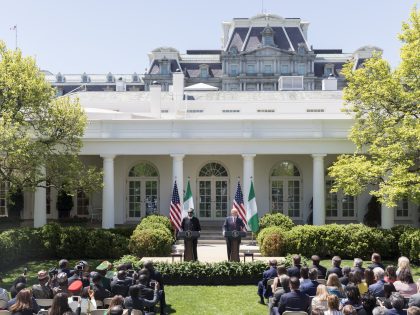
On December 25, 2025—a day symbolizing peace for billions worldwide—US President Donald Trump announced what he described as a “powerful and deadly strike” against Islamic State affiliates in Sokoto State. Framed as a “Christmas present” to terrorists targeting Christians, the operation was reportedly carried out with intelligence support and approval from the Nigerian government.
In the wake of the strike, much of the analysis has fallen into two broad categories. The first camp welcomed the strike. Many Nigerians who have endured years of violence, kidnapping, and state failure saw it as a rare moment of decisive protection. For some, the airstrike functioned as a consolation prize—short of the regime-toppling intervention they had hoped for—but evidence nonetheless that a capable external actor might succeed where the Nigerian state has struggled. For Trump, the strike also served as political theater: a carefully staged demonstration of strongman leadership that reinforced his self-image as a defender of Christians and played effectively to his evangelical base.
The second camp opposed the strike, arguing that responsibility for national security must ultimately rest with the Nigerian state. Their disappointment was compounded by the fact that the operation was first announced by Trump himself, casting Nigeria as a hapless bystander in matters of its own sovereignty—even as Nigerian officials later emphasized that intelligence sharing had made the strike possible. The Tinubu administration’s hurried effort to brand the operation as a joint undertaking suggested an acute awareness of the sovereignty crisis such optics might provoke.
Yet beyond these competing reactions lies a deeper concern. The intervention risks energizing the very ideology it seeks to suppress, by furnishing jihadist groups with fresh material for their narrative of a Western crusade against Islam. It also establishes a troubling precedent in which security is perceived as a gift from abroad, potentially weakening public pressure on the Nigerian government to build a competent, accountable, and domestically grounded security architecture.
The debate also reduces the question of security to a false binary: reliance either on the state’s formal security apparatus or on foreign military force. This narrowing is dangerous. Nigeria’s history offers numerous examples of communities organizing to protect themselves, demonstrating that the hope of collective self-security is neither naive nor misplaced. This essay therefore turns to a neglected question—why, despite this history, have we grown hesitant to seriously consider this third path of community-level security provisioning?
Both historical and contemporary examples of community organized self-defense abound. In Northwest Nigeria, the Lakurawa faction—the group reportedly targeted in the Christmas day attack—is said to have begun as a self-defense militia invited by local communities to provide protection from rampant banditry. Its subsequent drift toward ISIS affiliation is a tragic but predictable evolution. Such authoritarian drift has often led the progressive-minded to shy away from the thorny terrain of citizen-based community defense solutions. The question that jumps out examples such as that of the Lakurawa is whether this tragic arc (from community protection to predation) is the inevitable fate of all bottom-up security initiatives. This is the core hesitation surrounding such ideas, and it is a valid one. The literature on vigilante groups in Nigeria and community-based militias elsewhere is replete with cases of abuse and predation victimizing both host communities and neighbors. However, the mistake we often make in interpreting this history is to use it to invalidate the more fundamental impulse of community self-defense instead of using it to diagnose its typical point of failure.
What stands out from a more nuanced analysis is that these experiments falter precisely when defense becomes an end in itself. Where defense becomes a task for a specialized (and often masculinized) cadre that is divorced from the holistic needs of the community, it replicates the military-civilian dichotomy of most states and increases its risk of illegitimacy and predation. What would the alternative to this look like?
Some successful, though often suppressed, counterexamples: The Black Panthers’ survival programs, Amílcar Cabral’s “liberated zones,” and the Zapatistas’ autonomous municipalities of Chiapas have shown us a different logic. The logic they have put forward to move beyond armed vigilantism is that security must be embedded in, and subordinate to, a collective project of material care and democratic agency. This is the missing step that can turn a desperate reaction of “community defense” into a durable alternative.
The same logic extends into the arena of popular struggle. We have found, from the free meals of #EndSARS to the mutual aid in the Occupy encampments in the US, that the most promising moments of protest emerge when material care is heavily shared. This is not just history. The ongoing resistance and nonviolent direct action opposing ICE abductors in Minnesota today is heavily reliant on the material care and mutual aid that is being provided to immigrant families who have to stay at home to avoid being snatched off the streets by a racist immigration police.
Yet probing further into the limitations of these counterexamples helps us identify the lingering weaknesses of the logic that they put forward. This logic is rational in theory. Just as the Care Collective inferred in The Care Manifesto, the more interdependent a community gets in terms of welfare and care, the more an individual would feel like a harm done to the community is materially a harm done to them as an individual. In practice, it has not been that simple, whether in Africa elsewhere.
In the liberated zones of Guinea Bissau, Cabral and the African Party for the Independence of Guinea and Cape Verde (PAIGC) did not just wage guerrilla war against Portuguese forces but simultaneously organized schools, people’s stores, and healthcare systems. Security was not made the duty of a separate militia; it was woven into the fabric of building a new society. The fighter was also a teacher, and this created a resilient alternative sovereignty that earned popular legitimacy. Most commentary have theorized that Cabral’s eventual assassination (which the African Party for the Independence of Guinea and Cape Verde PAIGC outlived) was because of the identity tensions between mainland Guinean fighters and Cape Verdeans (like Cabral) who were in top leadership positions, which led to the infiltration by Portuguese intelligence and decline of PAIGC. It is important to point out that the structural weakness that was exploited is the perceived separation between those who were in leadership positions and those fighting on the front lines. Historical documents noted that the separation created tensions because those on the front lines were opposed to “the continuing subordination of military [aims] to political aims.” While it can be argued that this subordination of the military aims to political aims is correct, the material fact is that those making the correct argument (especially Cabral) were not often present on the front lines, and Cabral himself was often conducting diplomacy from Guiñea Conakry. It can be argued that the limited extent of this separation in PAIGC ranks could have been a structural necessity of Cabral’s time and context, especially the need to build connection and international solidarity between the struggle of PAIGC and that of the rest of the colonized world.
A reading of António Tomás’s book Amílcar Cabral: The Life of a Reluctant Nationalist reveals the fact that Cabral himself dismissed the need for personal security and bodyguards, and that is one way to show that Cabral himself did not want a situation where the leadership is separated from the rank and file and elevated with special privileges. As seen in the chapter of the book on Cabral’s assassination, the fact that Cabral did not oppose the disgruntled fighters of the PAIGC getting positions in the navy that could strengthen their position against him, also did not seem to portray him as someone who wanted to create a separation between those in leadership and those fighting on the frontlines. This limited separation was later weaponized with identity and used to assassinate Cabral. While the assasination in January 1973 was a tragedy, it created an immediate shock that made it possible for the PAIGC to declare independence by September 1973, which became formal independence by 1974 after the April Revolution.
The more contemporary example of the Zapatista Army of National Liberation (EZLN) in Chiapas, Mexico, offers similar lessons. The EZLN’s example is all the more relevant given how closely gang-related and drug-trade-enabled insecurity in Mexico mirrors the ride banditry in Nigeria. For over three decades, the Zapatistas have maintained de facto autonomous communities in the face of state hostility, raging cartels, and paramilitary violence. Their resilience is due to a similar conscious fusion between defense and welfare. Their armed defense is a last resort, and it remains only a backdrop to a deep commitment to autogobierno (self-government) built around communal assemblies, autonomous education and health care, and cooperative economics. Everyone is a soldier and the “soldier” is first and foremost a compañero or compañera working the collective field or teaching in the local school. Their security apparatus is subordinated to, and emerges from, their social fabric. While their context differs from Nigeria’s in some other ways, they have shown us that sustained community defense is impossible without a parallel, deeply connected and functioning social contract that addresses poverty, dignity, and collective decision-making. The Zapatistas are still standing today because the exact point where failure sets in is the point of separation of the gun from the granary, of patrols from public works, or of security from social sovereignty. They refused to see community defense as merely a tactical military problem but treated it as a strategic political project of building parallel power.
While much smaller in scale, I was part of a history of student activism at the Obafemi Awolowo University, Ile Ife, Nigeria, where student congresses have organized anti-cultist citizen-based defense since 1999. That year witnessed the Ife massacre where students were killed and injured in a wave of attacks by members of violent campus confraternities. The relative success of student response to such violence since then has been possible because those of us at the vanguard of that citizen-based defense were also at the vanguard of student academic and personal welfare, as official leaders of the students’ union or as active students.
This is what is missing in the well-intentioned but ultimately vulnerable vigilante initiatives across Nigeria, from the Yan Sakai, to the Civilian JTF, and even the OPC: Where defense is reduced to young men with guns conducting reactive patrols it inevitably succumbs to corruption, brutality, or capture by extremist narratives or by the state. The Civil Defence Corps of the Nigerian civil war era was ultimately absorbed by the state, ending up with paramilitary status by 2003.
The question for Nigeria is thus not whether community self-defense is justified. Our history and current desperation have shown us that this is the only way to defend ourselves efficiently without losing our sovereignty, but what kind of self-defense will it be? Will it be the narrow militaristic kind that risks degenerating into another armed faction in the middle of this chaos—or can it be something more durable and transformative?
This is the only way to give substance to the protests against insecurity that were called in December 2025 by Nigeria’s main union center, the Nigerian Labour Congress. While attendees linked the poor turnout in the protests to poor planning by the NLC leadership and distrust of NLC by citizens, we must also admit that the lack of a bottom-up immediate alternatives for people to organize around, was also demobilizing.
From my experience and the examples above, one way that citizen-based defense could start to work in the present context of Nigeria’s insecurity is to have locally elected civilian security corps that are not sectarian based on tribe, religion, or ideology. This can show people that defense is a public and democratic good that can be rooted in popular accountability and sovereignty—as they could directly report to a community assembly. This is what will replace the authoritarian identity-based command of the existing vigilante models. Instead of reactive patrols, they can form early warning networks that can pass information about strange movements to communities instead of waiting on someone from some far away barracks to approve and give orders to soldiers. They can organize nonviolent resistance to terrorists occupying their villages and they can mobilize people to swarm vulnerable locations in a way that peacefully overwhelms any terrorist trying to invade such territory. Such corps, rather than work like another paramilitary, can simultaneously operate like a community works program that rebuild infrastructure, dig for water, plant trees, and help to work out solutions for community needs. This is the practical way to reject foreign military assistance and expose the corruption in Nigeria’s military budget to the masses, who will now see that they can defend their community at low or no cost.
The task ahead, for a large territory like Nigeria, could be to forge the concrete links that can make this alternative tangible. This requires building an unprecedented network that connects the sovereignty politics of radical parties to the grassroots legitimacy of existing community-defense networks, and to the organizational power of the labor movement and the Pan-African solidarity of other socialist forces. This network must simultaneously wage a battle against the imperial spectacle that treats Nigeria as a theater for foreign politics and against the domestic kleptocracy that manufactures the poverty and corruption fueling the crisis, while connecting community defense experiments to the horizons of community well-being. This network must tie immediate community protection to long-term demands for massive public investment, job creation, and a decisive reallocation of national resources from the security sector’s corrupt coffers to the people’s welfare.
South Africa’s Economic Freedom Fighters (EFF) condemned Trump’s strike as a “dangerous escalation of American military imperialism” and warned that the strike was a precedent-setting move to justify future interventions under the guise of counterterrorism, ultimately aimed at securing resources and undermining African sovereignty. This can be seen in the escalation of American imperialism in Venezuela in the early days of January 2026, with the audacious arrest of a sitting president while killing about a 100 Venezuelans and Cubans in the process. This means that Trump’s strike on Sokoto on Christmas Day was not just for the symbolism alone but also to create a precedent for further strikes, which he has already threatened to carry out. Just like Hollywood action movies were used to normalize US interventionism as salvation, the strike has contributed to normalizing further US airstrikes in Nigeria and the rest of Sub-Saharan Africa. The continuation will also stoke more crises because of the divisive “Christian vs. Muslim” narrative already imposed by Trump. Nigerians must resist this. The only sovereignty that will endure is the one that will be built from the ground up by communities organized to defend their lives, their livelihoods, and their right to a future. Not the one given to us by national borders drawn by colonialism. The work begins in the streets, neighborhoods, and villages where security must become a common project of the people, not a gift to be given to us by the Tinubu or a performance staged by Donald Trump.