From Mogadishu to Minneapolis
The Trump administration’s crackdown on Somalis in Minnesota ignores a longer history: decades of US intervention that helped produce the violence and displacement Somalis fled.
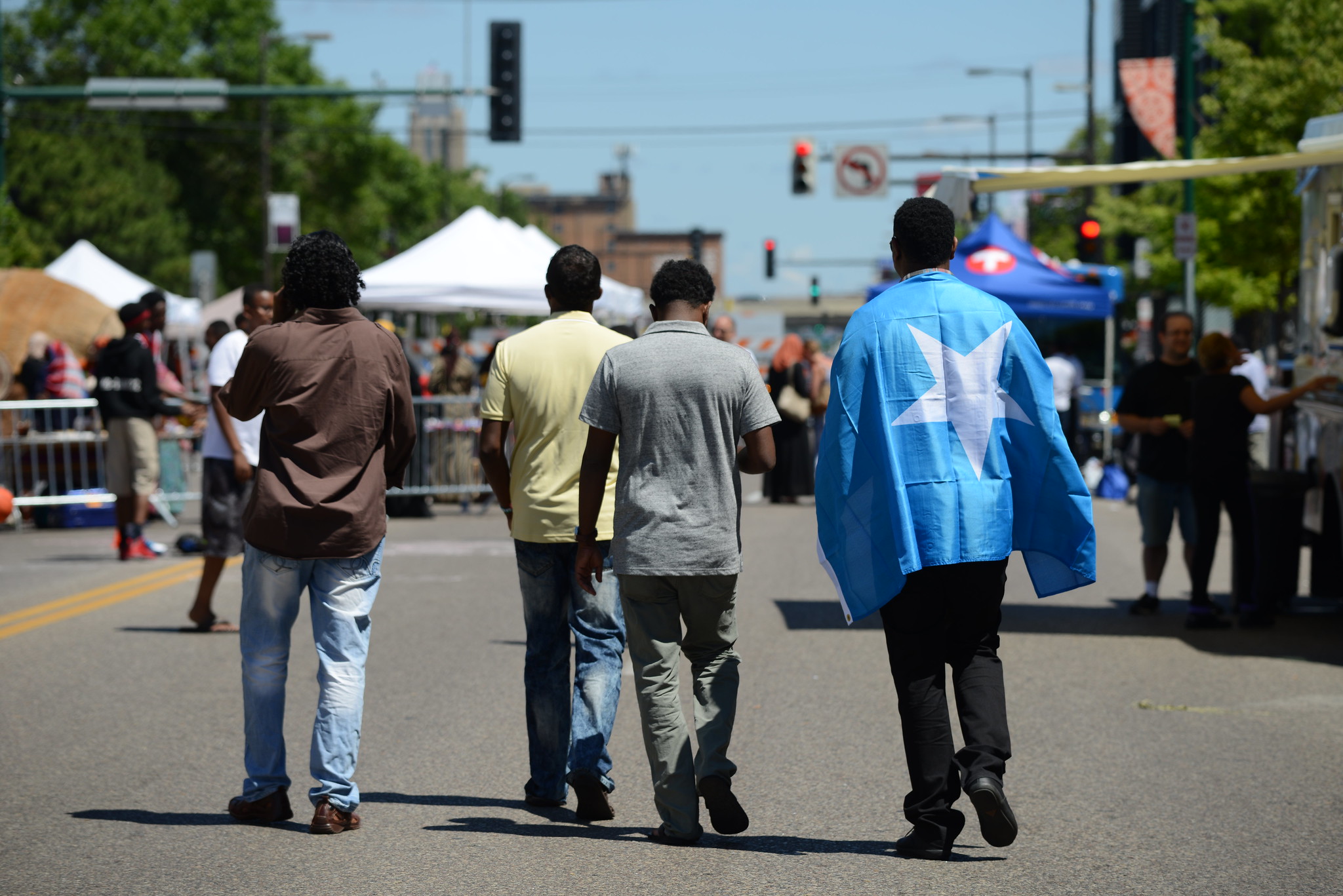
A street fair during Somali Week in Minneapolis, 2016. Image credit Fibonacci Blue via Flickr CC BY 2.0.
The Trump administration’s crackdown on Somali refugees, immigrants, and US citizens of Somali descent in Minneapolis, Minnesota, the home of some 80,000 people of Somali heritage, has been headline news in recent weeks—especially since the Immigration and Customs Enforcement killing of two American citizens—both white—who witnessed ICE brutality.
The presence of so many Somalis in Minneapolis and the special antipathy the Trump administration has for them has roots that go far deeper than the president’s hostility toward Minneapolis Congresswoman Ilhan Omar, one of his most forceful and outspoken critics. Rather, it has strong roots in the history of US intervention in Somalia from the Cold War to the “war on terror.”
Although Somalis are not the only people targeted by the Trump administration—which has a long list of “enemy” nations—they are a prominent group, a group that entered the US with refugee or Temporary Protected Status (TPS) as a result of the mayhem in their homeland, much of it sparked by US intervention.
President Trump has disparaged Somalis and other Africans since his first administration. In 2018, he notoriously referred to African nations as “shithole countries.” In December 2025, he upped the ante, making scathing, xenophobic remarks about Somali immigrants and their US-born descendants. Labeling them “garbage,” he told reporters that he wanted to expel Somalis from the country—and that they should go home and “fix” their problems. The dehumanization of targeted populations was a tactic employed by the Nazis in Hitler’s Germany to justify their murder.
In particular, Trump has villainized Congresswoman Ilhan Omar, a US citizen who was born in Somalia, accusing her of “political crimes” and declaring that she should “go back and help fix the totally broken and crime-infested places from which [she] came.” Omar has been plagued by death threats since Trump began targeting her.
Subjected to a series of travel bans during the first Trump administration, Somalis have again been targeted during his second term. Following a tirade about Somalia’s inability to drive al-Qaeda and Islamic State elements from their country, Trump announced that he would end the TPS status of nearly 2,500 Somalis, who would then be subject to deportation.
What caused the turmoil in Somalia that drove so many people from their homes, and what role has the US played? Since an abortive US military mission to Somalia in the early 1990s, the country has most often been featured in the US mainstream media as a terrorist haven that launches attacks on neighboring countries or as the source of piratical raids on international shipping routes in the Indian Ocean and Gulf of Aden.
Much of this coverage gives readers the impression that Somalia’s problems are self-generated and that the rest of the world has been trying to save it. In reality, there is a protracted history of outside interference in Somali affairs that has worsened its long crisis. From the Cold War to the “war on terror,” the US has turned Somalia into a battleground for its geopolitical schemes, with profoundly destructive consequences for the Somali people.
Somalia’s early attempts at democracy ended in 1969, when its second president was assassinated and Major General Mohamed Siad Barre seized power. The next year, he announced that Somalia would pursue a scientific socialist agenda, beginning with a massive public works program. While the country made significant strides in mass literacy, primary education, public health, and economic development, the Siad Barre regime also suspended the constitution, banned political parties, and assassinated rivals.
Wary of Somalia’s socialist orientation, the US suspended economic aid and the Soviet Union became the country’s main source of military and economic assistance. By 1976, Somalia boasted one of the largest armies in sub-Saharan Africa. Cuban technicians trained Somali troops, while Soviet and East German agents strengthened the country’s repressive National Security Service.
Meanwhile, a revolution in Ethiopia ousted the feudal regime of Haile Selassie, a staunch ally of the West. It was replaced by a military dictatorship that described itself as Marxist-Leninist. Viewing Ethiopia’s Marxist credentials as stronger than Somalia’s, Moscow initially embraced both governments. However, in 1977, when Somalia invaded Ethiopia in an attempt to claim land occupied by ethnic Somalis, the Soviet Union threw its full support to Ethiopia.
In 1978, without Soviet assistance, Somalia was forced to withdraw. The US resumed its support, and by 1986, Mogadishu was one of the largest recipients of US military aid in sub-Saharan Africa. This aid notwithstanding, Somalia was in dire straits by the mid-1980s. The cost of the Ethiopian war, along with corruption and mismanagement, had run the economy into the ground. Onerous taxes stimulated rural unrest, which was brutally suppressed. Government critics were drafted or killed. Members of Barre’s own clan increasingly dominated the regime. By 1989, clans that had suffered from harassment or discrimination had united in their opposition to Siad Barre’s rule, as had Islamists, whom the dictatorship had also repressed.
The Mogadishu government’s resettlement of hundreds of thousands of war refugees in Somalia’s semi-autonomous region of Somaliland threatened the economic interests of the indigenous population. In the early 1980s, the Somali National Movement, backed by Ethiopia, instigated an insurgency in the region. In response, Somali military planes, piloted by white South African and former Rhodesian mercenaries, bombed the northern capital of Hargeisa. Tens of thousands of people were killed.
By the late 1980s, the Soviet Union was weakening politically and economically. The US, no longer needing a regional policeman, expressed newfound concern for Siad Barre’s human rights abuses and again suspended military and economic aid.
Without US support, the Siad Barre government was an easy target. In January 1991, warlords and their clan-based militias overthrew his regime. Conflict between competing warlords destroyed much of Mogadishu. State institutions and basic services crumbled, the formal economy ceased to function, and southern Somalia disintegrated into fiefdoms ruled by rival warlords and their militias, which clashed with a resurgent Islamist movement.
As the fighting intensified in 1991, war-induced famine, compounded by drought, threatened much of the population. Massive population displacement, the theft of food and livestock by marauding soldiers and militia members, and crop failure rendered 4.5 million people at risk of starvation. By late 1992, some 300,000 Somalis had died from starvation and war-related disease and violence, while two million people had fled their homes.
Concerned about instability in this strategic region, the US, backed by the United Nations, launched a multinational military intervention in 1992. Its mission was to ensure the delivery of humanitarian relief. In 1993, another UN mission permitted US-led forces to disarm and arrest Somali warlords and militia members. As a result, the United States took sides in what had become a civil war—favoring one warlord (Ali Mahdi Muhammad) and opposing another (Mohamed Farah Aidid). Civilians were caught in the crossfire. Many were killed in US airstrikes, eliciting a furious backlash from the population. US troops, in turn, increasingly regarded Somali civilians as hostile actors.
Although the delivery of food aid had been the priority of the US military in early 1993, it was not the objective eight months later. From late August to early October, the US armed forces were bent on capturing or killing Aidid and his top lieutenants. The final raid took place in October 1993, when US Army Rangers and Delta Force troops attempted to capture key leaders of Aidid’s militia in Mogadishu. Aidid’s forces shot down two Black Hawk helicopters, which crashed into children in the streets below. Angry crowds attacked the surviving soldiers and their rescuers. Eighteen American soldiers and hundreds of Somali men, women, and children were killed in the ensuing violence.
In 1994, having stirred up a hornet’s nest, the US hastily withdrew from Somalia. However, the emergence of al-Qaeda elsewhere in East Africa sparked new US concerns about violence in the Horn. The bombing of US embassies in Kenya and Tanzania in 1998, followed by the 9/11 attacks in 2001, led to increased US collaboration with the post-Marxist government in Ethiopia.
Meanwhile, Islamist groups had gained significant popular support in Somalia by offering essential social services no longer provided by the government, including schools, health clinics, and courts that brought some semblance of order to the war zone. Ignoring the reasons for the appeal of Islamism, Washington set out on a violent campaign to stamp it out.
Worried that Somalia could become an al-Qaeda outpost, Washington joined Somali warlords and the Ethiopian government in opposing Islamist advances, imposing an ineffectual government in 2004. Two years later, Washington supported an Ethiopian invasion and occupation that lasted until 2009.
Foreign intervention precipitated a domestic insurgency led by al-Shabaab, originally a youth militia organized to defend the Islamic courts. Provoked by outside meddling, it had transformed into a violent jihadist organization. By 2007, al-Shabaab had taken control of large swaths of central and southern Somalia, prompting the UN, the African Union, and neighboring countries to intervene. In 2012, the youth militia affiliated with al-Qaeda.
The US worked in the shadows, launching low-intensity warfare against al-Shabaab operatives, deploying both private contractors and Special Operations Forces to train and accompany Somali and African Union troops in combat operations. US drones and airstrikes killed key al-Shabaab leaders, who were rapidly replaced by others.
In 2012, outside forces again imposed a new political dispensation that was mediated by the UN, backed by the international community, and disavowed by large segments of Somali civil society, which had had little input in the process. Al-Shabaab was again diminished, but not defeated. A decade and a half later, al-Shabaab maintains its powerful foothold in Somalia, and the central government still cannot provide basic services, law, order, and justice.
Meanwhile, the US has continued to wage a shadow war. Reducing the number of American feet on the ground, the Obama administration escalated the use of drones and airstrikes to kill al-Shabaab insurgents. While this method diminished the number of US deaths, it slaughtered hundreds of Somali civilians. The first Trump administration withdrew most US forces, but carried out 219 air strikes in Somalia. The Biden administration increased the number of US Special Operations Forces whose job was to train and assist Somali forces in counterterrorism operations focused on killing extremist leaders deemed a threat to the US, its interests, and its allies.
In its first year, the second Trump administration oversaw more air strikes than the number carried out by the George W. Bush, Barack Obama, and Joe Biden administrations combined. A top US Navy admiral described a February 2025 strike as the “largest air strike in the history of the world.” The US military has refused to provide information on civilian casualties.
In 1991, when Siad Barre was ousted and the central government disintegrated, Somaliland, the semi-autonomous region in the north that had been brutalized by the central government, declared independence. The region is strategically located along the Gulf of Aden—the gateway to Europe for Middle Eastern oil. The city of Berbera is home to a port and one of the longest landing strips in Africa, both coveted by the Trump administration. Access to these facilities would offer the US a strong presence on the oil shipping route and enable it to monitor conflicts in the region. Moreover, new studies have shown that Somaliland has numerous deposits of rare earth minerals that have not yet been claimed or exploited.
In a letter to Trump in March 2025, the Somali president offered the US exclusive control of two air bases and two ports, including the air base and port in Berbera. Trump hopes that the addition of military facilities in Somaliland, one of the few African governments that recognizes Taiwan rather than Beijing, will weaken China’s stronghold on the continent. In December 2025, the Netanyahu government in Israel, a staunch US ally, became the first to recognize Somaliland as an independent state. News reports claim that Israel hopes to resettle Palestinians from Gaza in Somaliland—a forced relocation, which is in clear violation of international law.
How has foreign meddling shaped the Somalia of today? It has internationalized what had been a local conflict, strengthening violent extremist factions and precipitating al-Qaeda involvement. Far from containing the bloodshed, external intervention increased it, provoking internal actors to affiliate with al-Qaeda and the Islamic State, establishing extremist outposts where none had been before.
This, President Trump, is the country the Somalis of Minnesota fled—a country that has been brutalized by both the US and violent extremists provoked by the actions of outsiders. This is the mayhem that qualified Somalis for refugee and Temporary Protected Status in the United States. And yes, Mr. President, it is this population and its US-born descendants who have been targeted by ICE for incarceration and deportation. Shame on the United States of America.