Waiting to believe
After years of heartbreak, Congolese fans are guarding their expectations ahead of a decisive play-off against Jamaica for a place at the 2026 FIFA World Cup. Yet qualification would mean something bigger than sport.
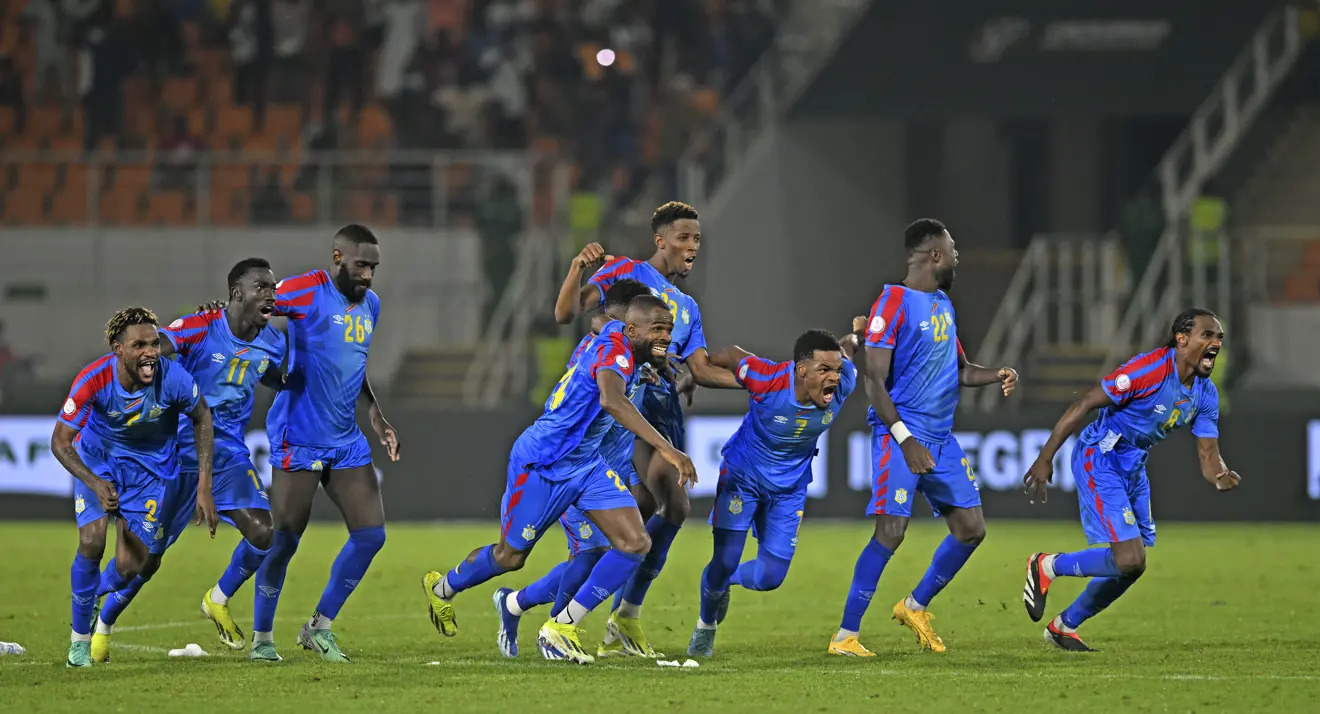
DR Congo players celebrate their penalty shootout victory over Egypt at the 2023 AFCON. Source: CAF (fair use).
Whenever I visit Kinshasa, getting a haircut is part of the ritual. There’s something about the barbers here—even the ones working on the street—that always impresses me. This time, I went to Rachidi, who was recommended by a wewa, or mototaxi driver, whose haircut was on point. Before he even starts, Rachidi puts his clippers down.
“This one will not work on your hair.” He tells me.
I sometimes forget that I am mixed.
He then takes a razor blade, slides it behind a comb, and starts working on my mid-fade. Any initial doubts about his skill immediately dissipate, and I relax enough to address the elephant in the room.
“What are you doing on the 31st?” I ask.
It’s March, and at the end of the month, Mexico will host the most consequential game in our country’s history in over fifty years. DR Congo play Jamaica in a single-leg intercontinental play-off where 90 minutes will determine which of the two countries will go to the 2026 FIFA World Cup in North America.
Still, Rachidi looks at me as if I’ve come back from the future or escaped from Shutter Island.
“The 31st?” he repeats.
“Yes… for the game,” I answer, convinced that I’m stating the obvious.
“Ozo loba match nini?” (What game are you talking about?)
The fact that Rachidi was oblivious was accentuated by the fact that his small barbershop, tucked away in the northern commune of Lingwala, sits just a few hundred meters from the Stade des Martyrs, the mythical home of the national team when they play in Kinshasa.
I had extended my stay in Kinshasa for an opportunity to witness history as it unfolded, but my conversation with the barber made me ask myself, “are people even aware of what’s at stake?”.
That same evening, I had dinner at Majestic River, a boat restaurant docked along the Congo River, facing Brazzaville, the capital of the “other Congo.” The view over Africa’s second-longest and most powerful river is stunning.
My Nile perch skewer was perfectly grilled, but I nearly choked on it when the waiter gave me the same puzzled look as Rachidi when I mentioned the match. Incredibly, the same thing happens with the Yango driver who takes me home, and with Daouda, who tops up the Vodacom credit that always seems to disappear as soon as I load it.
The following evening, I found an exception: a waitress at my favorite “malewa” (street-food restaurant) in Kin’ says, “Of course I’ll watch the game. Right here, actually. You should come. It’s going to be crazy.” It took someone whose job depends on people showing up to be reminded of the stakes.
The DRC is a football country, and I only began to understand the general atmosphere as I thought more about it. This was not indifference; it’s a form of collective self-protection.
No expectations, no disappointment.
It all began last September, when DR Congo were one win away from automatically qualifying for the World Cup, without having to play an intercontinental play-off. But a home defeat against Senegal —losing 3–2 after leading 2–0—was one heartbreak too many.
The Leopards were so close to qualifying for the World Cup in 2022 and 2018.
The first traumatic episode came in 2017, when DR Congo were once again in a crucial World Cup qualifier and were leading Tunisia 2–0 with forty minutes to go, in a roaring Stade des Martyrs. Then? Two goals conceded in fifteen minutes. 2–2. Another dream over before it even began. In 2022, hope returned yet again against Morocco, only to be dashed. Again. A 4–1 defeat away. Another World Cup missed.
So, people have learned to protect themselves.
A few days ago, a follower of Leopardsfoot, my media outlet, recognized me while I was working on my laptop at Le Premier, Kinshasa’s first shopping mall, which was inaugurated with great fanfare a decade earlier. After a brief discussion about the Leopards’ prospects, he told me he would not watch the upcoming game. He would switch his phone to airplane mode to “protect his heart.”
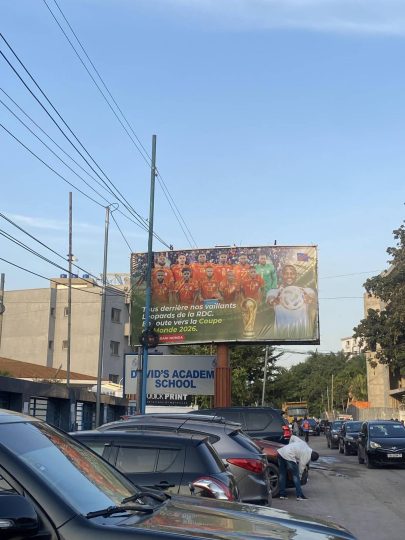
In the Congolese capital, a few official banners are advertising the match, but not much else, one week before the game.
But I know my people… this is just the calm before a potential storm.
You see? Our country is at war.
As I write this, the under-equipped national army continues to fight rebel groups backed by outside forces who are competing for control of the country’s vast resources. This situation predates independence and continues to deepen ethnic, social, and political divisions in Africa’s largest nation south of the Sahara.
In Kinshasa, in the conflict-affected east, or in Katanga—a region with its own history of secessionist tensions—the national team jersey is everywhere. Sometimes it’s just clothing, but often, it’s something more.
Two days before that heartbreaking match against Senegal, a colleague in Goma sent us a video. He was asking locals about the game. A man in his sixties responded, full of confidence, “Of course we’ll beat Senegal. With players like Wissa? At home, at the Stade des Martyrs? I am definitely confident. And we’ll go to the World Cup.”
He may never have been to Kinshasa, and is currently living in a region governed by a parallel administration. Yet, the 2,500 kilometers separating him from the capital do not stop him from calling that stadium “home.”
That says everything.
It is no coincidence that the player he mentioned was Yoane Wissa. The forward is particularly beloved in the east, not only for his performances in the English Premier League, but for a gesture he made.
In 2022, he chose to spend his vacation in Goma.
It was a rare decision for a player of his stature. In a region often associated with conflict and displacement, he decided to use his platform to show something else: green hills and a breathtaking landscape of lakes, volcanoes, and endemic wildlife. He shifted the narrative.
If Wissa were to score the goal that sends DR Congo to the World Cup, you can bet that they will be painting several murals of him in Goma.
It has been fifty-two years.
For most of my Congolese compatriots that are my age, the 1974 World Cup is just an inherited memory of flared pants, perfectly coiffed afros, and the music of Zaïko Langa Langa. It’s our grandparents. The era of Zaire. It’s a time we feel nostalgic for, even though we didn’t experience it.
Zaire was the first African nation south of the Sahara to qualify for a World Cup, but the reality of our participation was less glorious. We were eliminated in the first round after conceding fourteen goals and failing to score any. By then, disputes over unpaid bonuses had already arisen.
Should DR Congo qualify for the 2026 edition, they will face Portugal, Colombia, and Uzbekistan in Group K. This time, they will be expected to do better. Beyond results, however, something else is at stake: the possibility of reconnecting with a form of collective pride that has long remained out of reach.
The players know it.
They speak the language of diplomacy, using words like “mission,” “responsibility,” and “being ambassadors.”
DR Congo has already eliminated Cameroon and Nigeria on the road to the World Cup. Now comes Jamaica, which is more than a football match. It is a meeting of two nations where African identity intersects across continents. Whether through the Democratic Republic of the Congo directly or Jamaica indirectly, a part of Africa will be represented on the global stage.
But for Congolese supporters, only one outcome is acceptable: qualification.
That is because they feel they have earned it. The country has given much to the world, often at its own expense: its resources, its land, and its people. Four years ago in Doha, eleven players of Congolese descent played in the 2022 World Cup under other flags. Seeing the Congolese flag featured amongst participating nations this time around would carry a different meaning.
Of course, a qualification would be politically co-opted. Footballing exploits always are. And let’s be clear about the fact that qualifying for the World Cup would not fix everything. Football infrastructure across the country remains poor, and funds are diverted. The Stade des Martyrs itself is no longer homologated for use by the Confederation of African Football.
Congolese football mirrors general affairs in the country: there is immense potential, constrained by mismanagement. But qualification would still prove something. It would suggest that even a deeply flawed and corrupt system cannot suppress everything. It would show that if football can offer a moment of progress, then the idea that the country itself might move forward does not feel entirely out of reach.
If the “giant of Central Africa” awakens on the pitch, maybe it can do so elsewhere, too.


