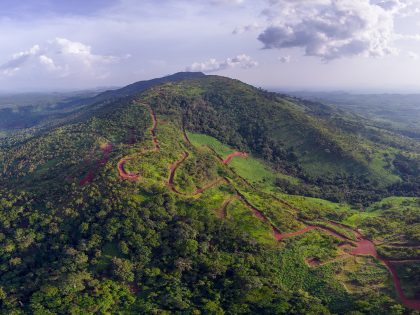
Where mining and conservation meet
Far from signaling a break from the past, the convergence of mining and conservation in West Africa underscores a recurring pattern that stretches back to colonialism.
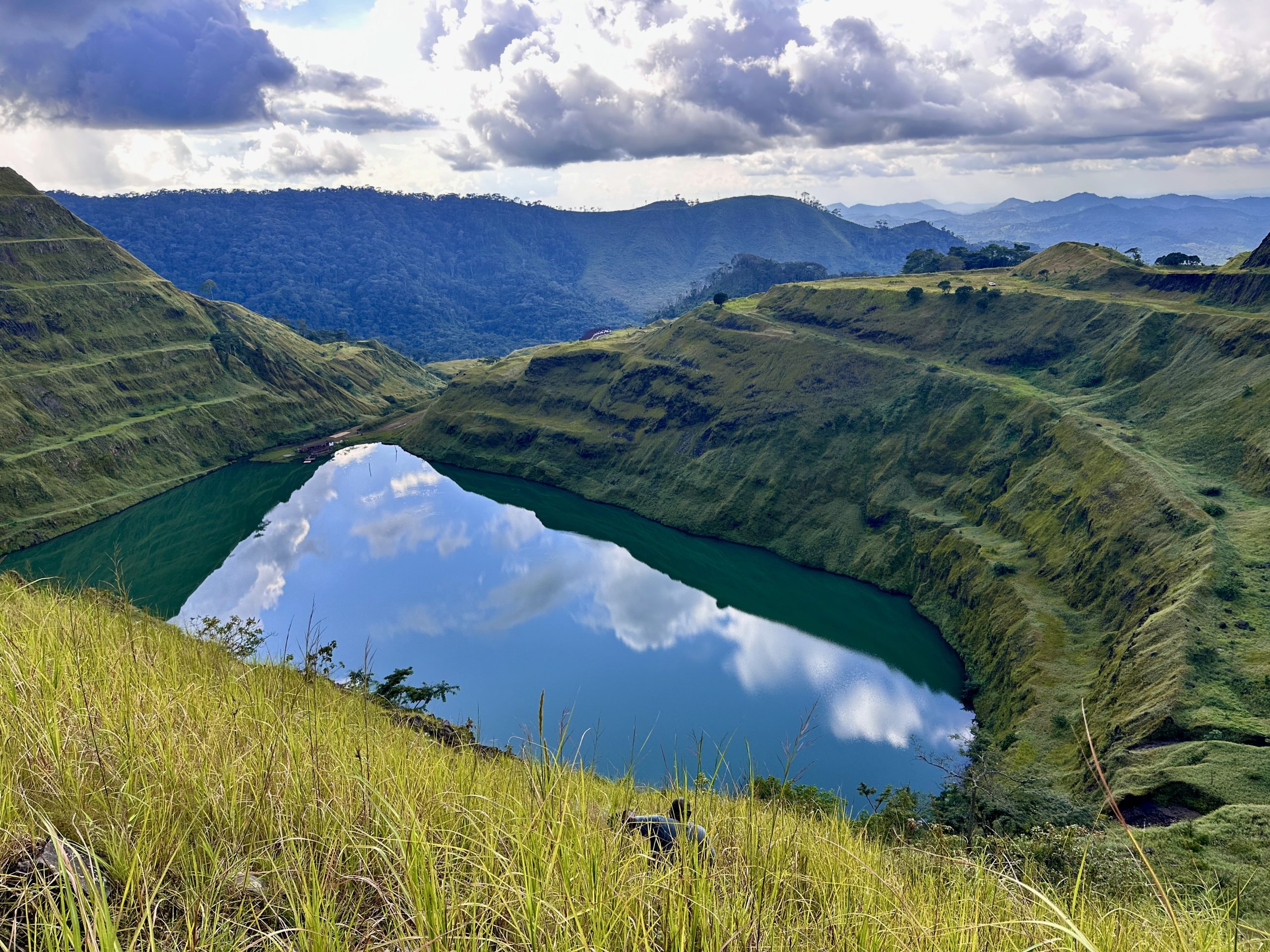
Blue Lake, the former open pit mine of LAMCO, now part of the East Nimba Nature Reserve. Credit Sarita West © 2025.
In Guinea’s mountainous forest region lies the world’s largest untapped reserve of iron ore. The $24 billion Simandou mine—a joint venture between the Republic of Guinea, British-Australian mining giant Rio Tinto, and a consortium of Chinese state-owned steel producers and investors—is Africa’s largest mining project and one of its most ambitious infrastructure investments.
The steel industry, the world’s second-largest greenhouse gas emitter, accounts for between roughly 7%-9% of global greenhouse gas emissions. At the same time, the world’s iron ore mines are concentrated in areas of intermediate to high biodiversity prioritized by conservation organizations. Mining, which typically entails large-scale environmental disturbance, and conservation, which seeks to preserve and restore delicate ecosystems, appear irreconcilable. Yet, the two are increasingly intertwined.
Talk of a “green steel revolution” may sound like a corporate oxymoron. Steel is marketed as “green” if it is produced using high-grade iron ore and clean energy inputs to drastically reduce carbon emissions. But as the steel and mining industries came to embrace sustainability over the past two decades, this green branding has come to impact the conservation sector as well. A key turning point came with the formation of the International Council on Mining and Metals (ICMM) in 2001, an initiative led by companies such as BHP and Rio Tinto. The ICMM’s emphasis on collaboration helped shift the industry’s stance on environmental issues away from confrontation to what it calls a sustainable development model. As Rio Tinto’s David Richards put it, “Mining … can be part of the solution to biodiversity conservation, not the problem.” The perspective shift is pitched as yielding mutual benefits. Mining companies gain legitimacy through partnerships with conservation groups, while those groups gain access to corporate funding by agreeing to conserve nature “in and through the expansion of capitalism.”
The first shipment of ore departed from Guinea for China on December 3, 2025. Simandou’s high-grade iron ore is prized for its potential to produce low-emission, or “green” steel, positioning it as a key player in the shift toward cleaner energy in rapidly growing economies.
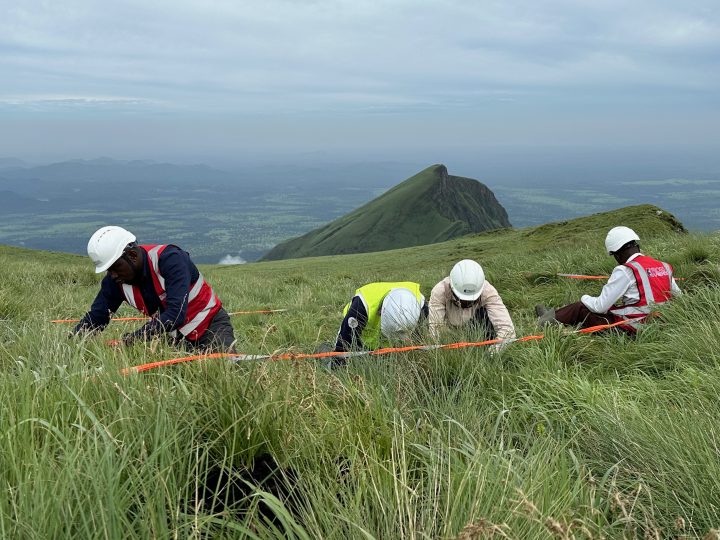
Just 150km south, another “jewel in the African iron ore landscape,” the Mount Nimba range, which straddles the borders of Guinea, Liberia, and Côte d’Ivoire, is poised for development. A literal white rope divides the Ivanhoe Atlantic concession, owned by US mining magnate Robert Friedland, from the Mount Nimba Strict Nature Reserve, a UNESCO World Heritage Site that is home to rare endemic species of toads, bats, and butterflies, as well as the critically endangered Western chimpanzee. In Nimba, World Bank experts bet on “forest-smart” mining practices to protect biodiversity, promoting a model of “sustainable mining” that frames technological innovation and environmental responsibility as compatible goals. Beneath this narrative, however, lies a far more complex and contested reality.
In practice, the state often facilitates corporate expropriation of land from agrarian and indigenous communities, lands that are then reclassified as mining concessions or forest reserves. Ecologically destructive extraction and the formal setting aside of land for biodiversity conservation, once opposing agendas, increasingly operate hand in hand. Together, they enable value accumulation through dispossession and privatization, and natural World Heritage Sites across Africa—recognized by UNESCO for their “outstanding universal value”—are increasingly under pressure from extractive industries.
Biodiversity offset programs under the guise of the steel and mining industry’s commitment to sustainability mark the latest chapter in conservation’s alignment with capital expansion. Environmental historian Archana Prasad argues that capitalism resolves its periodic crises through “the reinvention of nature as capital,” generating new opportunities for accumulation. This process relies on expropriation, often through the restructuring of political and economic relationships between the Global North and the Global South. These dynamics are not limited to the private sector: states in the Global South often act in concert with transnational capital, managing natural resources through regimes of control that align national development goals with the interests of its own bourgeoisie and the global economic elite. As the late Zimbabwean scholar and activist Sam Moyo observed, the North-driven environmental agenda is ultimately structured to “reserve more African land and biodiversity for external forces.”
Within this framework, biodiversity and carbon offsets—cornerstones of neoliberal conservation—have become critical tools for mining companies. These schemes, promoted by the International Finance Corporation (IFC), allow firms to meet environmental standards while continuing large-scale extraction. ArcelorMittal (AML), the world’s second-largest steel producer, touts its commitment to “smarter steels for people and the planet” through a biodiversity conservation program in Liberia, implemented in the East Nimba Nature Reserve with the help of Conservation International and Fauna & Flora International. Its program is considered a biodiversity offset to compensate for the ecological havoc caused by eating away at nearby mountains that lie outside the park borders. In Guinea, offsets have engendered consequential social and ecological costs. As a condition for IFC financing for a bauxite mine, the Moyen-Bafing National Park was established to protect a population of chimpanzees threatened by extraction. But as Song reports, the process displaced five communities and led to the deaths of up to 400 chimpanzees.
In Guinea, Mount Nimba’s status as a “priceless and irreplaceable asset” has fueled a tense relationship between UNESCO and Ivanhoe Atlantic. Yet despite this friction, Ivanhoe has invested heavily in the area. Since completing its exploration phase in 2013, the company has supported annual monitoring of “single-site endemic species” such as the Nimba toad, the world’s only known true viviparous amphibian. Assertions of “universal value,” while not explicitly market-based, reflect an expert-driven, hegemonic narrative that often erases the plural meanings these landscapes hold for local communities.
“We want both—[mineral] exploitation and conservation,” say many Guinean state conservationists, some frustrated by the decade-long delay of mining operations, which some partly blame on “a few frogs.” Conservation and extraction, it seems, are not opposites but mirror industries: both turn rocks and animals into tradable assets, speculating on markets, while deflecting the material consequences. Promises of tourism, conservation-linked livelihoods, and mining revenues circulate as symbolic currencies in meetings with “community partners,” while the true beneficiaries remain obscure. Such claims echo the speculative promises made by corporate actors: both hinge on imagined futures of value creation, often detached from local realities.
As geographer Marketta Vuola notes, mining and conservation represent “overlapping commodity frontiers”—frameworks that extract resources and erase alternative relationships with land. In these borderlands of global capitalism, mineral deposits and biodiversity hotspots alike become resources for accumulation, following a logic of enclosure that transforms both nature and territory into assets. The language of “resources” serves to legitimize the neoliberalization of conservation, a dynamic illustrated by the World Bank’s promotion of “strategic mineral and natural resource management” in Guinea, a country often cited as one of the poorest in the world.
Far from signaling a break from the past, the convergence of mining and conservation in West Africa underscores a recurring pattern: conservation refashioned to serve economic imperatives, under the enduring shadow of Africa’s colonial history.