Pints and powerpoints
From IMF history to astrophysics, Nairobi’s Drunken Lectures turn casual drinkers into an engaged public.

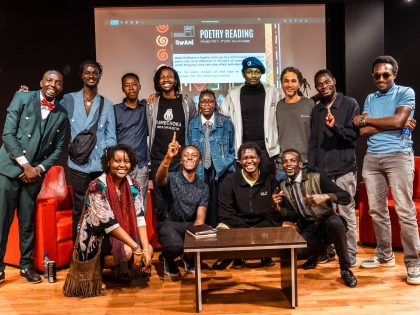
Screenshot from Drunken Lectures and Africa Is a Country © Onesmus Karanja.
Imagine it’s a Monday evening. You’ve probably had a boring day at work, still struggling to find your footing after the long weekend. When the clock hits 5 p.m., you finally clock out. But instead of heading home, you make your way to the bar and order a drink. A day like this calls for something to soothe the soul.
But this isn’t like any other Monday. Lately, Mondays have taken on a new name: Drunken Lectures Mondays. These days, rather than head to the bar just to drink, you also show up to hear a lecture on a chosen topic. You’re relaxed, drink in hand, surrounded by friends—and in that state, you’re ready to think and speak freely. A proper dialectic ensues. Ideas are exchanged, arguments are sharpened, questions asked. That’s the usual scene every other Monday at 254 Beer District in Westlands, Nairobi, where the Drunken Lectures are held. The series began on February 24, 2025, with a lecture titled “The Economy During the First Nyayo Decade,” delivered by yours truly. I took people through the performance of the Kenyan economy between 1978 and 1988, focusing especially on the structural adjustment programs being pushed by the IMF as a condition for the loans they offered Kenya to resuscitate its economy. More than 100 people showed up that night. Not bad for our very first event.
So where did the idea come from? Like many things today, it started on TikTok. Mutinda Kilonzo came across a video of Lectures on Tap in New York, where people were sitting in a bar sipping beer while listening to a lecture. He shared it on Instagram in late December and asked his followers if they would be interested in something similar here. The response was overwhelming. So we got to work. The goal was simple: to create a space for nerds to share what they love. Every day, we meet people who are deeply knowledgeable in their fields, and many of them are hungry to share that knowledge—or to find someone to talk to about it. But they’re often limited. Local universities don’t function as true knowledge hubs, and becoming a lecturer usually requires a master’s degree, which comes with its own set of barriers. That leaves the internet, which doesn’t always provide the kind of interactive, grounded exchange people crave. There’s often a mismatch between those eager to teach and those eager to learn.
We decided to bridge that gap by meeting people where they already are: at the bar. The idea was to take intellectualism out of the lecture hall and return it to a more organic third space—one where people feel comfortable, a little loose, and ready to engage. We weren’t reinventing the wheel. Back in 1995, Wahome Mutahi did something similar when he took theater out of formal halls and into the bars. Through Igiza Productions, he scripted and dramatized Gikuyu plays like Mugaathe Mubogothi (His Excellency the Hallucinator) and Igoti ria Muigi (The People’s Court), staging them in places like Ngara and Nyeri so that everyone had a chance to see them.
In fact, bars have long served as intellectual spaces. Impressionism was born out of barroom conversations among Edouard Manet, Claude Monet, Pierre-Auguste Renoir, Paul Cézanne, and others at Café Guerbois in Paris. Existentialism, too, took shape through discussions among Jean-Paul Sartre, Simone de Beauvoir, Raymond Aron, Albert Camus, and Martin Heidegger over apricot cocktails at the Bec-de-Gaz. Across history, bars have always made space for dissent, experimentation, and the exchange of ideas.
Cognizant of this tradition, we felt it was important to take matters into our own hands—to take back intellectual life and bring it to the bar, where people can talk freely, their minds loosened not only by drink but by the casual, collective energy of the space itself.
Behind the scenes, the idea quickly grew into a fully fledged operation. After floating the concept, Mutinda Kilonzo began assembling a team. First, he brought on Matthias Mwangi as the resources and logistics manager, responsible for partnerships and the welfare of the team. Then I joined as lectures coordinator, in charge of curating the lectures we host. We use a Google Form where prospective lecturers apply by submitting their name, the title of their proposed lecture, a detailed breakdown of their content, and an explanation of why they believe their topic matters. Based on its relevance and the strength of the proposal, I select the lecture for the upcoming session.
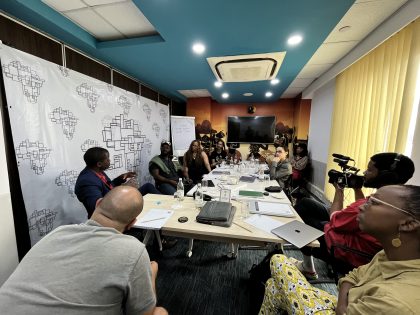
Once chosen, the lecturer prepares a PowerPoint presentation and conducts a demo lecture over Zoom with me and Gaul Saul Simiyu, our lead researcher. The demo is more than a dry run—it’s an interactive session where the lecturer teaches as they would to a crowd. Gaul and I provide suggestions, identify weak points, and help fine-tune the flow of the talk. Where needed, Gaul also helps build out research or refine slides.
We also have a dedicated media team: Anthony Kabuthu serves as official photographer and Ernest Mungai as videographer. You can see their work on our social media pages—sharp, energetic, and full of life. Our communications lead, Jemimah Mukasa, handles our digital presence and sends out our official newsletter. On the ground, our operations are run by Ted Muhota Wambugu and Winstone Odhiambo, while our emcee and host, Timothy “Hamster” Mbuthia—easily the funniest millennial on earth—keeps the mood light and the energy high. At the center of it all is Mutinda himself, managing the brand and curating every event. He handles marketing, community building, media engagements—basically everything that gives Drunken Lectures its pulse.
With the team in place, the program settled into a rhythm. Gates open at 5:30 p.m., and by 6, the event kicks off with a group presentation. Each table becomes a group—usually eight people—and they’re handed a sarcastic or provocative prompt inspired by the evening’s topic. One member presents the group’s defence at the front, and the funniest group—judged by crowd reaction—wins a prize. For instance, during the lecture “Why Your Votes (Don’t) Count,” one group was asked to argue that “people’s votes shouldn’t be deemed equal, and should vary depending on one’s education, wealth, or career.” That meant explaining why a rich, educated doctor should get three votes, while a rural farmer’s vote might not even count. Just for laughs—but also, strangely illuminating.
At 7 p.m., the main lecture begins. The bar is fitted with five screens, and attendees can also follow the PowerPoint presentation on their phones via a shared Google Drive link. After the hour-long lecture, there’s a Q and A from 8 to 8:30 p.m., where audience members dig deeper, challenge ideas, or just satisfy their curiosity. Then we end on a high note: a trivia game based on the evening’s lecture. It runs for half an hour, live on participants’ phones, with prizes for the top three scorers. By 9 p.m., the formal program ends, and people mingle, swap contacts, or quietly slip out.
So far, we’ve hosted 18 lectures. Topics have ranged from politics to brewing, astrophysics to architecture. Keith Ang’ana opened with “The Kenyan Economy During the First Nyayo Decade.” Tracey Mukami spoke on “The Kraft of Beer Brewing.” JohnMark Njihia took us through “The Great Lakes Conflict.” Gakuru delivered a powerful talk on “Art and Its Role in Politics.” Dr. Innocent Ouko explored “The Biological Evolution of Male and Female Attraction.” Gaul Saul Simiyu broke down “The Magic Behind Cars.” Wamboga Okoth compared “Neoliberalism in Kenya vs. Uganda.” Julians Amboko addressed “The Finance Bill 2025.” Prof. Eric Mwaura tackled “The Geometry of the Universe.” Chao Tayiana traced “The Colonial Roots of Police Brutality in Kenya.” A stellar trio—John-Allan Namu, Justine Wanda, and Tom Mukhwana—discussed “How Journalism Builds and Breaks Societies.” Wangu wa Majani shared “The Tea Behind Kenyan Tea.” Kimemia Macharia unpacked “Historia ya Ugawanyaji Mashamba Nchini Kenya.” Mega Muia dissected “The Art of Stealing Music in Kenya.” Wakili Mutua Mutuku asked, provocatively, “Is Consent an Illusion?” Brenda Ngoya taught us “How to Design a City.” Brian Sengeli explained “How the Electoral Process Works.” And Wairimu Gathimba offered a sobering lecture on “Debt in the Global South.”
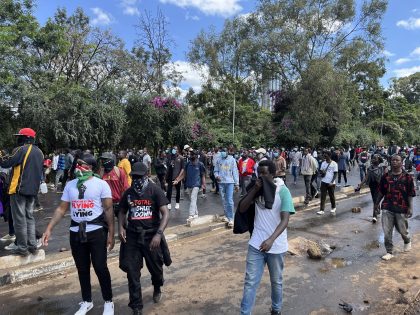
After the June 2025 protests, there emerged a deep hunger for context—for knowledge of Kenya’s long history of political agitation. It felt wrong to be in the streets demanding change without knowing how people had fought, organized, and sacrificed in generations past. That intuition led to the idea of organizing a public festival, one that could blend popular education with culture, music, and memory. We called it Uchungu na Uhuru—Swahili for Pain and Freedom. It took place on Saturday, September 13, 2025, from 2 p.m. to 8 p.m., at Nairobi Street Kitchen. Among our key partners was Africa Is a Country, whose support we remain deeply grateful for.
The festival offered three lectures, an exhibition, and a musical performance. Two of the talks explored how pain and struggle have been central to Kenya’s historical quest for freedom. Ngartia Kimathi gave a powerful lecture on the country’s early resistance movements, tracing how communities mobilized against colonial intrusion from the late 19th century. Then, Kimemia Macharia took us through the complex path toward independence, detailing the strategies and sacrifices that shaped Kenya’s liberation struggle. After these two historically grounded lectures, I presented a talk titled “Why Protests Work (Sometimes).” In it, I traced protest histories ranging from the 1908 Maseno School strike, to the 1922 demonstrations for Harry Thuku’s release, to the 1950s trade union marches, the clandestine organizing of the 1980s, and the iconic protests by the mothers of political prisoners in the 1990s. Each example yielded a lesson. My closing argument was simple: If we are to protest today, let’s do so with knowledge of what has worked, what hasn’t, and why.
To soften the emotional weight of these histories, R&B singer Njoki Karu offered a soul-stirring musical performance. Her renditions of “Mawio” and “Holes” brought a quiet catharsis to the crowd—closing the lecture portion of the festival with intimacy and grace. What followed was a wide-ranging panel discussion, which brought all the lecturers on stage for an open Q and A. Unexpectedly, Boniface Mwangi—who had recently announced his presidential bid—joined the panel and quickly became the focus of questions. Attendees wanted to know how he planned to lead, what distinguished his platform from others, and why he believed he was the one to bring genuine change. For a moment, the stage became a site of radical accountability: a public square, open and unfiltered.
In addition to the talks, the team at PAWA 254 curated a powerful exhibition tracing both Kenya’s first liberation (from colonial rule) and second liberation (for multiparty democracy). It featured unsung heroes, bold organizers, and vivid archival material that mapped the contours of struggle in image and text. PAWA Radio was also present, recording interviews with attendees about their hopes, grievances, and reflections on state power. Our emcee for the day, Kibunja, kept the energy high and the mood vibrant. When the event ended, what lingered was a shared feeling: People left more informed, more grounded, and more hopeful.
So where to next? Mutinda Kilonzo, the driving force behind Drunken Lectures, is now laying plans for a regional tour that will take the format to towns and cities across and beyond Kenya. Everyone, he believes, deserves the chance to experience the magic of public intellectualism in public spaces. Some of these future events may take the form of culturally focused festivals—one for each community in their home county, where people can learn about their histories, see their artifacts, and hear their stories told by one another. Others may carry themes that cross borders: lectures on debt, climate, sexuality, political systems—where the audience spans many regions but shares a common stake. The dream is to organize festivals more regularly, possibly every quarter. The next one might be on finance—an accessible and ambitious deep dive into the structures and myths that shape our relationship to money.
And so, if you’re ever in Nairobi, or if Drunken Lectures passes through your city—inshallah—make a point to join us. Have a drink, learn something, argue a bit, dance a little. See you there.