Wrestling power from political dinosaurs
The passing of Raila Odinga has unsettled Kenya’s political equilibrium, exposing a crowded field of veterans, opportunists, and activists, alongside a growing generational demand to reclaim power from an aging elite.
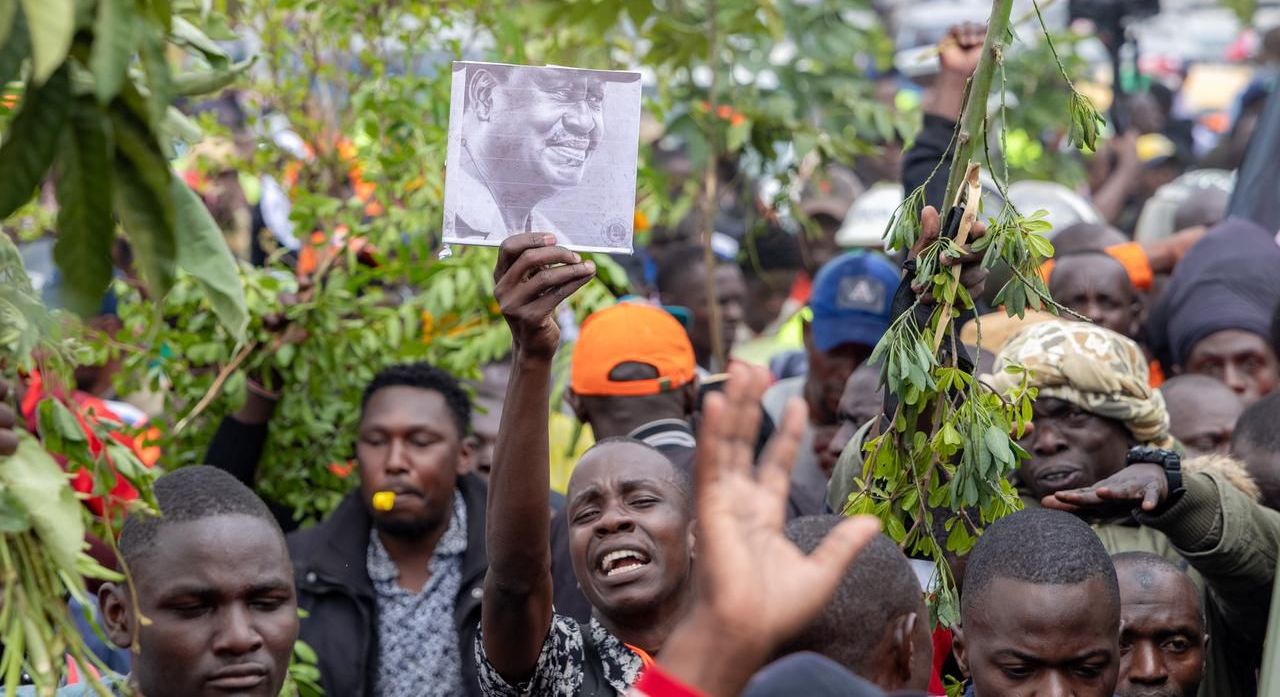
Mourners at the memorial for Raila Amolo Odinga at Kasarani Stadium, Nairobi, October 2025. Image credit Dawan Africa CC BY 4.0.
The last quarter of 2025 jolted Kenya’s political landscape like no other; Raila Odinga, arguably Kenya’s most visible politician in the last three decades, joined his ancestors on the morning of October 15—the master of political handshakes had taken his final bow and exited the political scene for good. Fifth time unlucky as a presidential potentate, it’s believed Raila would have given the presidency a sixth stab, defying all odds, including his advancing age (he would have been 82 in 2027).
In December 2025, the death of another maverick politician, Cyrus Jirongo, shook the nation’s consciousness. Not so much because he was as beloved as Raila, but because of the bizarre nature of his death: Jirongo ostensibly died in a grisly road accident at an ungodly hour of the morning of December 13, 100 kilometres from his home in Nairobi. Many mysteries surround the last hours of his life: he is having a drink with friends in a posh neighborhood of greater Nairobi, and at about 11:30 p.m., he rounds off his stay with a nightcap and heads home to an equally posh neighborhood created for the nouveau riche. How he ended up on the Trans Africa highway, which also leads to his rural home, continues to baffle many Kenyans. Jirongo would have been 65 in March 2026. And he is relevant here because he became infamous for creating a nebulous entity called Youth for Kanu in 1992 (YK 92), which propelled a besieged President Daniel Moi to recapture power in the December 1992 general election, and is the same formation that conscripted and launched one William Ruto, freshly graduated from the University of Nairobi.
At his requiem service on December 30, 2025, retired President Uhuru Kenyatta, among other things, described Jirongo as a man who was fit to be a president. Indeed, in the 2017 general election, Jirongo was one of the eight candidates who were cleared by the Independent Electoral and Boundaries Commission (IEBC) to run for the coveted presidential seat. Would Jirongo have tossed himself into the 2027 presidential contest had he lived?
Nineteen months to the August 10, 2027, presidential election, the candidates have already ballooned to 15, including President Ruto, who will be seeking to win his second term. The only other time we had this many candidates was in 1997: There were 15 candidates that included Moi, who was on his way out, and Mwai Kibaki (who, subsequently, defeated Moi’s protégé, the greenhorn Uhuru Kenyatta in 2002 to become the country’s third president), Raila Odinga, and two female candidates including Wangari Maathai, who later became a Nobel laureate.
After the 1997 general elections, Raila, who ran with the National Democratic Party (NDP), joined Moi’s Kenya African National Union (KANU) party, and was even made its secretary-general. By dissolving his NDP, Raila had essentially initiated his first of several political handshakes. Thereafter, Raila trained his guns on being made the presidential flagbearer in 2002, but Moi had other ideas; he picked a prince, the blue-eyed boy called Uhuru Kenyatta—scion of the larger Kenyatta family. Piqued by Moi’s brazen choice, Raila orchestrated a walkout of the equally resentful KANU stalwarts, and they formed the Liberal Democratic Party (LDP) that joined the National Alliance of Kenya (NAK) and became the National Rainbow Coalition (NARC), of which Kibaki was the frontrunner—Kibaki successfully bid for president with NARC in 2002 and, albeit contentiously, in 2007 .
When Kibaki’s term ended in 2012, Uhuru defeated Raila’s presidential bids in 2013 and 2017. After both defeats, Raila went to court. In 2013, the Supreme Court of Kenya (SCOK) ruled out this petition and said that their case was unconvincing. However, in September 2017, the SCOK, under Chief Justice David Maraga, annulled Uhuru’s Jubilee Party victory and called for fresh elections in 60 days. Unexpectedly, Raila, then the National Super Alliance (NASA) coalition candidate, opted out of the race, and technically, Uhuru ran against himself, to the chagrin of many Kenyans. Even so, on March 9, 2018, Raila, characteristically with an ace up his sleeve, shook hands with Uhuru, undoubtedly his fiercest antagonist, and claimed his third handshake.
Interestingly, Maraga, now retired, will be one of the presidential contenders come 2027. Maraga will be running on a United Green Movement (UGM) party ticket. The UGM party was co-founded by Agostinho Neto, a former MP, to presumably champion green politics, but also after he failed to regain Raila’s party nomination for the 2017 elections. With the former chief justice joining Neto, it isn’t clear whether he joined the party because he’s also a champion of green politics (whatever that means in the Kenyan context), or because he will not have to fight to be nominated as the party presidential flagbearer. Whatever the case, Maraga has been aligning himself with Gen Z, who, in June 2024, jolted the nation with their countrywide protests and shook President Ruto’s government to the extent that he had to occasion a cabinet reshuffle. Maraga projects himself as a clean man untainted by the corruption scandals that seemingly dog many of the political elites. He is calling for constitutional order and claims his government will be a government of law and due diligence. However, in 2027, Maraga will be 76 years old. And it will be interesting to see how he goes about creating the all-important nexus between himself and the Gen Z demographic, if, indeed, he hopes to tap into the single largest non-ethnic voting bloc that could propel his candidature.
It is not only Maraga who is looking to woo Gen Z; spurred on by the June 2024 zillennial zeitgeist, three civil society and political activists have taken up the cue and declared their presidential bids: Bob Njagi, Boniface Mwangi, and Sungu Oyoo. Although they themselves are not Gen Z, they would like to believe they are closer to Gen Z in spirit and political makeup. The activists joined their protests and, as seasoned “street boys,” lent their hands and shared strategies and tactics in dealing with the trigger-happy riot police and paramilitary. But there is also something else, I believe; this is the presidential candidature of Robert Kyagulanyi, a.k.a. Bobi Wine, in neighboring Uganda. Bobi, the former MP, was only four years old when President Yoweri Kaguta Museveni stomped into Kampala City and effectively became president in 1986. Four decades later, Museveni is still at the helm, and won the presidency again after ethe lections on January 15, 2026. I don’t think Bobi has caused Museveni sleepless nights, but he has agonized over the fact that a young man old enough to be his last born son has been drawing organic crowds better than the choreographed National Resistance Movement (NRM) ones. Bobi, apparently, serves as a good model for the younger generation across East Africa that is keen to wrestle power from the political dinosaurs.
The double abductee Njagi announced his candidature on November 12, 2025. Njagi has had the rare distinction of being abducted by both the governments of Kenya and Uganda. In 2024, Njagi was abducted by the Kenya police following the wave of Gen Z protests. In October 2025, he was kidnapped alongside a friend, Nicholas Oyoo, by Ugandan police in central Kampala; without a doubt, this was a kidnapping sanctioned by the Ugandan state, and which Museveni openly bragged about.
Sungu will be running on a Kenya Left Alliance platform, courtesy of the Ukweli (Truth) Party. The Ukweli Party was co-founded by activist Boniface Mwangi, who, in 2017, tried his hand at urban politics by unsuccessfully vying for a parliamentary position in Nairobi. If, as Sungu claims, he will be running as the candidate for the Ukweli Party, what platform will Mwangi run on? When launching his bid in August 2025, Mwangi never spoke of the party he will use; of course it is assumed it will be the Ukweli Party, in which case, then, he and Oyoo will have to square off for the nomination ticket.
The troika of Njagi, Oyoo, and Mwangi are not the only activists who will be throwing their hats into the ring; Okoiti Omtatah, the current senator of Busia County, will also be vying subject to the report of an exploratory team that he set up in November 2024 to traverse the country and determine the suitability and viability of his bid for the top seat. The ten-member team was given 18 months to do this work, and to report back to Okoiti by May 2026. For close to three decades, Okoiti has stamped his authority as a preeminent social and political activist in this part of the world. A playwright of note, Okoiti is also the Rambo of constitutional litigation in Kenya, a venerable one-man army and peoples’ advocate, who has battled with the state over matters of constitution and constitutionalism.
Since the onset of the return to multiparty politics 35 years ago, there have been other nondescript characters that have vied for the presidency, oftentimes for the feel-good factor. In 2027, there will be no shortage of them: They include Ruth Odinga, a younger sister to departed Raila Odinga, who publicly said that she was considering vying for the presidency a month after her brother’s death. And Fred Ogola, an economist and virulent critic of President Ruto, has also said he will toss himself into the ring.
In another interesting twist, Oburu Odinga, Raila’s brother, said that he, too, will be gunning for the presidency if the Orange Democratic Party (ODM) opts to field a candidate. As the interim party leader of ODM, Raila’s party, this “youth leader” will be 84 in 2027 and will be the oldest of the presidential contestants. It looks like the Odinga family isn’t ready to forgo the presidential ambition that has eluded them since the days of the patriarch Jaramogi Oginga Odinga, who first ran for this seat in 1992.
Presumably, the biggest threat to President Ruto’s second term will come from the fragile and nascent “United Opposition,” a motley group of oldies and has-been politicians, some of whom are hoping to cap their political careers by capturing the presidency. The senior most of this political cabal is Kalonzo: He will be 74 in 2027, and has been everything but president. In the controversial elections of 2007, which led to the post-election violence (PEV), he came third after Kibaki and Raila. In the subsequent Government of National Unity (GNU), formed to assuage and incorporate Raila, who then became the country’s second prime minister, Kibaki named Kalonzo his vice president. Kalonzo hoped Kibaki would lend him support after his final term ended, principally for saving him from the jaws of Raila’s defeat. Kibaki didn’t, and for the next decade, from 2012, he commenced his dalliance with Raila, serving as his running mate in 2013 and 2017. In 2027, Kalonzo will again run for the presidency under a revamped Wiper Democratic Front Party. Also within the United Opposition, Matiang’i strikes one as the odd man out: a former powerful super Cabinet secretary in Uhuru’s government, he was endorsed on October 30, 2025, as the Jubilee Party flagbearer. Matiang’i has been described as Uhuru’s marionette, with many within the opposition ranks suspiciously viewing him as Uhuru’s project.
The impeachment of former Deputy President Rigathi Gachagua, in October 2024, was meant to bury his career but has instead catapulted him to national fame. In February 2025, he formed the Democratic Citizen Party (DCP), and Gachagua, also within the “United Opposition,” has now said he will run for president in 2027, notwithstanding his impeachment barring him from contesting any political seat.
On December 30, 2025, Kalonzo said the United Opposition will announce its consensus flagbearer in April 2026. It is probably a badly kept secret that the candidate is Kalonzo himself. But, in the new year, Gachagua contradicted Kalonzo and said the “united” candidate will not be revealed until three months before the August 2027 election.
Outside of the United Opposition, but still noteworthy, is the candidature of businessman Jimi Wanjigi. If there’s an opposition figure who has enlightened Kenyans on the debilitating, mounting, and odious debt that is threatening to strangle the country’s economy, it is Jimi. He has continually and single-handedly broadcast and elevated the national debt discourse to the lips of every Kenyan of all walks of life.
Even as he looms large in the histories of many of these “oldies” candidates, for the first time in 30 years, Raila Odinga will not personally be a factor in the coming general election. Or will he? In all the preceding elections since 1997, he largely dictated the pace and rhythm of the electioneering process. What or who will dictate the pace of the 2027 campaign rhythm? In the coming days, we will soon get an answer to this all-important question.