How to fix a match for $280
Burundi’s football league rarely draws headlines—making it an easy target for match-fixing networks now entrenched in its top division.
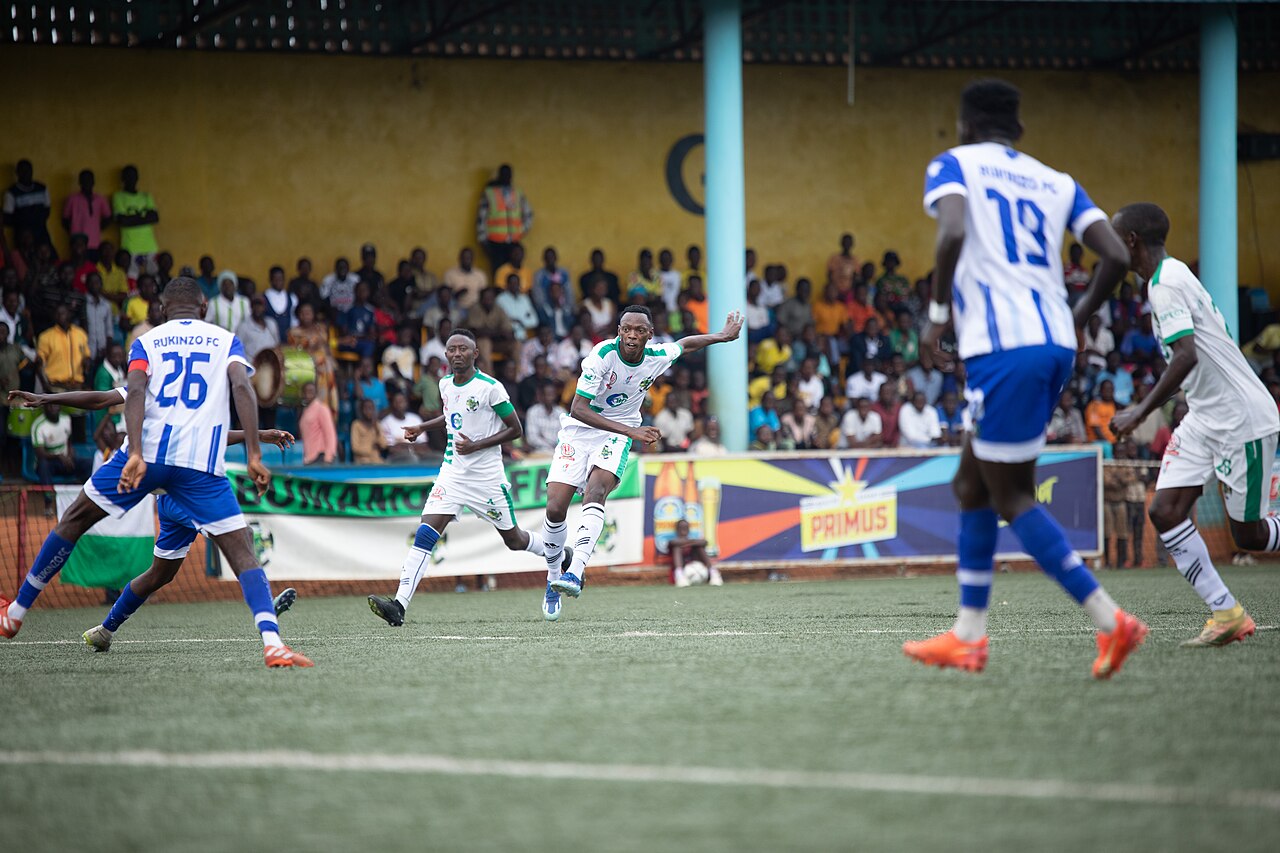
Burundi Premier League competition at Urunani stadium, 2025. Image credit Patrick Found via Wikimedia Commons (Public Domain).
In October 2025, the International Betting Integrity Association (IBIA) flagged five suspicious bets placed on Burundian league matches between June and September of the previous year. These were the first such alerts the organization had recorded in the country since 2020.
FIFA had already been in contact with the Burundi Football Federation (FFB) earlier that year over suspected manipulation in the top flight. Alexandre Muyenge, the President of the FFB, and also a police brigadier general, moved quickly, notifying national authorities and stepping up surveillance efforts.
All coaches, players, officials and independent observers contacted during this investigation maintain that match-fixing has become routine in Burundi’s top division. One club, in particular, Deira Academy, stands out to investigators above all others.
On October 30, 2024, Deira hosted Lydia Ludic Burundi Academic FC. Until that point in the season, LLB Academic FC had collected zero points from six games, and they had even been thrashed 9-1 by Musongati. Yet, in this match, LLB Academic stunned onlookers by scoring first. They were then pegged back for the duration of the match until they scored a decisive second-half winner to register their first points of the season. For those who had placed live bets on the outcome at the right moment, as the odds shifted, the returns were considerable.
Other matches also alarmed the authorities, who ultimately arrested six players (Masumbuko Jules, Ndayishimiye Gloire, Nzoyisaba Epimaque, Ntahoturi Hussein, Uwimana Morgan and Shabani Ramadhan) and Deira’s coach (Jaffar Djumapili) on charges of match-fixing before the end of the calendar year. They have since been released.
Aware of the growing problem, the FFB organized an integrity workshop in January 2025, targeting referees from the first and second divisions in particular. It was a commendable initiative, though it drew some criticism given that the federation announced a partnership with betting operator 1XBet just five days later.
To his credit, President Muyenge has not sought to minimize the problem, describing a grim reality with regional, continental, and even international ramifications. “No team is spared,” he said. “Match-fixing is present in every club in Ligue A.” In mid-January, Gilbert Nkurunziza of Burundi-Eco spoke to the FFB president, who noted: “The people involved in match-fixing come from all over the world—Russians, Belgians, French, Congolese, Ugandans, etc.”
The Ugandan connection is particularly telling. Uganda is among the most match-fixing-affected countries in the region, alongside Kenya. In June 2024, the Ugandan federation suspended 13 individuals (including 10 referees) with links to a criminal syndicate believed to be directed from South Africa. In March 2026, five more were provisionally suspended over a December 2024 match between Kitara FC and Express FC that ended 7-0. Beneath those headline cases lies a broader infrastructure from Kampala and Nairobi that regional fixing networks have long operated within. Now neighboring countries are increasingly in their sights.
Ugandan operatives had already set up networks in Burundi around 2020, when a series of international alerts led to arrests. Since then, Kenyan, Ugandan, and Congolese middlemen have acted as local brokers for larger continental and international organizations.
The logic is straightforward. “Burundi was an obvious choice,” said one investigator working for an international body that monitors betting markets, speaking on condition of anonymity:
We were used to numerous alerts in Southern Africa and some in East Africa, mainly in Kenya and Uganda, but the phenomenon has grown in this region. The Burundi championship gets almost no media coverage, and the players earn next to nothing. Fixing a result here is cheap.
The average Burundian footballer in the top division earns around $30 a month, in a country where 87% of the population lives on less than $2 a day, according to the World Bank. For criminal syndicates that place hundreds of thousands of dollars to launder money or simply turn a profit, the cost of corrupting players is negligible.
According to the various sources interviewed during this investigation, sums as little as $100 or $200 are sometimes enough to corrupt a player. “Relative to the standard of living here, that’s six months of peace of mind for the family,” one of them noted.
Payments rarely exceed $1,000, a trivial sum for the organizations behind the schemes, which are carefully insulated by layers of intermediaries. More worryingly, Burundian players and officials have begun acting as fixers themselves, cutting out neighboring East African middlemen.
An FFB spokesperson described how the investigation unfolded:
Interpol provided the initial intelligence, and we worked with national authorities from there. We found that external actors were paying players, coaches and club officials to deliver pre-arranged scores. Sometimes this was for an entire match, sometimes just a half or a specific minute. Since last season, several betting operators have also come to us directly. They were seeing new accounts being opened and those same people betting on the same matches with exact scores.
While the federation’s efforts deserve recognition, the “vast network” described will require sustained support from international governing bodies, including FIFA, which did not respond to requests for comment. Separately, FIFA has faced criticism from the Afghan national team players over its handling of match-fixing allegations against officials of the Afghan federation.
Deira Academy goalkeeper Epimaque Nzoyisaba provided investigators with a window into how the operation worked. He described being contacted through a US phone number by someone known only as the “American Ninja,” alongside a Kenyan and a Russian whose identities he never learned.
A man named Morisho Kibasomba—now being sought by authorities—paid Nzoyisaba the equivalent of roughly $2,700 to fix the match against Vital’o. A second contact, identified only as “Alain” and also wanted by authorities, offered him around $6,730 to engineer a six-goal defeat to Olympic Star. That deal fell through when the players refused to go along with such a lopsided scoreline.
Nzoyisaba then recruited his own teammates—and the club’s technical director—distributing approximately $280 each to ensure the 0-3 loss to Vital’o went as planned. In March 2025, the FFB’s Ethics and Discipline Commission handed five-year bans and fines of around $3,300 to eight individuals, including players from Deira Academy and one from Inter Star.
“It has become so widespread here that our own players now act as fixers for foreign organizations,” lamented a Burundian coach speaking anonymously. “It’s a way to make quick money, and given that our championship is relatively low-profile…”
Despite the arrests and suspensions, the networks have not retreated. The “American Ninja,” according to sources, was exploring the possibility of purchasing a club outright, which could provide them control from the inside. Who exactly is operating behind that pseudonym, connected to an untraceable US number and anonymous accomplices across multiple countries, remains unknown.
For his part, President Muyenge strikes a cautiously optimistic note. “We continue to fight this plague,” he said, “and we are halfway satisfied compared to last year. Its scale has noticeably diminished.”
Yet what cannot be denied is that Burundi has become the latest quiet frontier in a global match-fixing industry that keeps finding new places to operate.