African Hospitality
The artist Andrew Putter make use of the past to construct images of how we might live together in the future.
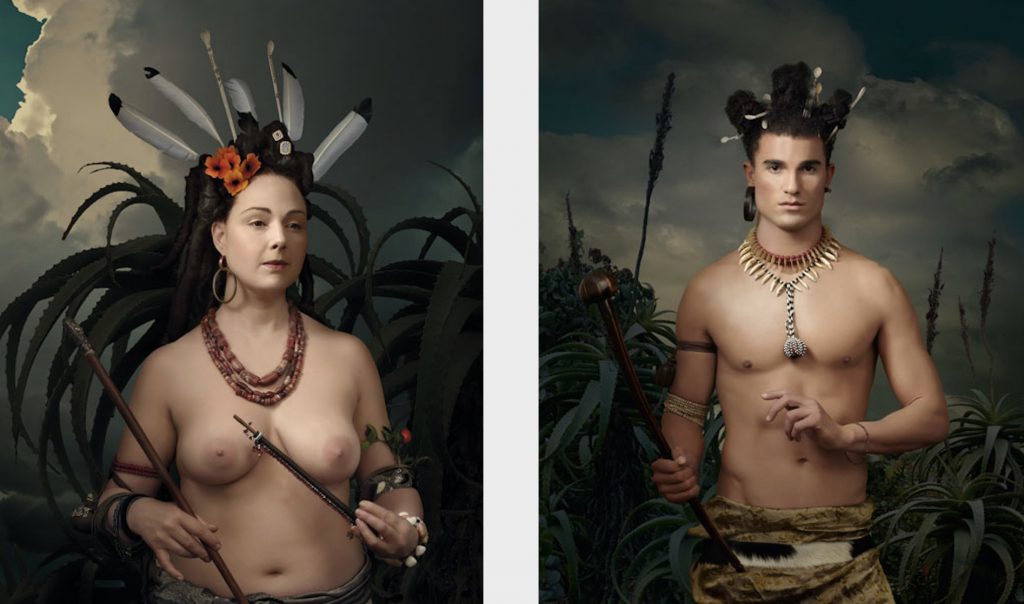
Bessie and Joao Joao the Portuguese (From the series African Hospitality; Courtesy of Michael Stevenson).
This series of staged photographs by artist Andrew Putter (it was exhibited in South Africa earlier this year) that draws on the style of 18th century European painting, specifically the painting “African Hospitality,” painted in 1790 by George Morland, that, according to information from Putter’s South African gallery, Michael Stevenson “ . . . shows castaways from the Grosvenor (an English ship wrecked on the Wild Coast [on what is now South African Eastern Cape coast] in 1782) being rescued by the native Mpondo . . . ” Others were from shipwrecked Portuguese ships. Some of the castaways “ . . . were taken in by local Xhosa-speaking communities.
Thanks to Waldo Muller for pointing me towards to it.
A number of the European castaways formed deep ties with their African hosts, learning Xhosa, marrying into “the tribe,” and “dying as Africans.” One woman, Bessie (that’s her in the first image in the slideshow above), “ . . . (later) married a chief and became a great Xhosa queen.” All the characters portrayed by Putter are real, but the portrayals are fictional– based on reconstructions. Putter’s aim is to “ . . . make use of the past to construct images of how we might live together in the future.”
Putter draws equally on the cultural histories of Europe and Africa in these works. Although the adornments and landscape are largely south-east African, the poses, compositions and lighting are heavily indebted to 18th-century English painting. Putter proposes that it is not inevitable for one culture to thrive at the expense of another, but that it is possible for new forms to emerge through the interplay of dissimilar cultures. Indeed, he shows that this interplay is already present in colonial history, gently reminding purists that everything is always already a mixture.
I haven’t seen any reviews of the show in the local press especially as it questions and complicates some of the understandings of whiteness in South Africa.