#ThisFlag, social media and political agency in Zimbabwe.
In Zimbabwe, the leap from online conversation to citizen protest has followed the same path as other protest movements around the world.
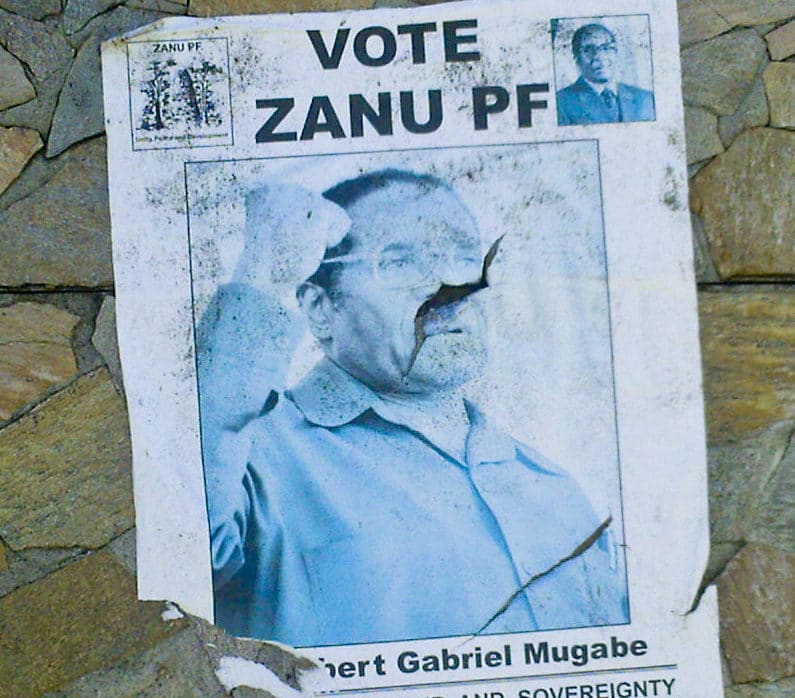
Robert Mugabe on a Zanu PF poster during the 2008 election period. Image Credit: Babak Fakhamzadeh
Late last week, President Robert Mugabe mocked the protest movement that has risen against his governance over the past few months. “Enough is enough,” the President declared, ordering the judiciary to fall in line with government policy, a move widely thought to be authoritarian and a threat to the separation of powers. The phrase “enough is enough” was not accidental. In using it, the President co-opted the slogan-cum-hashtag used by protestors, referencing the movement without naming it.
Earlier this summer, news from Zimbabwe was dominated by seemingly non-partisan protests against Mugabe’s government and the ruling ZANU-PF. The figurehead of these protests was a Baptist pastor, Evan Mawarire, who took to YouTube to express a deep affection for his country and an even deeper frustration with the governance of Zimbabwe. Mawarire’s video, entitled ‘This Flag’, which has been posted on multiple apps, remixed, debated and reported on, has somehow spurred a movement across social media channels that has resulted in the largest sustained protests against bad governance in the country since 2008.
Perhaps when history is eventually written as a series of tweets, a la BuzzFeed, we will come to truly recognize the revolutionary nature and power of the smart phone. But until then, traditional journalism and analysis demands that every time a population uses the tools available to them to voice their frustrations and concerns as a collective, we have to answer the question: “Can social media activism change a country?”
In Zimbabwe, the leap from online conversation to citizen protest has followed the same path as other protest movements around the world. The protests have always come first, the hashtag has followed, and in this case the protests have grown.
Among different, floundering attempts to discredit the protest movement, the most curious tactic employed by the Zimbabwean government has been the state-organized, pro-government protests designed to counter the narrative that the popular uprising is popular at all. Many of these protests have involved recruiting Zanu-PF’s youth wing, a ruling party organization, as well as bussing in rural Zimbabweans to enhance the numbers attending.
The question then, has been asked: are rural Zimbabwean’s pro-Mugabe? Consensus amongst the commentary class seems to be “yes”, the implication being that social media-led protest movements are urban phenomena and are not representative of the rural majority of the country. The narrative suggests that rural Zimbabweans are generally pro-Mugabe, and that urbanites erroneously elevate their current grievances above the ultimate crime against the country that was colonialism.
This analysis is frustrating, if only because it is not nuanced. It assumes a lack of intellectual sophistication and agency in the rural population without evidence to support such claims. It is difficult to say how genuine rural support for the ruling party is. Perhaps the tradition of rural support of the current government is ongoing, however predating the 2009 election, evidence revealed that blind loyalty to the government is no longer the status quo. For as much as the rural population has been the majority of Zanu PF support, the base has had to be coaxed, nurtured, and often times beaten, into alignment.
It is possible that the distinction between voluntary and involuntary political support is insignificant in electoral terms, but it is worth highlighting when the discussion turns to social media and the current protest moment. If rural presence in pro-government “counter protests” is rallied as a form of self preservation against physical violence and economic retribution for non-participation, social media channels, like the almost ubiquitous Facebook instant-messaging entity WhatsApp, provide an outlet to say what you really think.
In the “mobile economy” narrative in which mobile technology is “sweeping across Africa” and revolutionizing communication and banking all over the continent, it seems an improbable argument that social media movements are not penetrating the rural population. It is cognitive dissonance to simultaneously claim that “mobile phones have begun providing a means of communication, connecting Zimbabwe’s rural population with urban dwellers” and that a movement that is being kept alive through social media is somehow a solely urban phenomenon.
In a country with a mobile penetration of 97 percent, perhaps the anonymity of social media profiles and the protection of end-end encrypted instant messaging allows for the first public glimpse of the real leanings of all Zimbabweans, including the rural majority.