Don’t call me Toubab
"White person!," people passing by shout, smiling and waving at me. I am black. I am African. I am Rwandan."
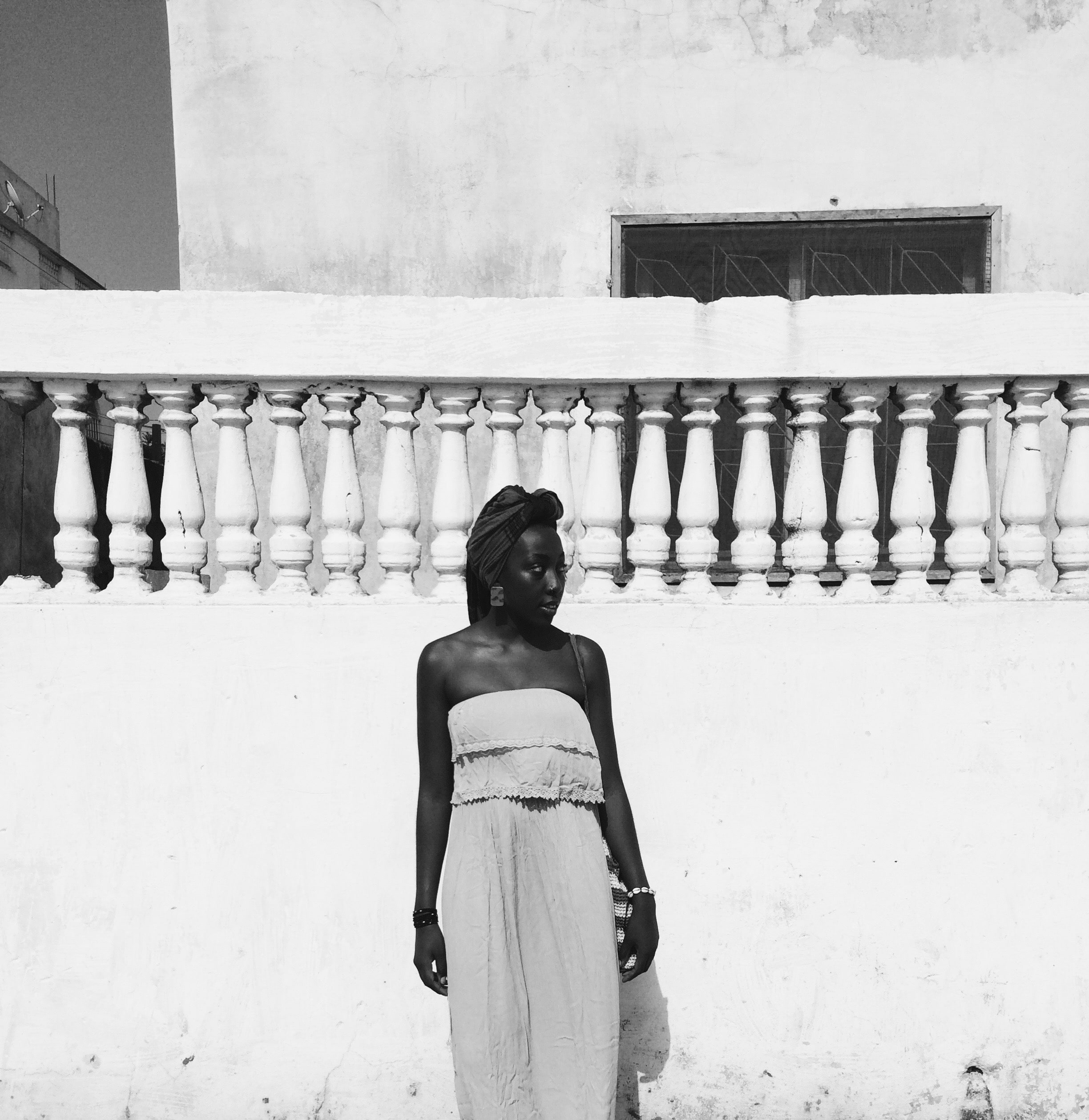
Author in front of Kanifing Estate, Gambia via Instagram.
It is mid-September. I am walking alone in the streets of Old Jeswang, a small neighborhood in Banjul, the capital of The Gambia, where I have been working as a health promotion intern for two weeks. I am wearing an H&M black and white stripped dress, an African print head wrap and pendant earrings.
“Toubab, Toubab, Toubab!” White person. People passing by shout, smiling and waving at me.
I am black. I am African. I am Rwandan. I look around. But there is no one but me. I stop. Partially shocked, partially amused. I wave and smile back. I think to myself, they are just kids. They don’t know. I walk.
Two weeks later, I head to Mustapha’s shop to get chicken and onions for the Yassa Gannarr I am about to cook for the first time. The Mauritanian shop keeper greets me. Amused and as if to provoke me, he calls me “Toubab”.
Not again, I think.
“Duma Toubab!” I am not a Toubab, I reply smiling, to hide what’s boiling inside of me.
Like many other Africans living in the diaspora and traveling to the continent, my trip to The Gambia symbolizes familiarity, comfort and kinship that is somewhat hard to find in places where we are constantly othered. For the first time, there I am not a visible minority. Back in Canada, my blackness goes unquestioned. I am dark. My hair defies gravity.
My trip also means that I can see and experience The Gambia without Eurocentric lenses; on my own terms, not defined by some anthropological jargon-filled book. I am well aware of the many privileges I wear. As an African studies major however, I have grown critical of both overly pessimist and romanticized misrepresentations of Africa as an academic subject.
How dare do they call me Toubab? I am not here for it. I can’t bear to be othered.
I am not one to preach the romanticized unification of Africans or black people as “one people.” I know I am “other.” I am Rwandan and raised in Canada. But somewhere deep down, I wish they recognized a little bit of themselves in me. It is their association of me with whiteness or the West that I can’t take.
When I ask my Gambian friends about the meaning of the term, especially targeted at me, they reply that it is custom to refer to visibly white people and foreigners raised in the West as Toubabs. For them, it is more my lifestyle and habits that define me as a Toubab than my mentality. I am the typical “western lazy student”. I don’t wake up at 6am on weekends to clean my house or cook for the day. However, I adapt fairly easily, eat all local meals with no refrain, and hang out mostly with locals unlike my fellow western friends. Locals call Indians, Lebanese or Chinese people by their respective nationalities regardless of their western upbringing, so why not me?
I reflect a lot on authenticity. What does it mean to be truly “African”? More so, to be a “real African” woman? I surely do not meet the local criteria. Non-African foreigners aren’t expected to enact “authentic Africanness,” but I am, because of my heritage. I have failed at the test and thus, I am Toubab. To them, I am Canadian. Period.
I surely was raised in Canada, but having spent most of my teenage and adult years fighting against skewed beauty standards, ideas of modernity and superiority rooted in white supremacy, I just couldn’t accept it. Even so, because for many, it meant that I was rich, that North America was better than The Gambia. Sure, our living conditions are different, but it is those romanticized ideas of the West that hurt the most.
I do not blame them, though. I realize how much we as diasporans, have a duty to bridge the gap. No more faking that we “made it.” No more romanticized African immigrant tales. As much as I am privileged, being called Toubab also signifies the erasure of my blackness and what it means to be black in white spaces. It signifies the erasure of my upbringing in the West as a Rwandan child, by Rwanda parents, who tried their best to inculcate in me the traditions, culture, history and language of our homeland while navigating exclusion, discrimination and feelings of not belonging.
Taiye Selasi, in her TED Talk (“Don’t ask where I’m from, ask where I’m a local”) proposed that home is where one grew up, lived or worked. As a “multi-local,” she (with British and American passports and living in Rome) rejects the concept of “coming from one country” as countries are merely concepts, their boundaries often unfixed, artificial. But what if my hometown, the country I grew up in hasn’t embraced me as local yet? Where am I local? What if I find solace in the resilience, the culture, the traditions of a land I have never seen?
As a diasporan, the constant quest for authenticity and belonging is one I grapple with on a daily basis. Longing for a land I have never seen. Not being western/White enough. Not being African/Rwandan enough. Processes of identity-making are complex. Ultimately, the hurt is rooted in constant feelings of not belonging. However, I now find solace in knowing that my acceptance is mine alone.