In Guadalajara, we found joy
In Guadalajara, fans from three continents celebrated football together in what was a taste of a World Cup that most won't be able to afford or attend.
All images courtesy of Florian Lefèvre, ©2026.
“Olé! Olé! Olé! Congooo Congooo!”
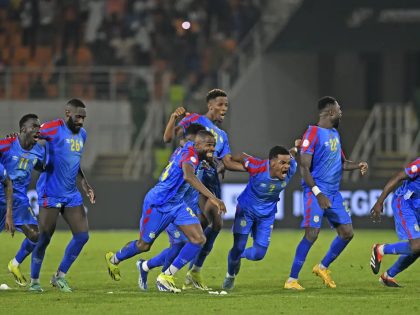
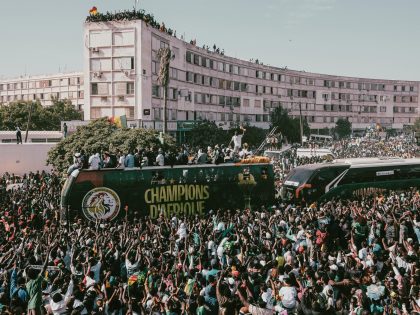
In the bowels of the Guadalajara stadium, Congolese and Mexican fans sang as one to celebrate the Leopards’ historic victory over Jamaica on Tuesday. Fifty-two years after their first appearance as Zaire, the Democratic Republic of the Congo’s men’s national team is back in the World Cup.
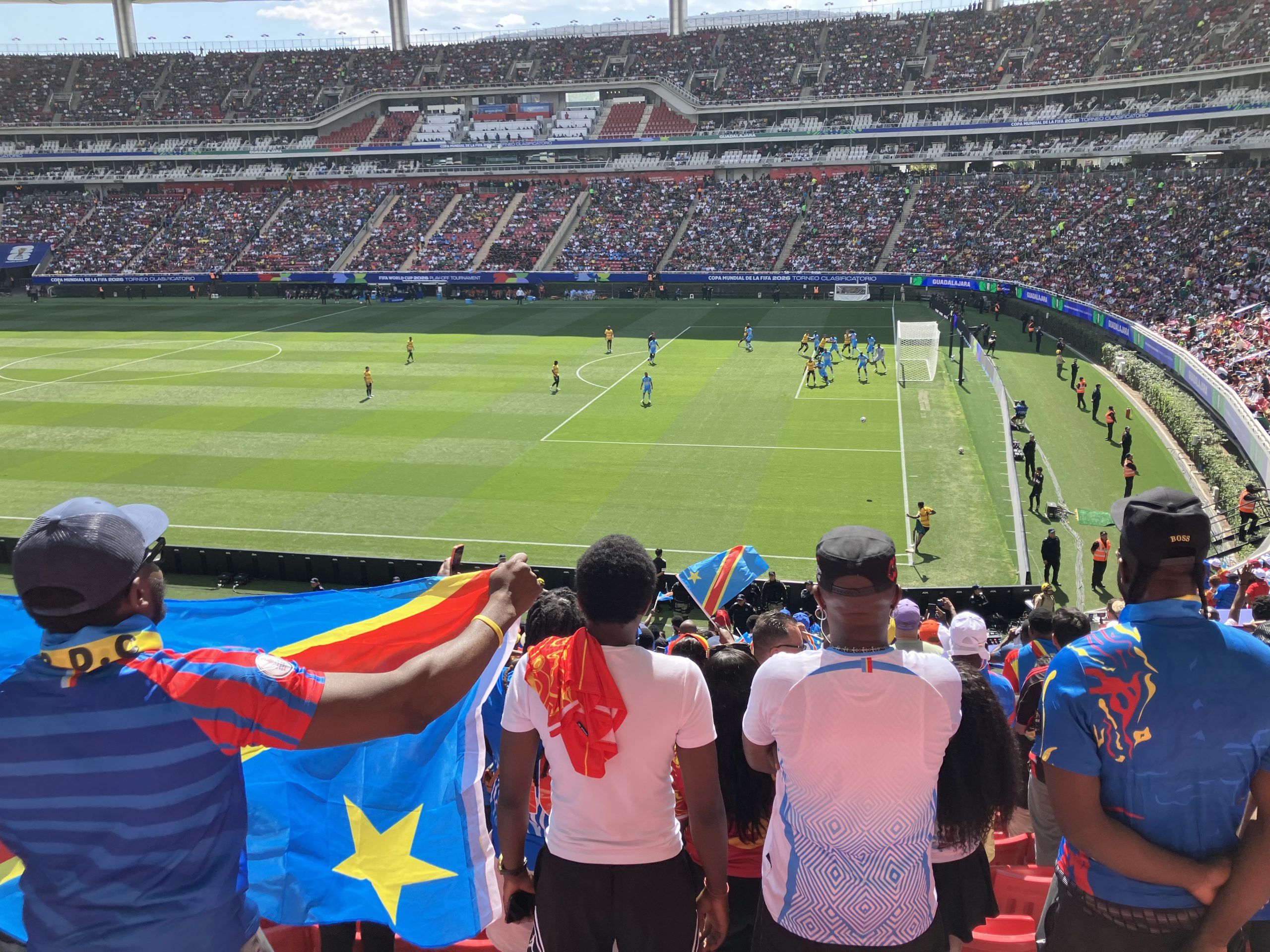
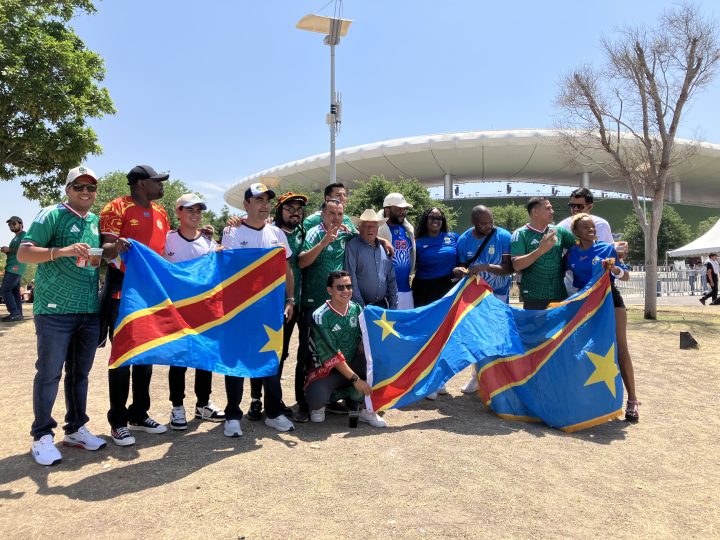
Among the roughly 1,000 Congolese fans, most of whom had come dressed in blue, some left the stadium with Mexico’s green jersey draped over their shoulders. Meanwhile, others continued to jump arm in arm to the beat of “Vamos al Mundial!”
Despite the Reggae Boyz’s loss, Amoy is still smiling. She traveled from Mexico City with her husband and is the owner of a Jamaican restaurant featuring specialties “made with chicken, of course”. She made the trip to share in the excitement. “It’s always ‘One Love’ with the Mexicans,” she laughs.
But are the scenes in Guadalajara a preview of what’s to come next summer in the United States, Mexico, and Canada? Or are they a stand-alone moment that will leave mostly nostalgia in its wake? Despite the “Football Unites the World” tagline on FIFA billboards, the next World Cup will, in reality, be reserved for the wealthy with the “right” passports.
Ticket prices for this intercontinental playoff were on sale at a flat rate of 300 pesos (about $17 USD), yet for the Mexico-South Korea match on June 18, the same seats in the stadium’s lower bowl cost $445 USD—26 times more! The same is true for other first-round matches as only a small fraction of tickets were available for less than $260 to the lucky winners of the online ticket queue.
Prior to the DR Congo vs Jamaica match, Carlos Alberto, a psychiatric hospital nurse who was attending the play-off with his family, admitted that he would have to settle for watching the matches on TV. For the play-off, he decided to take advantage of the reasonable prices to “soak up that World Cup atmosphere” with his wife, nephews, nieces, and 88-year-old father, who named him after the legendary Brazilian defender from the 1970 World Cup in Mexico.
A little further on outside the ground, some Mexican fans were learning the Congolese fimbu dance. “This atmosphere is much more popular than what you’ll see next summer,” admits Carlos Alberto.
I also met a Congolese supporter named Jonathan outside the ground. He was wearing a blood-red DR Congo shirt and had a national flag tied around his waist. After taking plenty of photos with locals, he took a break to charge his phone in a small shop selling Chivas jerseys. The young father in his thirties is a member of the diaspora in the United States and says, “If we qualify, it will be a historic day that we’ll tell our children about.”
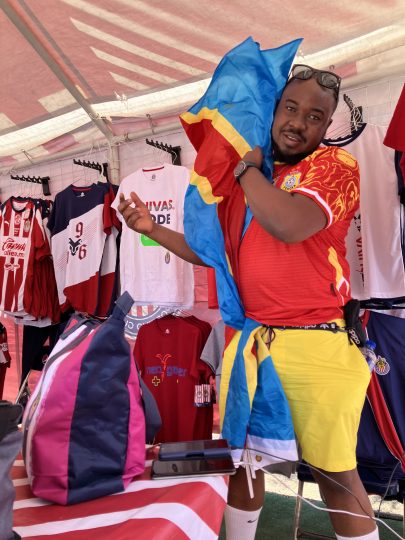
“The Mexicans are really warm,” he adds, explaining that he visited a tequila distillery the day before, indulging in the region’s famous specialty.
Unfortunately, the capital of the state of Jalisco is also sadly known for having the highest number of missing persons in Mexico. In February, chaos orchestrated by a powerful criminal organization paralyzed the city, and images of burnt vehicles blocking roads were broadcast around the world.
Around the stadium, thousands of police officers and soldiers were visibly armed to the teeth, as a show of security force.
“Since I arrived on Sunday with my mother, we’ve visited the heart of the city—the cathedral, the frescoes at the Cabañas Hospice—and we’ve never felt threatened,” asserts Robert, a member of the Jamaican diaspora in Florida.
Indeed, the retired U.S. Air Force pilot can’t stop raving about Guadalajara: “It’s just amazing. Guadalajara is a fantastic city with a world-class stadium,” he says, pointing to the stadium perched on a grassy hill.
When Jamaica defeated New Caledonia in the first intercontinental playoff a few days prior, I had seen Mexican fans turned away at the entrance with a hand-sewn Kanaky*. The ostensible reason is that it was deemed too large (over 1.2 meters). For the DR Congo Jamaica match a few days later, we saw security refuse entry with handheld cameras and dreadlock wigs. We also didn’t hear the usual drums that set the rhythm for Congolese chants, suppressed in favour of FIFA regulations, and an ideal, clean, sterile atmosphere we will experience in US sports stadiums.
At kickoff, many seats remained empty in the section where about 1,000 Congolese fans were gathered. A large portion of the diaspora had traveled from the United States and Canada. Others had arrived on a government-chartered flight from Kinshasa. Yet, many were also stranded in the country due to a lack of visas, including the now-famous Michel Kuka Mboladinga, a lookalike of Patrice Lumumba, a figure of Congolese independence.
“It was very difficult to get visas for fans in the country,” laments Brusny, who lives between Kinshasa and Paris and would not have been able to come without presenting a European document.
For those who have the desire and the money to follow the Leopards next summer, that’s another story altogether. The DR Congo is one of several African and Central American countries on the U.S. blacklist.
On top of the cost of tickets, hotels, and travel, as well as visa restrictions, there’s the threat of immigration and border police, who kill people in the streets and track down immigrants at stadium gates.
Sandra lives in Oklahoma, but she—like her cousin, Chandelier—would have preferred that the long-awaited event take place in another country. “I don’t even think it’s safe for us,” confides the young Congolese woman, preferring not to go into details. “The World Cup is supposed to bring people together. In the United States, that’s not what’s happening with Trump,” concludes Sandra.
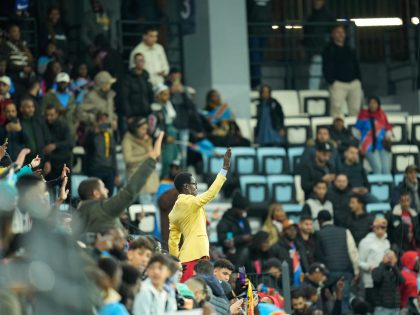
In the second half, the Leopards’ section of the stands draws neutral supporters. Young Mexicans, drawn by the atmosphere, came to mingle with their “Congolese brothers,” as a Spanish song sung in unison put it.
Together, they erupted in joy when Axel Tuanzebe opened the scoring in the 100th minute from a corner kick. Then, a second time after a tense moment during the Video Assistant Review.
Shortly thereafter, it was time for a souvenir photo with the players to celebrate their historic qualification. In the stadium corridors, the Congolese are now chanting “Viva México!” I think back to Jonathan, who will definitely tell his children about this afternoon in a few years.
DR Congo and their fans will be back at this same Guadalajara stadium on June 23, this time to face Colombia in Group K—no longer as hopeful qualifiers, but as World Cup participants. Though, as ever, only the fortunate few with visas in hand will be able to make the journey.