Art has never been innocent
Paulo Nazareth's latest show in Berlin follows the cunning architecture of power, from Germany to Brazil and across continents and epochs.
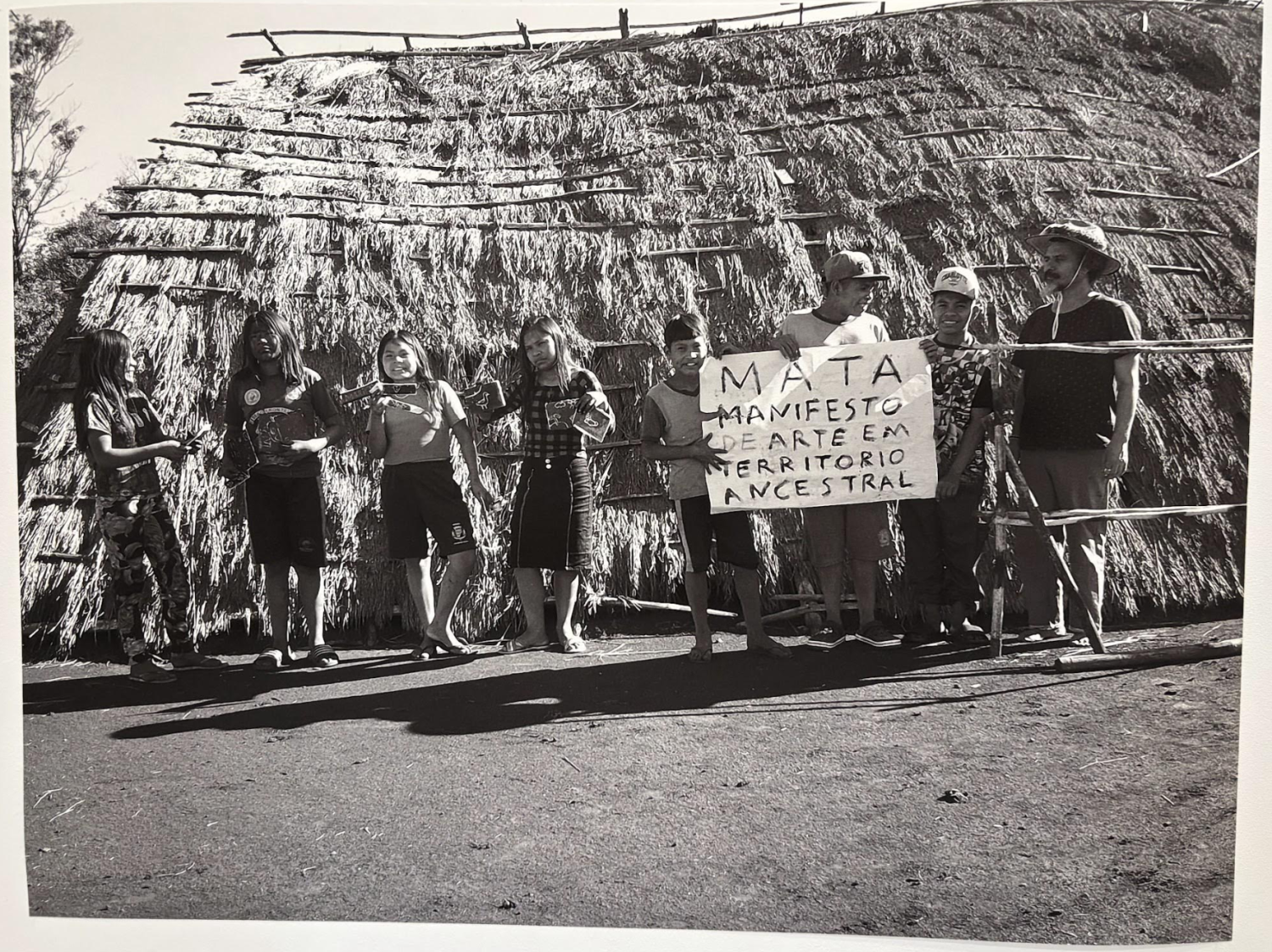
Paulo Nazareth, MATA MANIFESTO DE ARTE EM TERRITÓRIO ANCESTRAL, 2025, fine art print on cotton paper, 45 x 60 cm. Image courtesy of the artist.
There is something undeniably strange about seeing an artist’s solo exhibition in a land he refuses to set foot in. Yet, I couldn’t help but see Paulo Nazareth in one of his eight 180cm-tall posts at Meyer Riegger, Berlin. In IT’S ALL THE SAME TO HIM (2025), the only post not painted with conflicting propaganda from pre-reunification Germany, “him” is either a divine entity or science personified, broadcasting that racialization is not supported by blood evidence. His show ALLEMANN binds German to Brazilian land through past and present violence in linguistic plays that speak broadly to how power’s logics always find concrete ground.
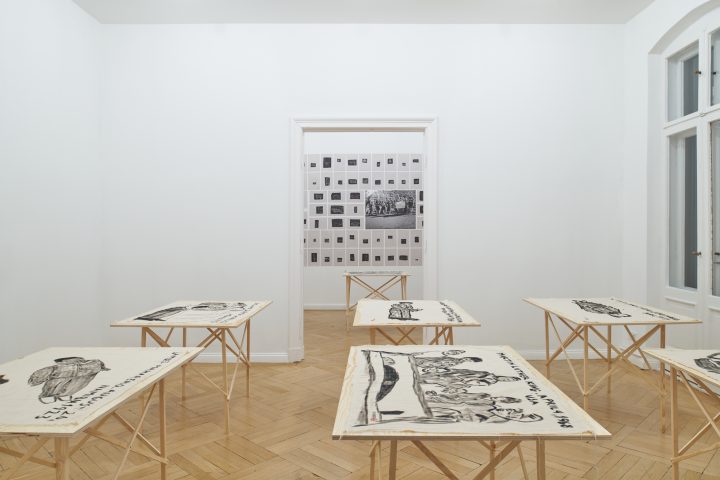
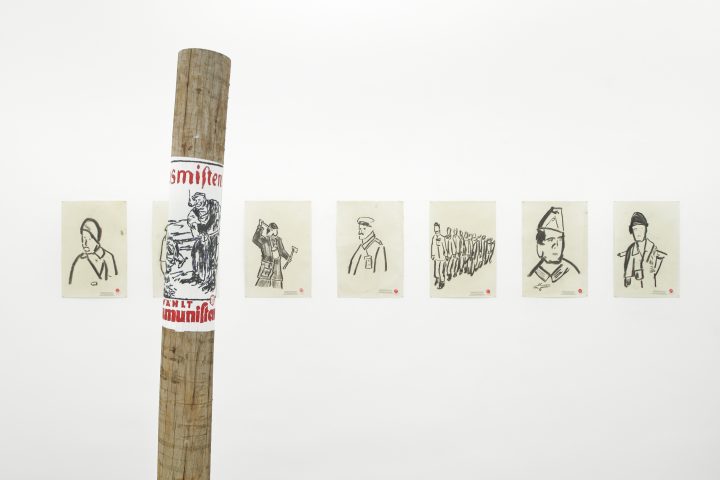
Because language is an effective marginalizing weapon, Nazareth often twists it, as in the exhibition title, where the Portuguese for “German” becomes a word that speaks to otherness in both languages. In German, alle Mann signals the idea of the “universal man”; in popular Brazilian Portuguese, alemão has come to mean the antagonist. But for Nazareth, language is never abstract. In the first exhibition room of his show, the eight posts with communist and anti-communist propaganda have a shape that recalls a brutal colonizing apparatus, and their eucalyptus material speaks to the persistent deforestation of extractive capitalism. Sanctioned violence is articulated so sharply that bodies are conjured in that space. Haunting these central posts, the 2025 charcoal drawing series Everything I was taught about the German soldier in USA movies features soldier figures that seem to emerge from First World War trenches, the cangaço of the Brazilian sertão, and Bram Stoker’s Gothic terror. In the violent power plays of dominant politics, ignorance can never go missing.
Nazareth carries the air of a wandering prophet. For more than 15 years, the artist has been systematically traveling, often barefoot, across the Americas and the African continent, summoning ancestrality through ritualistic walking. He refuses to set foot in Europe until he has walked all 54 African nations, and yet his work has been crossing that border for more than a decade—an echo of the typical South-North exchange. This year alone, besides his show in Germany, the artist presents work at Punta della Dogana parallel to the Venice Biennale.
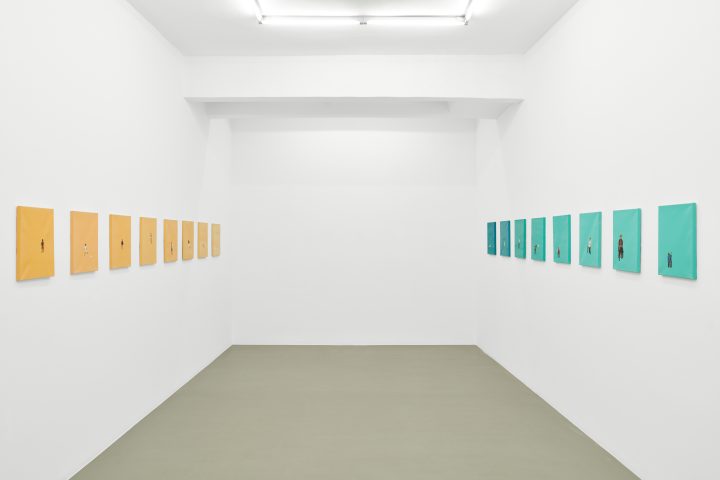
Evoking the pivotal era of transoceanic European exploration, the 2025 small-scale paintings Verde establish a rhythmic visual correspondence with the formally similar 2025 paintings of Amarelo-Laranja, in which solitary figures, carrying a football, heavy weaponry, and a school backpack, appear as creatures of their landscape. They made me think of Nazareth’s indignation at his college art professor saying one needs to go to Europe to “actually” learn art. With Nazareth’s pre-linguistic understanding of knowledge (pre-cept), and given how history played out in the Americas, the artist has already received all the European influence he will ever need.
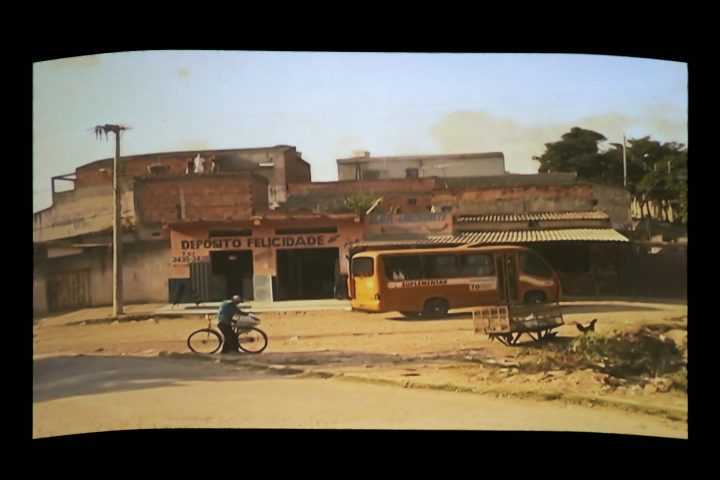
“Being Nazareth is my own work, perhaps the most visible and least visible work,” the artist told the Gargalheiras podcast in 2022. His grandmother’s name was Nazaré, a woman who had her own ways of refusing the system in Minas Gerais, where farmers shaped the fate of the abugraiados—“the Afro-borums with different marks,” as the artist says. To this day, Minas Gerais is a land in many ways the same. In the 2008 video Depósito Felicidade, Nazareth’s natal surroundings are depicted: a tranquil small town where bus, dog, chicken, horse, and bicycle pass in unhurried procession. Has time not yet passed in this mythical place, where the artist traces his ancestry to Luzia, the black woman whose remains are the oldest yet found in the Americas?
Those who connect lands through compulsory displacement are remembered by the artist. In the 2025 painting series RessurreizsaN’o, Olga Benário Prestes, deported by Brazil to Nazi Germany, stands amid a multitude of cotton-thread laying bodies. She is welcomed on German soil once more, this time by revolutionaries spanning centuries and continents—from Palestine’s Jesus to Argentina’s Che Guevara. In the exhibition’s final room, adjacent to the revolutionary icons whose lives were cut short, an installation of 86 woodblock prints of animals surrounds a black-and-white photograph: Indigenous people and Paulo Nazareth assembled before an oca house, holding a sign that is also the work’s title—MATA: Art Manifesto in Ancestral Territory. There is something in how the bodies stand in the photography; some don’t seem to know where to look. An Indigenous child wears a tentative smile, face turned toward where the artist stands. Mata is Portuguese for both forest and kill; art has never been innocent.


