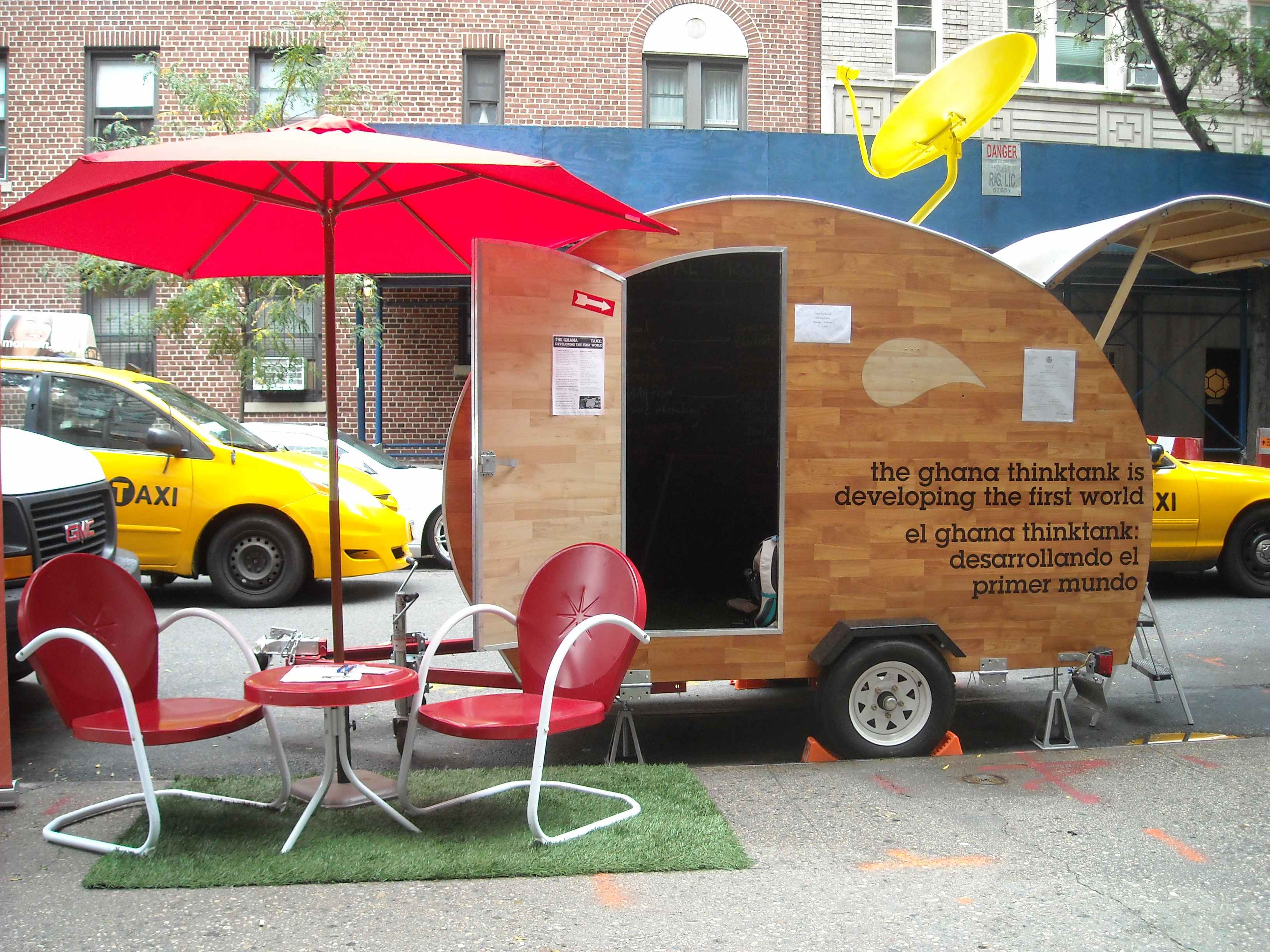
You couldn’t miss this trailer in front of The New School’s West 12th Street building in the West Village last week:

The Ghana ThinkTank Mobile Unit is a custom-built teardrop trailer designed to journey into the so-called “First World,” where it collects issues of concern from various local communities. The collected problems get sent to think tanks in Ghana, Cuba, El Salvador, Mexico, Serbia, Iran, Afghanistan and/or other countries, where strategies are developed. The trailer then rolls back into the previously visited communities, this time as a workstation, cooperating with community members to apply the strategies received from this global network of think tanks—whether they seem impractical or brilliant—for effected communities. Ghana ThinkTank thus reverses the customary flow of knowhow from “developed” to “developing” countries in playful and provocative ways.

Photo Credit: Amanda Ghanooni

Further Reading

Atayese

Honored in Yorubaland as “one who repairs the world,” Jesse Jackson’s life bridged civil rights, pan-Africanism, empire, and contradiction—leaving behind a legacy as expansive as it was imperfect.

Bread or Messi?

Angola’s golden jubilee culminated in a multimillion-dollar match against Argentina. The price tag—and the secrecy around it—divided a nation already grappling with inequality.

Visiting Ngara

A redevelopment project in Nairobi’s Ngara district promises revival—but raises deeper questions about capital, memory, and who has the right to shape the city.

Gen Z’s electoral dilemma

Long dismissed as apathetic, Kenya’s youth forced a rupture in 2024. As the 2027 election approaches, their challenge is turning digital rebellion and street protest into political power.

A world reimagined in Black

By placing Kwame Nkrumah at the center of a global Black political network, Howard W. French reveals how the promise of pan-African emancipation was narrowed—and what its failure still costs Africa and the diaspora.

Securing Nigeria

Nigeria’s insecurity cannot be solved by foreign airstrikes or a failing state, but by rebuilding democratic, community-rooted systems of collective self-defense.