The ‘Africa Rising’ Bandwagon
Al Jazeera falls for the fiction that business entrepreneurship and corporate capitalism will be Africa’s saving grace.
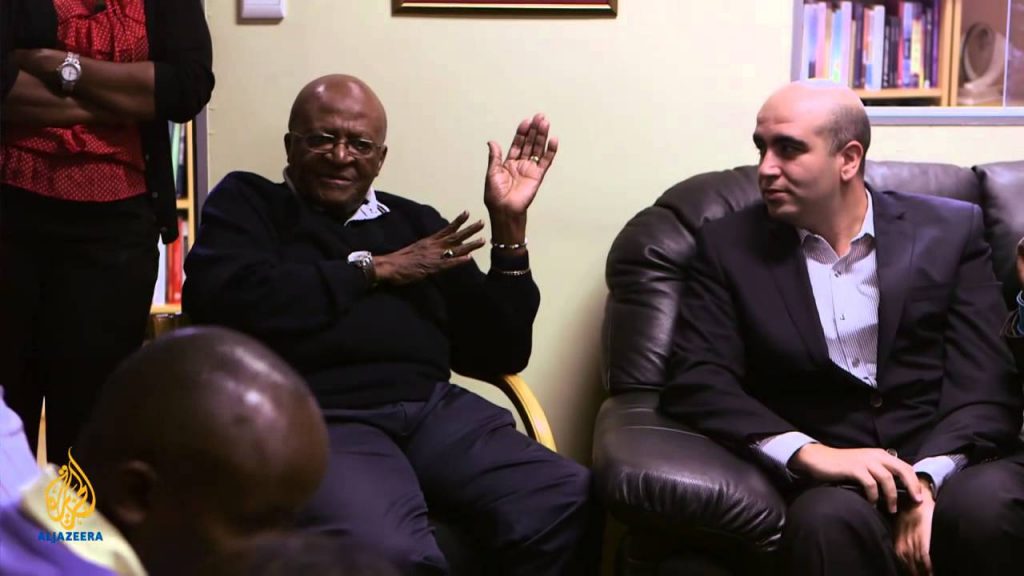
A still from Al Jazeera’s “Tutu’s Children.” Desmond Tutu is on the left.
We recently posted a bit on Forbes Magazine’s list of the 40 richest Africans. In a similar vain, Al Jazeera has chosen to glorify Africa’s privileged few and feed into Western media outlets’ current obsession with the “Africa Rising” narrative by releasing their four-part series, “Tutu’s Children.” With the first two episodes up on the website, I’m still not entirely sure what the point of it all is supposed to be.
The series follows twenty-five successful business people (and a Kenyan TV presenter thrown in for good measure) from across the continent who have been chosen as ‘Tutu Fellows’ by the South African non-profit organization, African Leadership Institute (whose founders, Sean Lance and Peter Wilson, are themselves retired white South African oil and pharmaceutical executives). All twenty-five individuals are flown down to South Africa, where they participate in group activities and workshops, as well attend lectures from icons and experts alike (including Desmond Tutu, himself). The producers of the series would like us to believe that these twenty-five corporate darlings are ‘Africa’s leaders of tomorrow.’ Yet, the whole thing plays out like a cross between a poorly conceived and edited reality television show (not as bad as this, but close) and an extravagant corporate retreat. The take away of the series would appear to be that business entrepreneurship and corporate capitalism will be Africa’s saving grace.
Interestingly, the backdrop for the first two episodes is the ultra-luxurious Mont Fleur Conference Centre outside of Cape Town. I suppose this was intended to be symbolic, but without providing any context, all symbolic significance is lost on the average non-South African viewer. Mont Fleur was in fact the venue for a series of forums that brought together a number of South African political, business, and civil society leaders between 1991 and 1992 in what has become known as the “Mont Fleur Scenario Exercise.” The goal of the exercise was to develop a series of potential scenarios describing what might happen in South Africa over the following ten years. In the end, the exercise produced four main scenarios, which were lightheartedly labeled Ostrich, Lame Duck, Icarus, and Flight of the Flamingos. (For more on the Mont Fleur Scenarios, see here and here.) Broadly, Mont Fleur underscored a capitalist, neo-liberal growth path for South Africa. And we know where that got us.
Ironically, both Tutu’s Children and the Mont Fleur Scenario Exercise seem to be endeavors of little consequence – ambiguous events that are more publicity stunt than substantive problem solving and action.
But let’s get back to Tutu’s Children. In just the first two episodes, the fellows have already debated the roots of corruption, gender bias, the Arab Spring, being white in South Africa (as usual this is handled very clumsily), and whether or not African nations are ready for democracy. The thoughts expressed by the fellows on these subjects are an exercise in fuzzy and rather outdated liberal attitudes. Perhaps the most revealing discussion of all is the one on democracy and, to a lesser extent, the discussion on popular uprisings (particularly those of the Arab Spring in North Africa). The entire group, with the exception of a Tunisian participant who had been involved in the Arab Spring, quickly comes to the consensus that Africans are not yet ready for democracy; implying at times that the so-called ‘masses’ are not intelligent enough, or too easily bought for democracy to work. They instead consider a “benevolent” dictatorship, like that of Paul Kagame in Rwanda, to be a better alternative. The Zimbabwean sounds like he was making excuses for Mugabe, and so on. This rather patronizing view of less-privileged Africans extends into the fellows’ discussion of the popular uprisings in North Africa. First of all, instead of seeing these popular uprisings as still ongoing, many of the participants interpret them as being finished. This view then allows them to deem these revolutions as failures in many regards and place the blame on those involved in these uprisings by arguing that they did not think ahead enough.
How deeply unsettling it is to see that these folks, who are supposed to be the new generation of African leaders, have such little faith in the people they will ostensibly be leading.