Afcon 2013 Preview: Bamako expects experienced Mali team to go far
Guest Post by Samira Sawlani*
We won’t be surprised if Malians don’t care much for football right now as conflict ravages through the country’s north and east (separatists and Islamists are occupying much of the north of Mali, engaged in a standoff with French and Malian government troops). So I asked a friend who lives in the capital Bamako, Yaya Traore, what he makes of the tournament: “Everyone has high hopes that the team will go far in the tournament. They will be extra motivated to put a smile on the country’s face. Despite all we are looking forward to the tournament.” Another Mali supporter Abdoulaye Semega, was less certain: “I can’t say it will unite the country, particularly as there are those in the North who probably want their own football team. However people in Bamako are making plans to watch the games.”
The conflict back home will either work as a motivating or distracting factor for the team. “We have faith that peace will return anytime soon, but we just can’t stop thinking of those back home,” midfielder Sigamary Diarra has told journalists.
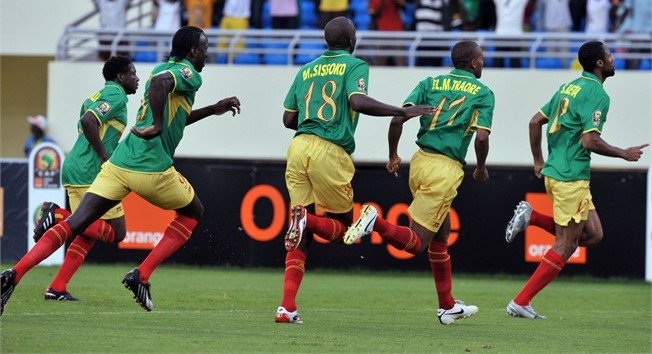
Mali secured 3rd place in last year’s Afcon tournament in Gabon and Equatorial Guinea (they beat Ghana in a shock 2-0 result). The passage to this year’s tournament was easier—because of the shortened qualification format, Mali only had to beat Botswana in a two-legged home and away tie.
Expectations are high. Mali is in Group B with Ghana, the Democratic Republic of Congo and Niger. Their first match is Sunday afternoon against lowly Niger. The Malian squad is made up of a large number of players who have competed in Europe’s most prestigious football leagues. The most exciting of these is Cheick Diabaté (he plays for Bordeaux in the French’s Ligue 1) whose two goals gave Mali 3rd place in Afcon 2012. Tough tackling midfielder Momo Sissoko (now at Paris St Germain; his former clubs include Valencia, Liverpool and Juventus), is also one to watch, though his temperamental personality both on and off the field is sure to set off fireworks.
The captain is former Barcelona player Seydou Keita, who now plays in the less fancied Chinese league and makes more harmless headlines. (A South African newspaper named him as one of the 10 sexiest players at Afcon 2013!)
Head coach Patrice Carteron (predictably French) blamed inconsistency for Mali’s past failures: “I have emphasised to the squad that they must play well in each game if they are going to win trophies.”
Aside from this, disillusion within the team set up has caused problems within the Eagles camp in the past and led to players leaving. It was only recently that the Malian government had to request Seydou Keita to return to the team.
However, in a team made up largely of veterans, the want for one final stab at victory may just prove to be the making of Mali.
Mali play Niger today in Durban tonight, kick off 18.00 GMT.
* Samira Sawlani is a freelance journalist and political analyst, working towards a career in International Affairs. Her main areas of interest are conflict, refugees, humanitarian response and politics of Africa and the Middle East. Follow her @samirasawlani