Black Power Mixtape
A critic of the documentary film, "The Black Power Mixtape 1967-1975," concludes that as an insight into black power, the documentary is utterly incoherent and useless.
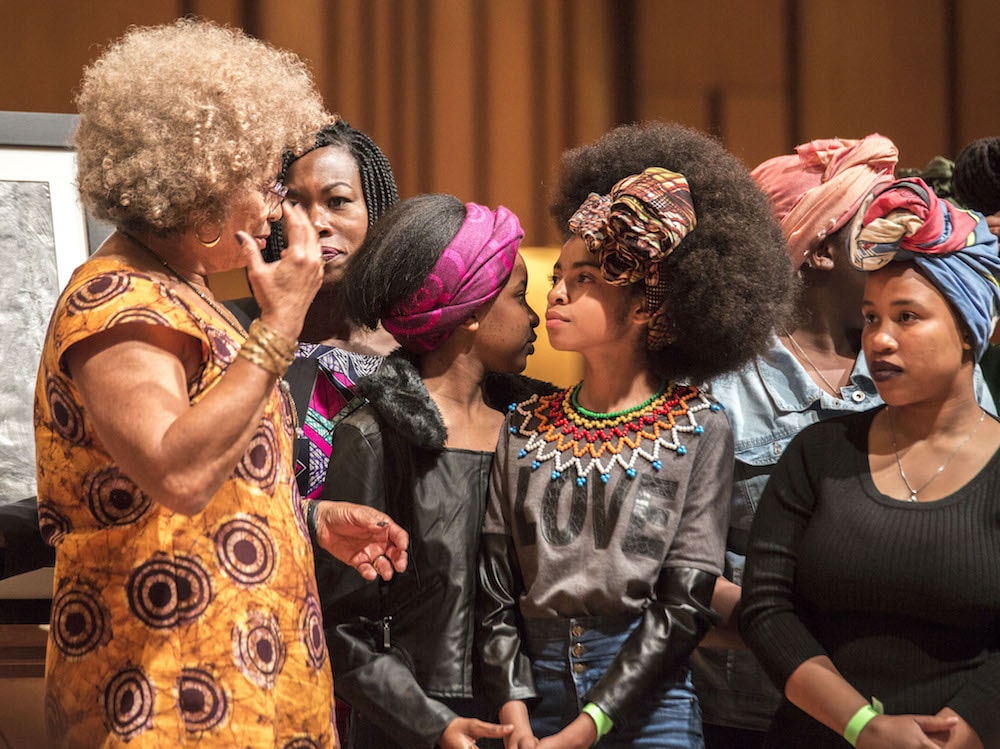
Angela Davis meets Zulaikha Patel, the student at the lead of the protests at Pretoria Girls
When the documentary film “The Black Power Mixtape 1967-1975” first made the rounds of festivals earlier this year and went on limited release this summer, the reaction of mainstream critics and film blogs (example here) was overwhelmingly positive.
I haven’t yet seen the film directed by Swede Goran Hugo Olsson and produced by Danny Glover. As for the Swedish connection, the documentary is organized around footage that a group of Swedish journalists shot in the late 1960s and early 1970s.
The footage languished in a basement archive for 30 years.
Meanwhile, let’s throw this verdict by a leading American political scientist who lived through and was involved in black power politics during the period covered by the film, into the mix:
I watched the Black Power Mixtapes last night and, among other issues, was struck to see that with the only technical exception of Robin D.G. Kelley, nearly if not all the non-participants who provided commentary were musical artists—Erykah Badu, Talib Kweli, and another rapper whose stage name I don’t recall, as well as Abiodun Oyewole from the Last Poets, who not only had nothing to add but also was off by five years on the Medgar Evers assassination. Not even Peniel Joseph, [who dominates current scholarship on Black Power], was involved. Although. this is not at all to suggest that his presence would’ve made it any different. All I can say about it really is that, although the footage was a nostalgic moment for people like me and does provide a nice illustration of Stokely Carmichael’s performance of Stokely Carmichael and copious display of Angela Davis’s self-important emptiness, as insight into black power, the documentary is utterly incoherent and useless.
There’s no sense of where it came from or went, nothing of internal tensions. At some points, it leaves space for the impression that black power emerged after the King assassination doesn’t clarify the temporality of Malcolm’s relation to black power rhetoric, most notably that he was dead before it emerged and always was linked to it as a martyr, juxtaposes Carmichael and the BPP without noting—except maybe through a passing, allusive reference by someone like Sonia Sanchez—the actual relations and tensions between the latter, Stokely and others in that radical wing on SNCC’s carcass that merged for a minute with the BPP. And, of course, there was no hint of anything other than speeches, pronouncements and the BPP’s breakfast programs.